
The AI Gold Rush Meets a Silicon Wall
- Unprecedented Demand: A massive pivot toward AI data center construction is cannibalizing the global supply of memory chips, leaving consumer electronics to fight for the remaining scraps.
- Price Hyperinflation: The cost of essential memory components has entered a “parabolic” phase, with some DRAM prices soaring by 75% in a single month, forcing retailers to update price tags daily.
- Structural Disruption: Industry titans like Apple, Tesla, and Sony are sounding alarms as the shortage derails product launches, compresses profit margins, and forces a radical rethink of manufacturing.
The digital world is currently gripped by a phenomenon industry insiders have dubbed “RAMmageddon.” What began as a surge in demand for artificial intelligence has evolved into a full-scale global crisis, as the thirst for memory chips—the fundamental building blocks of everything from smartphones to self-driving cars—outstrips the world’s ability to produce them. Tech luminaries, including Elon Musk and Tim Cook, are warning that this is not a temporary hiccup but a structural “super-cycle” that could redefine the cost of technology for the rest of the decade.
The AI Parasite: Sucking the Supply Dry
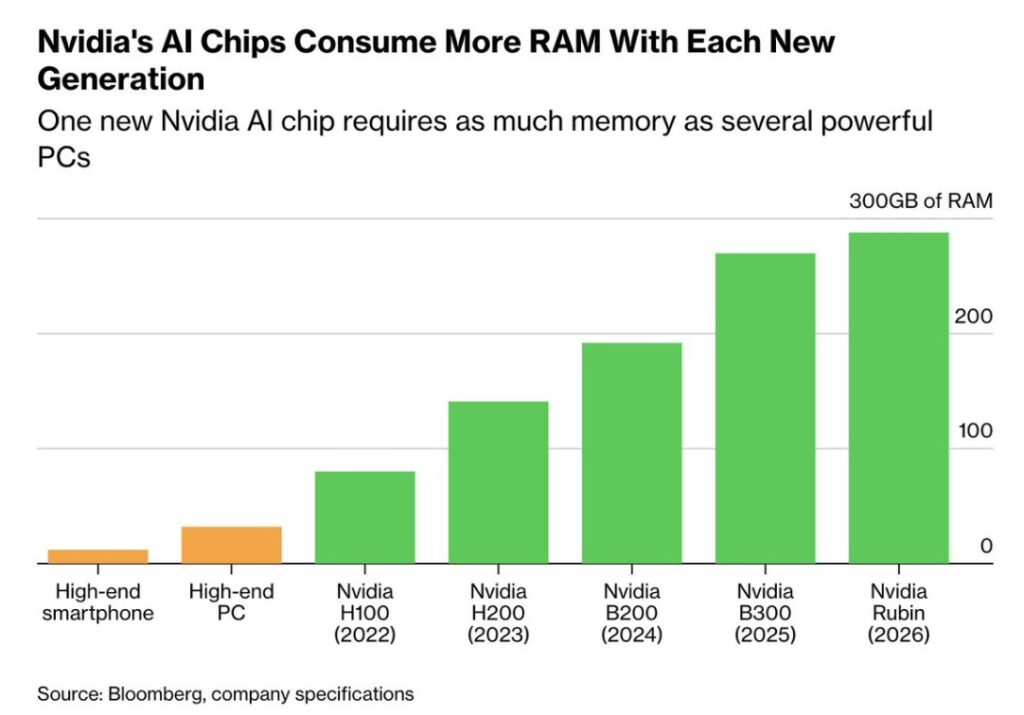
The fundamental driver of this shortage is the astronomical buildout of AI infrastructure. Companies like Alphabet and Amazon have announced construction blitzes reaching $185 billion and $200 billion respectively—unprecedented capital expenditures aimed at housing the millions of Nvidia AI accelerators needed to run advanced chatbots. These AI systems are “gobbling up” memory at a rate the market cannot sustain. For perspective, a single integrated server rack of 72 Nvidia Blackwell chips consumes as much RAM as 1,000 high-end smartphones.
This “headlong rush” has forced the world’s three dominant memory producers—Samsung, SK Hynix, and Micron—to pivot their manufacturing plants toward High-Bandwidth Memory (HBM). Because HBM offers higher margins and is essential for AI, “plain-vanilla” DRAM used in consumer goods is being neglected. As Tim Archer, CEO of Lam Research, noted, the current demand is “bigger than anything we’ve seen in the past” and is effectively overwhelming all other sectors.
From Consoles to Commutes: The Consumer Fallout
The impact on the average consumer is becoming painfully visible. Sony is reportedly considering a staggering delay for the PlayStation 6, pushing its debut back to 2028 or even 2029 to avoid launch-day price tags that could exceed $1,000. Similarly, Nintendo is weighing price hikes for the Switch 2. In the smartphone market, the crisis is even more acute: memory could soon account for 30% of a low-end phone’s total cost, tripling from just a year ago.
The automotive and PC sectors are equally embattled. Elon Musk recently declared that Tesla might have to build its own “TeraFab”—a dedicated memory fabrication plant—just to secure its future, famously stating, “We’ve got two choices: hit the chip wall or make a fab.” Meanwhile, in the DIY PC world, the “eerie quiet” at Seoul’s Sunin Plaza says it all: prices are rising so fast that vendors are hesitant to sell today, knowing they can charge more tomorrow.

A New Reality for Global Tech
This crisis bears a haunting resemblance to the Covid-era supply chain disruptions, but with a more permanent edge. While the pandemic was a temporary shock, the AI revolution is a structural shift. Bernstein analyst Mark Li describes the current price trends as “parabolic,” a trend that will bring “lavish profits” to chipmakers while the rest of the electronics sector pays a painful price.
With lead times for new factories spanning several years, the “structural imbalance” is expected to persist through 2026 and beyond. As we navigate this storm “hour by hour,” it is clear that the era of cheap, abundant memory has ended. For those looking to upgrade their tech, the message from the market is blunt: the chips are down, and the price of entry has just gone up.