
From automating complex refactors to uncovering critical vulnerabilities, the latest evolution in AI coding agents reshapes professional software development and cybersecurity defense.
- Next-Gen Engineering: GPT‑5.2-Codex delivers state-of-the-art performance in agentic coding, handling long-horizon tasks, complex refactors, and native Windows environments with superior context retention.
- Cybersecurity Breakthroughs: The model demonstrates a sharp jump in defensive capabilities, aiding in the discovery of critical vulnerabilities while operating under strict safety protocols regarding dual-use risks.
- Strategic Deployment: Available now for paid users, the release includes a new “Trusted Access” pilot for vetted security professionals, balancing widespread accessibility with rigorous safety standards.
The landscape of software engineering is shifting from simple code generation to autonomous, agentic problem solving. Today marks a significant milestone in that evolution with the release of GPT‑5.2-Codex. As the most advanced agentic coding model to date, it is designed specifically to handle the rigors of professional software engineering and the high-stakes demands of defensive cybersecurity.
Optimized from the GPT‑5.2 architecture, this new model addresses the friction points of previous generations. It introduces major improvements in long-horizon work through context compaction, stronger reasoning during large-scale code changes, and significantly bolstered performance in Windows environments.

Pushing the Frontier of Real-World Engineering
Professional development is rarely about writing a single function in isolation; it is about maintaining coherence across thousands of lines of code over days or weeks. GPT‑5.2-Codex addresses this by leveraging native compaction and improved long-context understanding.
This allows the model to act as a dependable partner for “long-horizon” tasks. Whether it is performing a massive refactor, executing a complex code migration, or building features from scratch, GPT‑5.2-Codex can iterate continuously without losing the thread of the project, even when plans change or initial attempts fail.
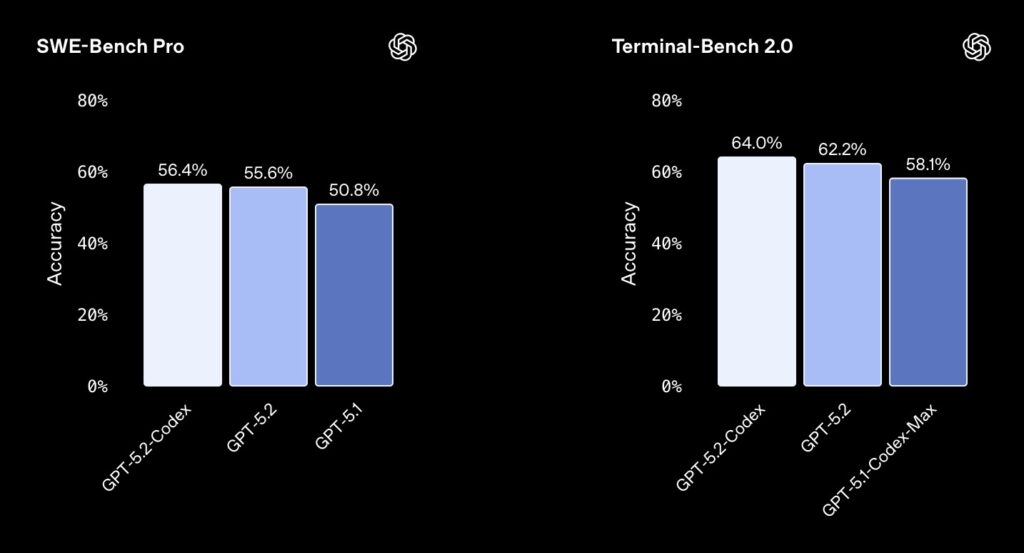
The model’s capabilities are backed by state-of-the-art performance on SWE-Bench Pro and Terminal-Bench 2.0, benchmarks specifically designed to test agentic behavior in realistic terminal environments. Furthermore, improved vision capabilities allow the model to bridge the gap between design and code; it can accurately interpret technical diagrams, charts, and UI screenshots to translate design mocks into functional prototypes, helping developers move from concept to production faster than ever.
A Quantum Leap in Cybersecurity
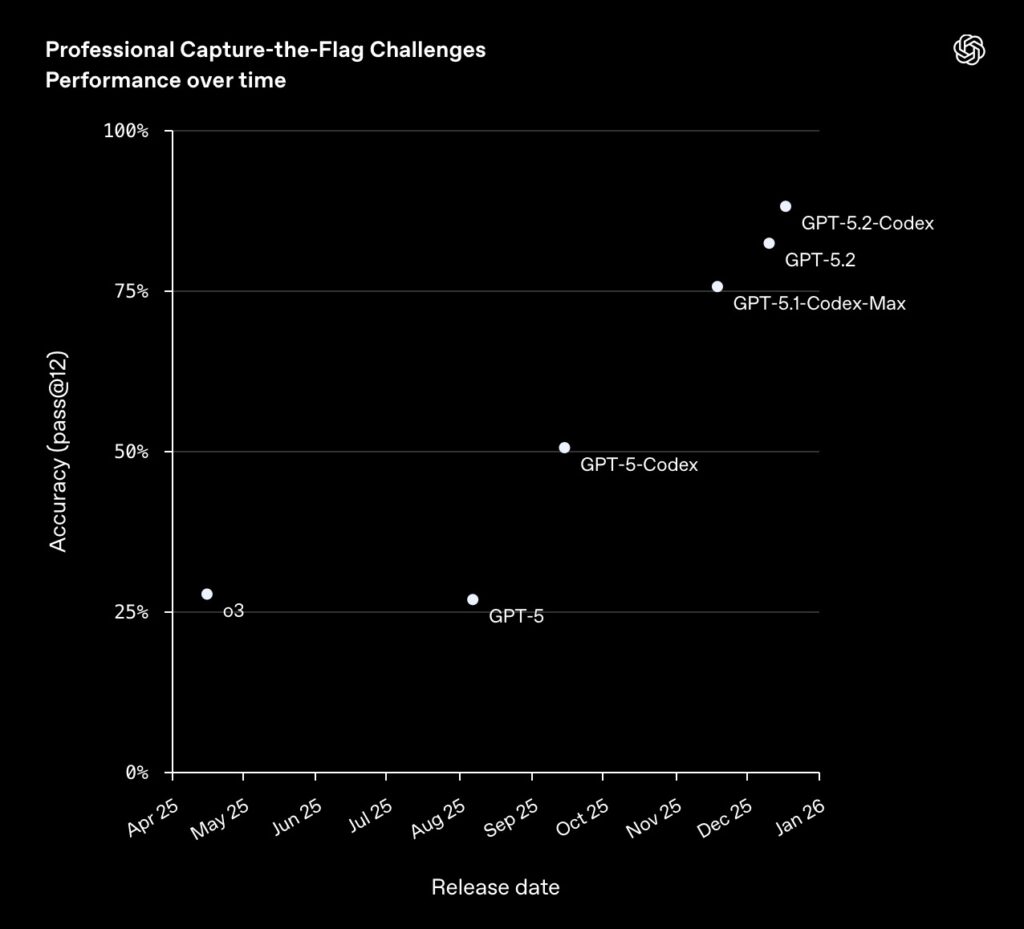
As AI models advance along the intelligence frontier, their capabilities in specialized domains like cybersecurity often see sudden, sharp jumps. GPT‑5.2-Codex represents the third major leap in this trajectory, following its predecessors, GPT‑5-Codex and GPT‑5.1-Codex-Max.
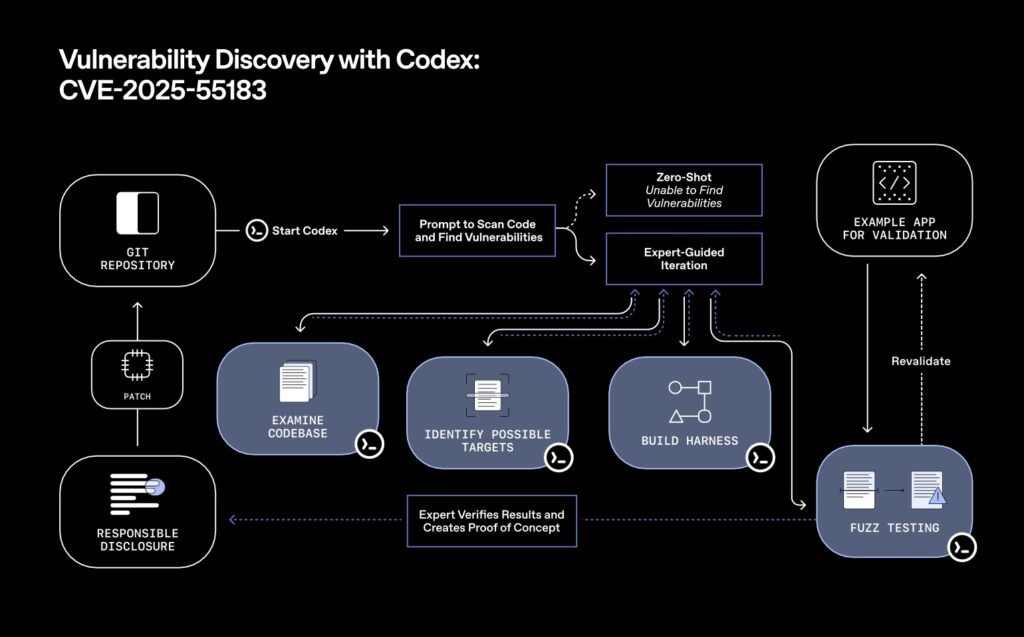
The potential for AI in defensive security is not theoretical—it is already happening. On December 11, 2025, the React team disclosed three security vulnerabilities affecting React Server Components. Notably, Andrew MacPherson, a principal security engineer at Privy, utilized the previous model, GPT‑5.1-Codex-Max, to aid in this discovery. By guiding the Codex CLI through standard defensive workflows—such as setting up test environments and fuzzing inputs—MacPherson discovered previously unknown vulnerabilities that were responsibly disclosed.
GPT‑5.2-Codex takes these capabilities further. It is designed to help engineers and researchers find, validate, and fix vulnerabilities at scale. However, this power comes with responsibility. While the model has not yet reached a ‘High’ level of cyber capability under the Preparedness Framework, the developers are acutely aware of the dual-use risks. Stronger capabilities that help defenders can theoretically be misused by bad actors, necessitating a careful, safety-first deployment strategy.
Empowering Defenders with Trusted Access
To fully harness these capabilities for defense without compromising safety, a new Trusted Access pilot is being launched. Security teams often face restrictions when AI safety filters prevent them from necessary tasks, such as emulating threat actors for red-teaming or analyzing malware.
This invite-only program is designed for vetted security professionals and organizations with a proven track record of responsible disclosure. It provides access to more permissive models specifically for defensive use cases, removing friction for those doing the critical work of securing digital infrastructure.
GPT‑5.2-Codex is available starting today in all Codex surfaces for paid ChatGPT users, with API access for developers rolling out in the coming weeks.
This release represents more than just a tool update; it is a step forward in how humanity partners with AI to maintain the software that runs modern society. By balancing accessibility with rigorous safeguards and collaborating closely with the security community, GPT‑5.2-Codex aims to maximize defensive impact while charting a safe path forward as the cyber frontier continues to advance.