

Move over, manual syntax wrangling. Spec-Driven Development is here to turn your product vision into executable reality—predictably, transparently, and faster than ever before.
- The End of Vibe Coding: Spec-Driven Development (SDD) flips the script on traditional engineering by making specifications executable, prioritizing intent and predictable outcomes over unstructured, trial-and-error AI coding.
- A Fully Open-Source Pipeline: GitHub’s newly released Spec Kit integrates directly with major AI agents to take your raw idea, draft a rigorous specification, formulate a plan, and automatically build the software.
- Built for Any Scale: Whether you are launching a greenfield application, extending a 400,000-line brownfield legacy system, or operating in an air-gapped enterprise environment, Spec Kit’s deep customization system of extensions and presets adapts to your specific workflow.
For decades, code has been undisputed king. Specifications, if they existed at all, were merely the scaffolding we erected to satisfy project managers, promptly discarded the moment the “real work” of writing code began. Recently, the rise of AI tools led to “vibe coding”—a chaotic, prompt-and-pray approach where developers stitch together generated snippets until something works.

Vibe coding is dead.
GitHub has just released Spec Kit, a 100% open-source toolkit designed to fundamentally change how we build high-quality software. It ushers in the era of Spec-Driven Development (SDD), a paradigm where the specification doesn’t just guide the implementation; it generates it.
Flipping the Script: The Spec Kit Workflow
Spec-Driven Development is built on a core philosophy: intent-driven development. It demands that developers define the “what” before the AI figures out the “how.” Instead of relying on one-shot code generation from a massive prompt, Spec Kit relies on multi-step refinement using advanced AI models.
The workflow is beautifully streamlined:
- Describe your idea: You provide the raw vision.
- AI writes the spec: Through guided, rich specification creation, the AI defines the guardrails and requirements.
- Generates a plan: The tool maps out the step-by-step architecture and logic.
- Builds it: The AI executes the plan, producing working software.
Proven Across Greenfield and Brownfield Realities
If you think this is just for simple boilerplate generation, the community has already proven otherwise. Spec Kit’s experimental goals validate its technology independence—it is a process, not a framework lock-in.
For greenfield projects, the toolkit shines. Walkthroughs have demonstrated building a .NET Timezone Utility from a blank directory using GitHub Copilot, and constructing a complex Spring Boot + React LLM analytics platform (complete with REST APIs, PostgreSQL, Docker Compose, and a cross-artifact consistency analysis pass) entirely from scratch.
But Spec Kit’s true power is revealed in brownfield environments. Developers have successfully injected Spec Kit into massive, pre-existing codebases without prior specs or constitutions. It was used to extend CarrotCakeCMS-Core—a ~307,000-line ASP.NET monolith—with a token-authenticated headless REST API and cross-platform Docker infrastructure. It easily navigated Piranha, a ~420,000-line Java runtime spread across 180 Maven modules, to add a Server Admin Console. It even extended NASA’s open-source Hermes ground support system (written in Go) with a React-based telemetry dashboard, driven entirely from the terminal using GitHub Copilot CLI.

Making Spec Kit Your Own: Extensions, Presets, and Pirates
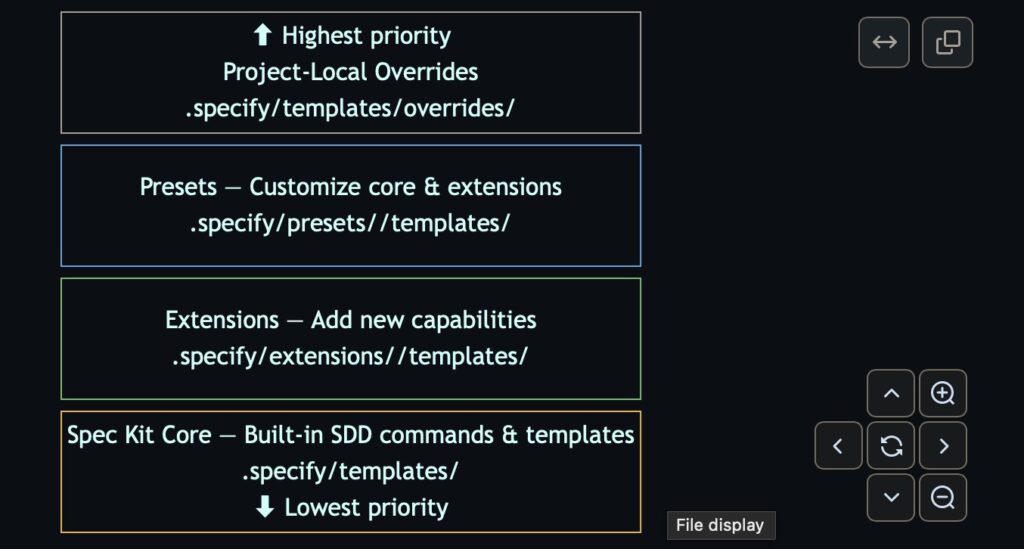
Every engineering team has its own flavor of chaos, compliance, and methodology. Spec Kit handles this through a deeply configurable architecture utilizing extensions, presets, and local overrides.
- Extensions (Adding Capabilities): These expand what Spec Kit can do. If you need domain-specific workflows not covered by core SDD commands, or integrations with external enterprise tools, you can install extensions (
specify extension add) to introduce entirely new commands and templates. - Presets (Customizing Workflows): These change how Spec Kit operates without adding new features. Presets (
specify preset add) override existing templates and commands. You can enforce a compliance-oriented spec format, mandate security review gates, adapt the workflow to Agile or Domain-Driven Design, or enforce test-first task ordering. - Project-Local Overrides: For one-off adjustments, developers can drop templates into
.specify/templates/overrides/to tweak a single project without building a full preset.
Because templates are resolved dynamically at runtime (top-down) and commands are prioritized at install time, you can stack multiple presets. How deep does this customization go? One community demo built a Spring Boot MVC application using a custom pirate-speak preset. Without changing the underlying tooling, specifications instantly became “Voyage Manifests,” plans turned into “Battle Plans,” and tasks became “Crew Assignments”—all generated in perfect pirate vernacular.
Spec Kit isn’t just a new tool; it is a research vehicle into the future of software creation. Its experimental goals are heavily focused on enterprise constraints—proving that AI can handle mission-critical development, support complex cloud architectures, and adhere to strict compliance requirements. It supports user-centric development, catering to both AI-native developers and those transitioning away from chaotic vibe coding, while validating creative processes like parallel implementation exploration.