
Fully Homomorphic Encryption has long promised bulletproof data privacy, but crippling slow speeds held it back. Now, specialized silicon is igniting a commercial race to secure the future of cloud computing.
- The Promise and the Problem: Fully homomorphic encryption (FHE) allows systems to compute on encrypted data without ever decrypting it, ensuring ultimate privacy—but it is notoriously sluggish on standard CPUs and GPUs.
- Intel’s Quantum Leap: Intel’s newly demonstrated Heracles chip accelerates FHE operations by up to 5,000 times compared to top server CPUs, leveraging cutting-edge 3-nanometer architecture and massive high-bandwidth memory.
- The Commercial Race: While Intel flexes its hardware muscle, a competitive ecosystem of startups is racing to commercialize FHE accelerators, targeting breakthroughs in secure AI, cloud processing, and semantic search.
Worried that your latest prompt to a cloud-based AI reveals a bit too much about your personal life? Or perhaps you want to know your genetic risk for a certain disease without handing over your DNA profile to a third-party server?
There is a mathematical holy grail for this exact problem: Fully Homomorphic Encryption (FHE). FHE allows computers to process data while it remains completely encrypted, never exposing the raw information. But there has historically been a massive catch. Processing encrypted data this way can take thousands—sometimes tens of thousands—of times longer on conventional CPUs and GPUs than simply computing the decrypted data.
To bridge this staggering performance gap, universities, tech startups, and at least one processor giant have been pouring resources into developing specialized silicon. Last month, at the IEEE International Solid-State Circuits Conference (ISSCC) in San Francisco, Intel unveiled its solution: Heracles.
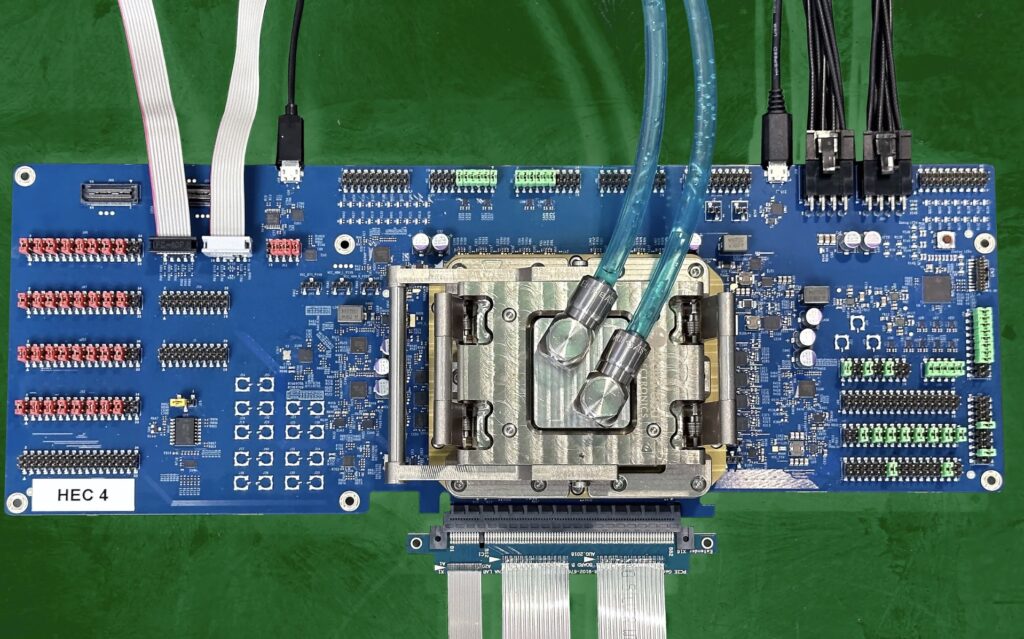
The Muscle Behind Heracles
Developed under a DARPA program initiated five years ago, Heracles is a masterclass in purpose-built hardware. Ro Cammarota, the former Intel project lead now at the University of California Irvine, notes that the team approached this as “a whole system-level effort that went all the way from theory and algorithms down to the circuit design.”
The scale of Heracles is unprecedented in the FHE space. While previous research chips hovered around 10 square millimeters, Heracles is roughly 20 times that size.
Key Hardware Specifications:
- Fabrication: Built on Intel’s most advanced 3-nanometer FinFET technology.
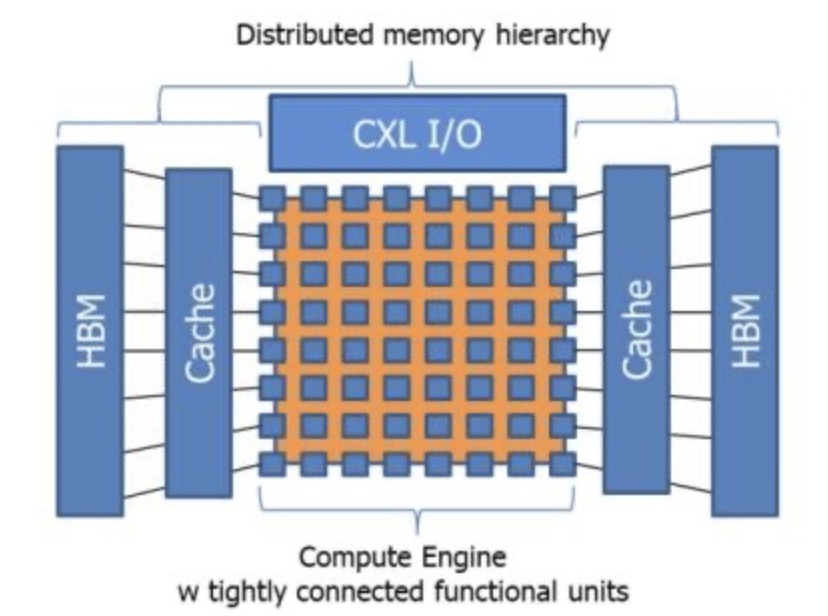
- Memory: Flanked by two 24-gigabyte high-bandwidth memory (HBM) chips in a liquid-cooled package—a setup typically reserved for heavy-duty AI training GPUs.
- Architecture: Features 64 compute cores (tile-pairs) arranged in an 8×8 grid. These Single Instruction Multiple Data (SIMD) engines tackle FHE’s complex polynomial math in parallel.
- Data Flow: An on-chip 2D mesh network uses massive 512-byte buses, moving data at an astonishing 9.6 terabytes per second through its 64 megabytes of cache.
In live demonstrations, the chip’s power was undeniable. Intel simulated a private query where a voter checked if her ballot was registered correctly against an encrypted government database. On a high-end Intel Xeon server CPU, this single secure verification took 15 milliseconds. Heracles crushed it in just 14 microseconds. Scaled up to 100 million ballots, the Xeon CPU would need over 17 days to complete the task; Heracles finished it in a mere 23 minutes. Across seven key FHE operations, Heracles proved to be 1,074 to 5,547 times faster than a 3.5 GHz Xeon CPU, despite operating at only 1.2 GHz.
The Mathematical Mountain of FHE
To understand why Heracles is necessary, you have to understand why FHE breaks traditional processors. FHE encrypts data using quantum-computer-proof algorithms, applying mathematical corollaries to achieve the same computational results on ciphertext as one would on plain text.
However, this creates a massive bottleneck known as data expansion. Anupam Golder, a research scientist at Intel, explained at the ISSCC that while standard ciphertext is usually the same size as plaintext, FHE ciphertext is orders of magnitude larger.
Furthermore, FHE requires computing massive numbers with absolute precision. While CPUs are precise, they are painfully slow at this scale—integer addition and multiplication take about 10,000 more clock cycles in FHE. GPUs, while great at parallel computing, severely lack the precision required for FHE. Add in bizarre, compute-heavy operations like “twiddling,” “automorphism,” and a noise-canceling process called “bootstrapping,” and standard processors simply choke.
Intel’s breakthrough involved breaking these gigantic numbers into smaller, manageable 32-bit chunks that could be calculated independently, maintaining high precision while unlocking massive parallelism within the chip’s smaller arithmetic circuits.

The Startups Chasing the Silicon Crown
Intel isn’t the only player on the board. A vibrant ecosystem of startups is racing to bring FHE acceleration to market, particularly eyeing the booming AI sector.
- Duality Technology: Also born from the same DARPA program as Intel, Duality focuses heavily on software. CTO Kurt Rohloff acknowledges Intel’s impressive scale but points out that specialized hardware will become truly essential for emerging applications like neural networks and Large Language Models (LLMs). Duality has already demonstrated an FHE-encrypted transformer model called BERT.
- Niobium Microsystems: This Dayton-based startup recently secured a $6.9 million deal with Semifive to fabricate its own FHE accelerator using Samsung’s 8-nanometer process. VP of Product John Barrus firmly believes smaller AI models will run flawlessly on accelerated hardware despite FHE’s data expansion.
- Optalysys: Taking a radical approach, Optalysys is bypassing traditional silicon limits altogether. CEO Nick New states they are using the physics of a photonic chip (currently in its seventh generation) to handle FHE’s intensive transform steps. They aim to deliver a fully 3D-stacked commercial optical chip in the next two to three years.
- Others: Companies like Fabric Cryptography and Cornami are also actively developing in this space.
The Journey Has Just Begun
Sanu Mathew, who leads security circuits research at Intel, is confident in their lead but acknowledges that the hardware is just the beginning. Intel plans to fine-tune its software, tackle larger FHE problems, and explore next-generation hardware designs.
“This is like the first microprocessor… the start of a whole journey,” says Mathew.
With hardware finally catching up to the mathematics, the dream of a fully secure cloud—where our data, our AI prompts, and our identities remain cryptographically locked even while being processed—is rapidly becoming a reality.