
Move over, keyword search—natural language is the new way to discover your next favorite track.
- Conversational Discovery: Bypass rigid search bars by using natural language to find music based on mood, context, or vague descriptions like “jazz fusion with prominent saxophone.”
- Seamless Integration: Generate custom playlists, listen to 30-second previews directly in the chat, and save tracks to your library without leaving the conversation.
- Privacy-First Approach: The extension searches Apple’s public catalog rather than your personal data, ensuring your listening history and private playlists remain inaccessible to the AI.
The way we interact with music is undergoing a fundamental shift. For years, finding the perfect song meant recalling an exact title or typing rigid keywords into a search bar. Now, with the new Apple Music extension for ChatGPT, that dynamic has changed. By integrating OpenAI’s conversational intelligence with Apple’s vast music catalog, users can now “speak” to their music service, turning vague ideas and specific moods into instantly playable realities.
Beyond the Search Bar
The core power of this integration lies in its ability to understand context. Standard streaming search bars are excellent for retrieval when you know exactly what you want, but they often fail at discovery. ChatGPT bridges this gap. Instead of searching for “80s hits,” you can ask for “upbeat 80s songs for a road trip that aren’t overplayed,” or “calm instrumental music for studying that features acoustic guitar.”
This “prompt engineering” for music allows you to layer criteria in ways that were previously impossible. You can combine genre, era, instrument, and tempo into a single request. For example, asking for “jazz fusion tracks under five minutes with prominent saxophone” prompts the AI to sift through metadata and audio characteristics to unearth tracks that a standard keyword search would likely miss.
How to Connect and Use It
Setting up the extension is straightforward and works across ChatGPT’s free and paid tiers. Users simply navigate to the ChatGPT settings, select the Extensions (or Apps) menu, and connect their Apple Music account.
Once linked, the workflow is intuitive:
- Ask: Describe the playlist or song you want.
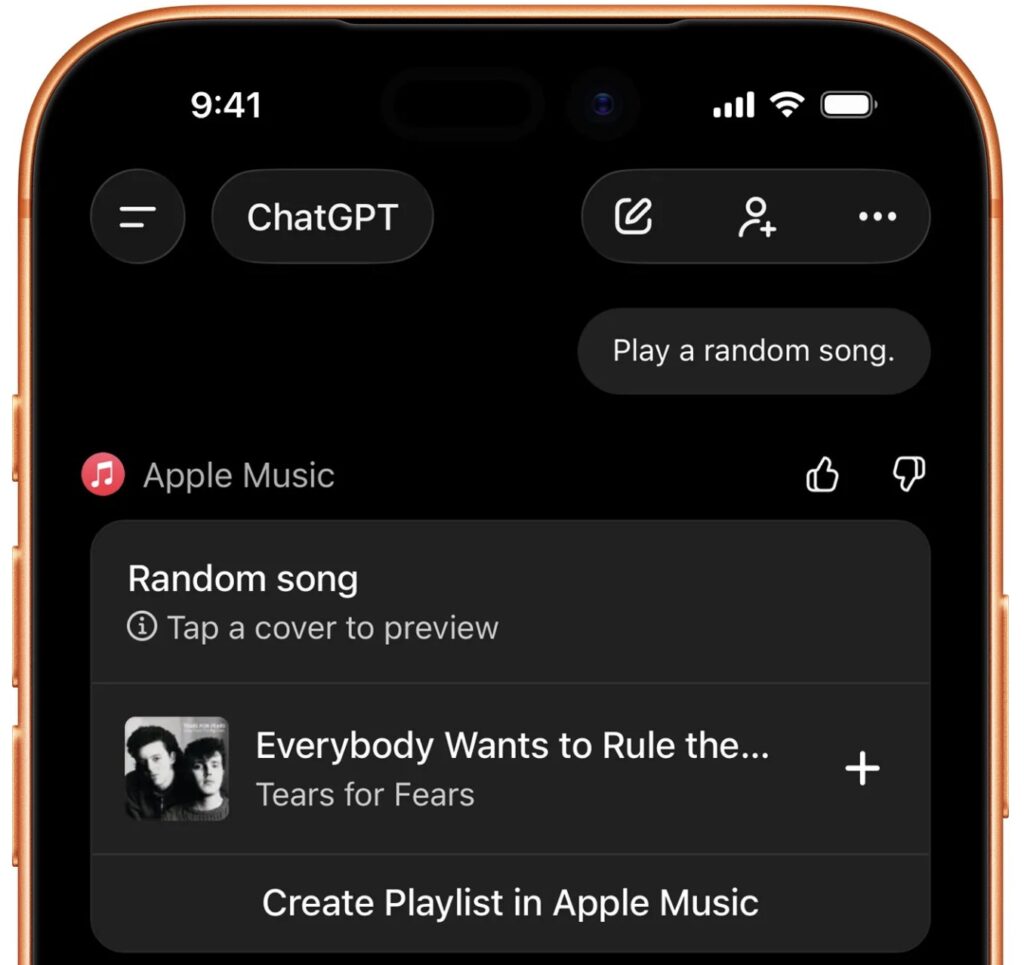
- Preview: ChatGPT generates a list where you can listen to 30-second preview clips of each track directly in the chat interface.
- Save: If you like what you hear, you can use the “+” button to save individual tracks or select “Create Playlist in Apple Music” to export the entire curation directly to your library.
While you don’t need an Apple Music subscription to search the catalog or hear previews, an active subscription is required to save playlists and songs to your library.

Privacy vs. Personalization
A crucial distinction in this integration is its approach to data privacy. Unlike Spotify’s AI tools, which lean heavily on your historical listening data to make predictions, the Apple Music extension is designed to be privacy-forward. ChatGPT has permission to push data to your library (adding songs), but it cannot pull data from it.
This means ChatGPT cannot analyze your listening history or view your existing playlists. While this limits the AI’s ability to say, “Play music similar to what I listened to yesterday,” it ensures that your personal data profile remains private. The AI acts as an expert record store clerk who knows the store’s inventory perfectly but doesn’t know you personally—offering recommendations based solely on your current request.
The Broader Perspective: AI-Mediated Discovery
This integration signals a broader trend in digital media: the move toward AI-mediated discovery. As catalogs grow to tens of millions of songs, the paradox of choice becomes a hurdle for listeners. Tools like this act as a filter, allowing technology to handle the “curation” so users can focus on the “listening.” By turning music discovery into a conversation, Apple and OpenAI are making the vast ocean of streaming music feel a little more navigable, and a lot more personal.