
How OpenAI is transforming scattered medical data into actionable insights with a privacy-first, physician-backed AI companion.
- Unified Health Intelligence: Securely connect medical records, wearables (like Apple Health), and wellness apps to receive personalized advice grounded in your actual clinical history rather than generic information.
- Fortified Privacy: A completely isolated environment where health conversations are encrypted, never used for model training, and kept strictly separate from your general chat history to ensure maximum security.
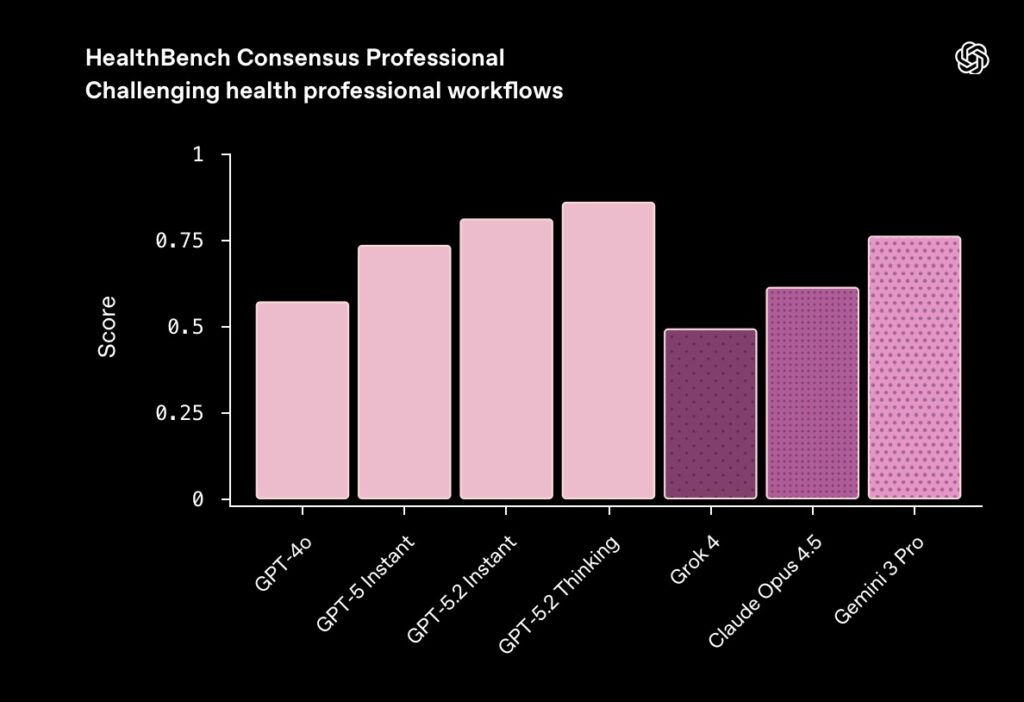
- Physician-Vetted: Developed in collaboration with over 260 doctors worldwide and tested against the “HealthBench” framework, ensuring guidance is safe, accessible, and supportive of professional care.
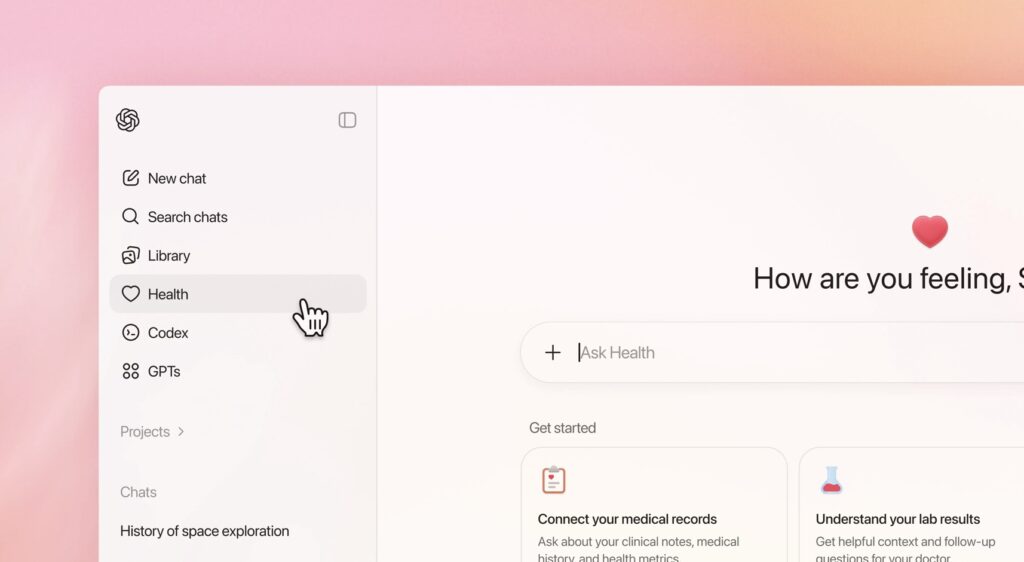
Navigating the modern healthcare landscape can often feel like trying to solve a puzzle with missing pieces. Medical information is frequently fragmented across various patient portals, fitness apps, wearable devices, and stacks of PDF lab results. Recognizing that hundreds of millions of users already turn to AI for clarity—with over 230 million people asking health questions weekly—OpenAI is launching ChatGPT Health. This is a dedicated, secure experience designed to bring your scattered health information together with ChatGPT’s intelligence, helping you feel more prepared and confident in managing your wellness.

A Personalized Health Command Center
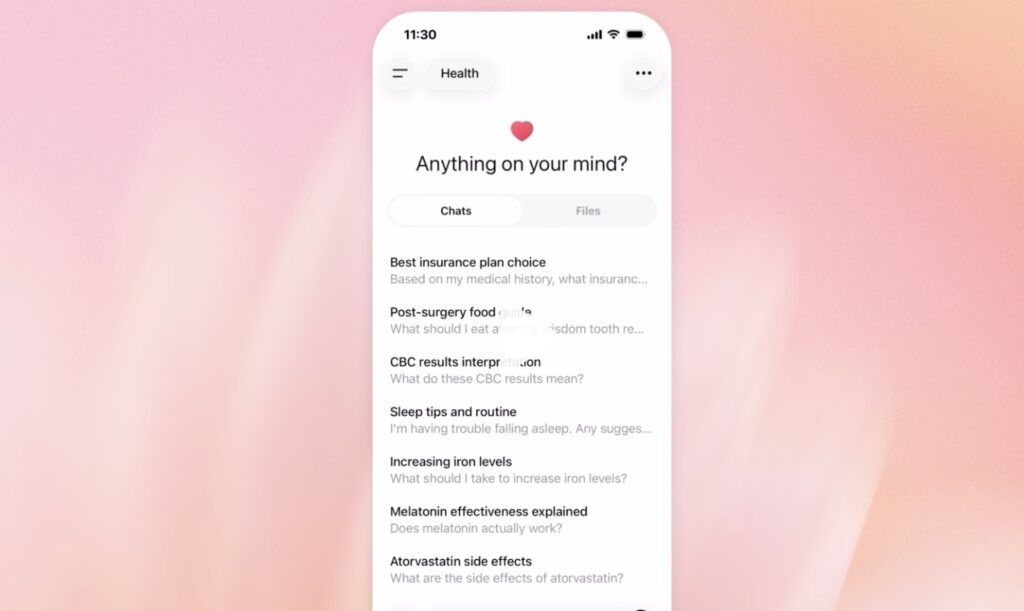
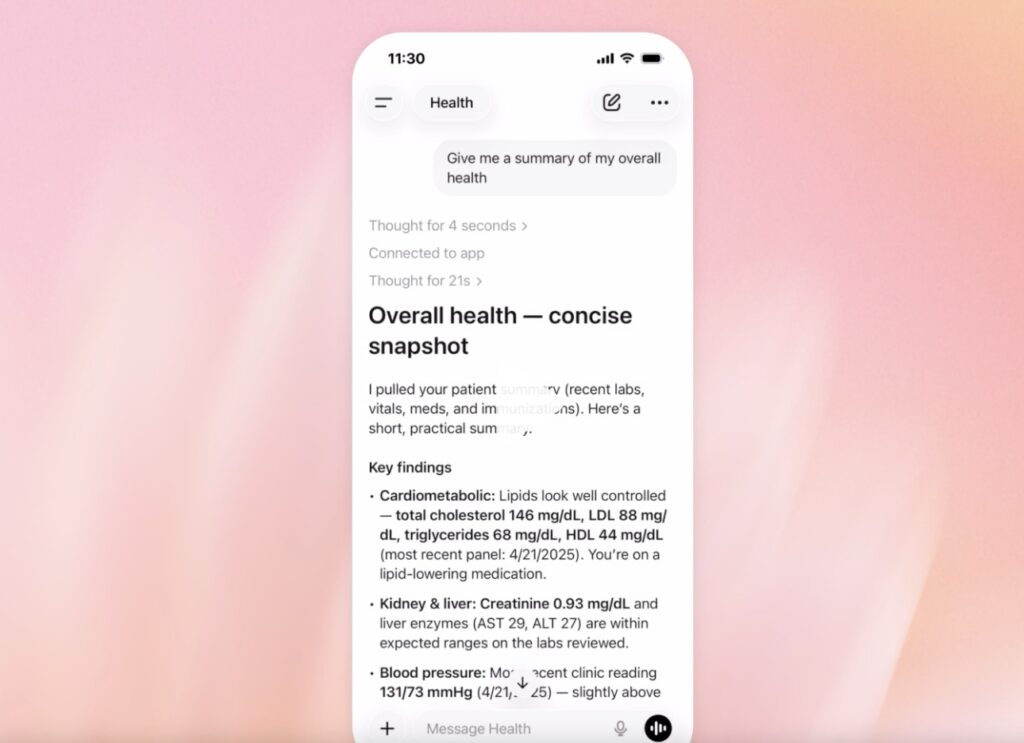
ChatGPT Health is not just a chatbot; it is a specialized environment designed to ground conversations in your specific medical reality. By securely connecting to medical records (via the b.well network in the U.S.) and popular wellness apps, the AI moves beyond generic advice. You can now ask complex, personalized questions such as “How is my cholesterol trending over the last year?” or “Can you summarize my latest bloodwork before my doctor’s appointment?”
The platform supports a robust ecosystem of integrations to paint a full picture of your health. Users can sync data from Apple Health (on iOS) for activity and sleep patterns, Function for lab insights, and MyFitnessPal for nutrition tracking. It even integrates with lifestyle tools like Weight Watchers for meal ideas, AllTrails for fitness, Instacart for shopping lists, and Peloton for workout suggestions. Whether you are uploading a photo of a medical bill or dictating a question about a new symptom via Voice Mode, the system is designed to provide relevant context instantly.
Privacy and Security at the Core
Understanding that health data is deeply personal, OpenAI has engineered ChatGPT Health as a “dedicated space” with an architecture focused on isolation. Health conversations, files, and connected app data are stored separately from your standard ChatGPT interactions. While the AI may use general context—like a recent move—to be helpful, sensitive health memories never flow back into your general chats. Furthermore, conversations within this Health space are never used to train OpenAI’s foundation models.
This security extends to technical infrastructure. Data is encrypted by default at rest and in transit, with additional purpose-built encryption layers for the Health space. Users retain full control: you can disconnect an app or remove access to medical records at any time, and the system supports multi-factor authentication (MFA) for an added layer of defense. If you begin discussing health topics in a standard chat, ChatGPT will even suggest moving the conversation to this secure Health environment to ensure these protections are active.
Built with Physicians, Not to Replace Them
Crucially, ChatGPT Health is designed to support—not replace—clinical care. It is not a tool for diagnosis or treatment. To ensure safety and efficacy, the experience was built in close collaboration with more than 260 physicians across 60 countries and dozens of specialties. These experts provided feedback on over 600,000 model outputs, shaping how the AI handles urgency, clarity, and safety.
This physician-led approach is codified in HealthBench, a new assessment framework developed by OpenAI. Unlike standard exams, HealthBench evaluates the AI using rubrics written by doctors to mirror how they judge quality in actual practice. This ensures the model excels at tasks that matter to patients, such as explaining complex lab results in accessible language or preparing a list of questions for a specialist, all while respecting the boundaries of medical advice.
Availability and Customization
ChatGPT Health allows for deep customization, letting users add specific instructions on what to focus on or avoid during conversations. Access is currently beginning via a waitlist for a small group of early users across Free, Go, Plus, and Pro plans, with a broader rollout to web and iOS planned in the coming weeks. At launch, availability is restricted to regions outside the European Economic Area, Switzerland, and the United Kingdom.
By combining the analytical power of AI with strict privacy controls and clinical oversight, ChatGPT Health promises to help users move from confusion to clarity, empowering them to take an active, informed role in their own well-being.