
A heavy-hitting partnership aims to re-engineer chip manufacturing for a trillion-watt AI future.
- Strategic Alliance: Intel officially joins forces with Tesla, SpaceX, and xAI to support the “Terafab” project, a massive semiconductor initiative led by Elon Musk.
- Infrastructure Revolution: The collaboration seeks to “refactor silicon fab technology,” combining Intel’s manufacturing prowess with Tesla’s demand for high-scale AI and robotics hardware.
- The 1 TW Goal: The project aims to deliver 1 Terawatt (TW) per year of compute capacity to power the next generation of autonomous vehicles, Optimus robots, and space-based data centers.
The landscape of global semiconductor manufacturing just shifted. After weeks of speculation and social media teasers, Intel has confirmed its participation in the Terafab project, a high-stakes venture spearheaded by Elon Musk’s portfolio of companies, including Tesla, SpaceX, and xAI. The announcement follows a high-profile weekend visit by Musk to Intel’s facilities, signaling that the partnership has moved from casual discussions into an active, strategic collaboration.
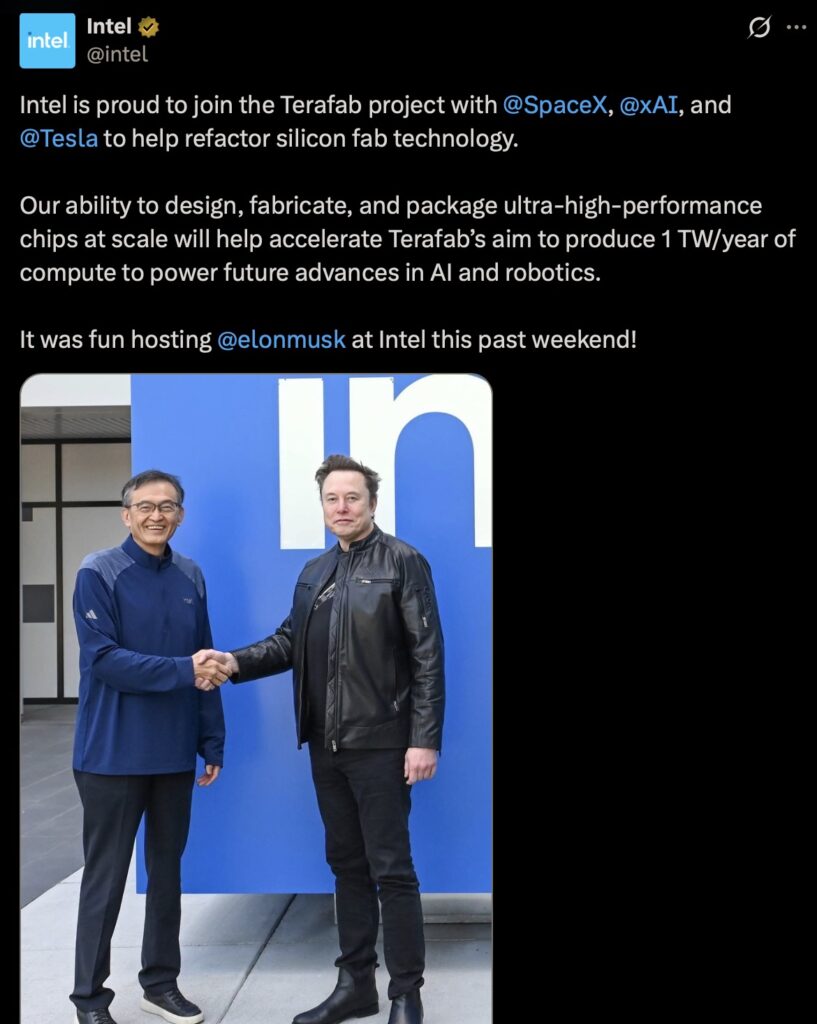
The core mission of Terafab is nothing short of breathtaking: to reach 1 Terawatt of compute per year. This ambitious target is designed to solve a looming bottleneck in the tech industry. According to Musk, traditional foundries simply lack the expansion speed required to meet the exponential demand for Tesla’s AI hardware. By “refactoring silicon fab technology,” Intel and the Terafab partners aim to build a more agile, high-output manufacturing ecosystem that can keep pace with the rapid evolution of artificial intelligence.
Intel’s role in this venture is pivotal. The tech giant will leverage its extensive “Intel Foundry” capabilities, including advanced chip design, manufacturing, and sophisticated packaging technologies. While Intel has remained tight-lipped regarding specific process nodes or the exact foundry model being used, their involvement places them at the center of the most ambitious manufacturing project of the year. This move reinforces Intel’s pivot toward becoming a primary foundry for the world’s most demanding AI innovators.

The physical footprint of this project is expected to center in Austin, Texas, where Tesla and SpaceX have already laid the groundwork for new semiconductor factories. These sites are destined to produce the “brains” for a wide array of futuristic tech, from the neural networks in Tesla vehicles and the humanoid Optimus robots to the specialized hardware required for SpaceX satellites and orbital data centers.
By bridging the gap between Intel’s decades of manufacturing experience and Musk’s “first principles” approach to engineering, the Terafab project represents a bold bet on the future of autonomy. If successful, it won’t just produce more chips—it will redefine how the world builds the hardware that thinks, moves, and explores.