
How a new multi-agent framework is bridging the visual communication gap for AI scientists by turning complex research into publication-ready diagrams and plots.
- The Innovation: PaperBanana introduces an agentic framework that automates the creation of high-fidelity, publication-ready academic illustrations and statistical plots, solving a major bottleneck in autonomous scientific discovery.
- The Proof: Rigorously evaluated against a newly introduced benchmark (PaperBananaBench) of 292 NeurIPS 2025 test cases, the framework consistently outperforms leading baselines in aesthetics, faithfulness, and readability.
- The Horizon: While facing current limitations—such as raster-only outputs and minor connectivity errors—the framework charts clear pathways for future advancements, promising to revolutionize not just academia, but UI/UX design, patent drafting, and industrial schematics.
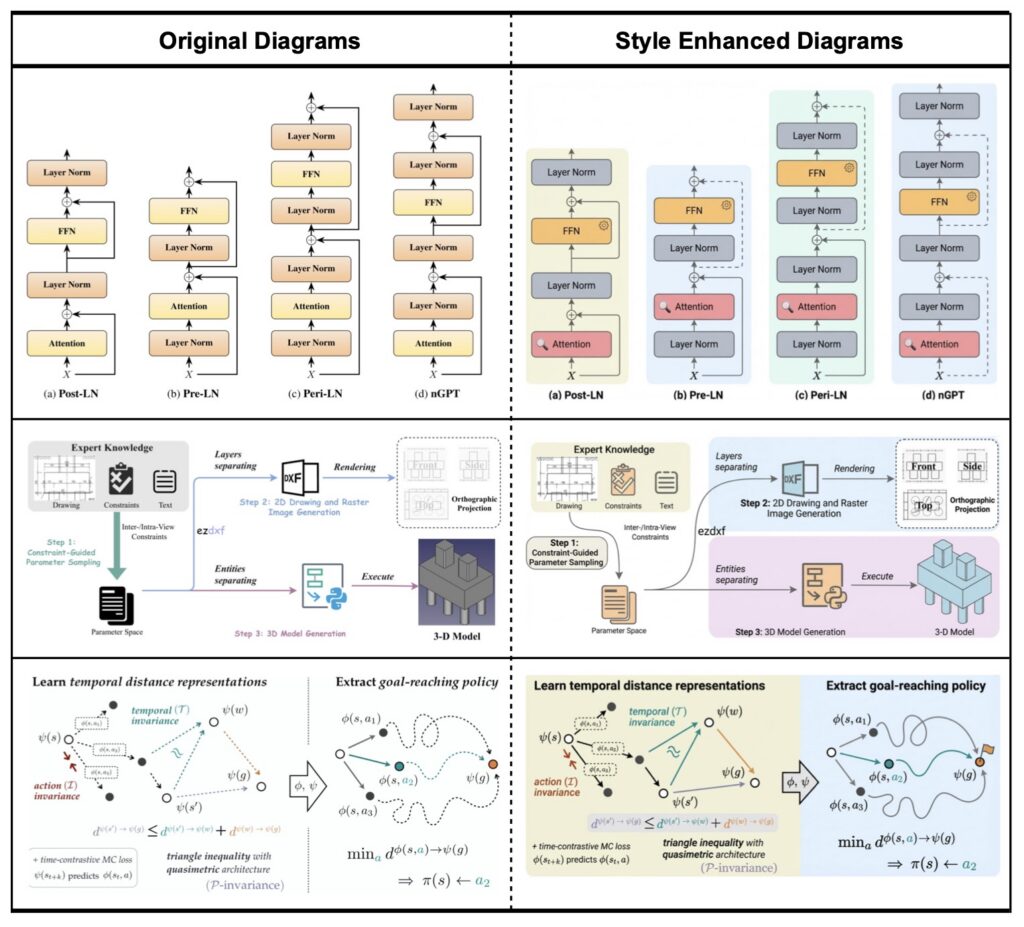
Autonomous scientific discovery has long been considered a defining milestone on the path to artificial general intelligence. With the rapid evolution of Large Language Models (LLMs), autonomous “AI Scientists” have already proven their immense potential to automate complex facets of the research lifecycle, from conducting literature reviews and brainstorming ideas to iterating code. Yet, a brilliant scientific discovery achieves its full value only when it can be effectively communicated. Despite their textual and computational prowess, today’s AI scientists routinely stumble when it comes to visual communication. Generating publication-ready methodology diagrams and statistical plots remains a highly labor-intensive bottleneck.
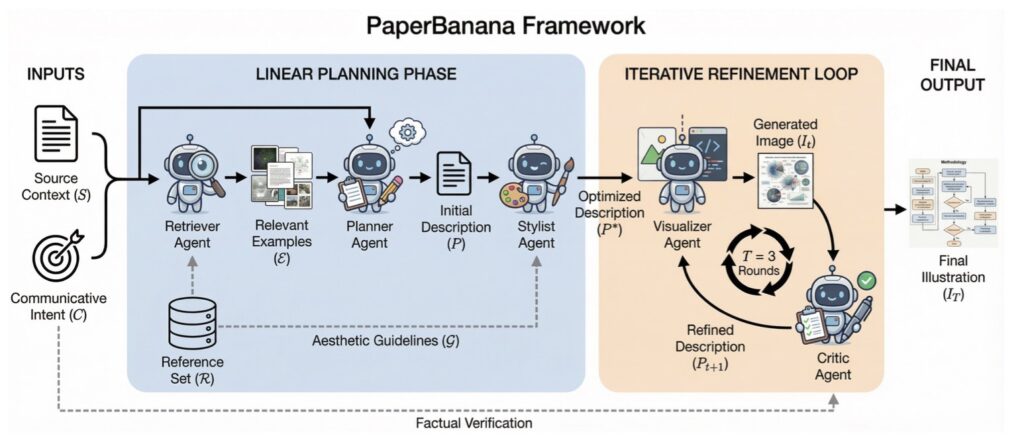
To finally lift this burden, researchers have introduced PaperBanana, a pioneering agentic framework specifically engineered for the automated generation of academic illustrations. By harnessing the power of state-of-the-art Vision-Language Models (VLMs) and image generation systems, PaperBanana transforms dense scientific content into professional-grade visuals. It achieves this by orchestrating a team of specialized AI agents: a Retriever to gather references, a Planner to structure the content and style, a Stylist to ensure visual cohesion, a Visualizer to render the image, and a Critic to iteratively refine the output through rigorous self-critique.
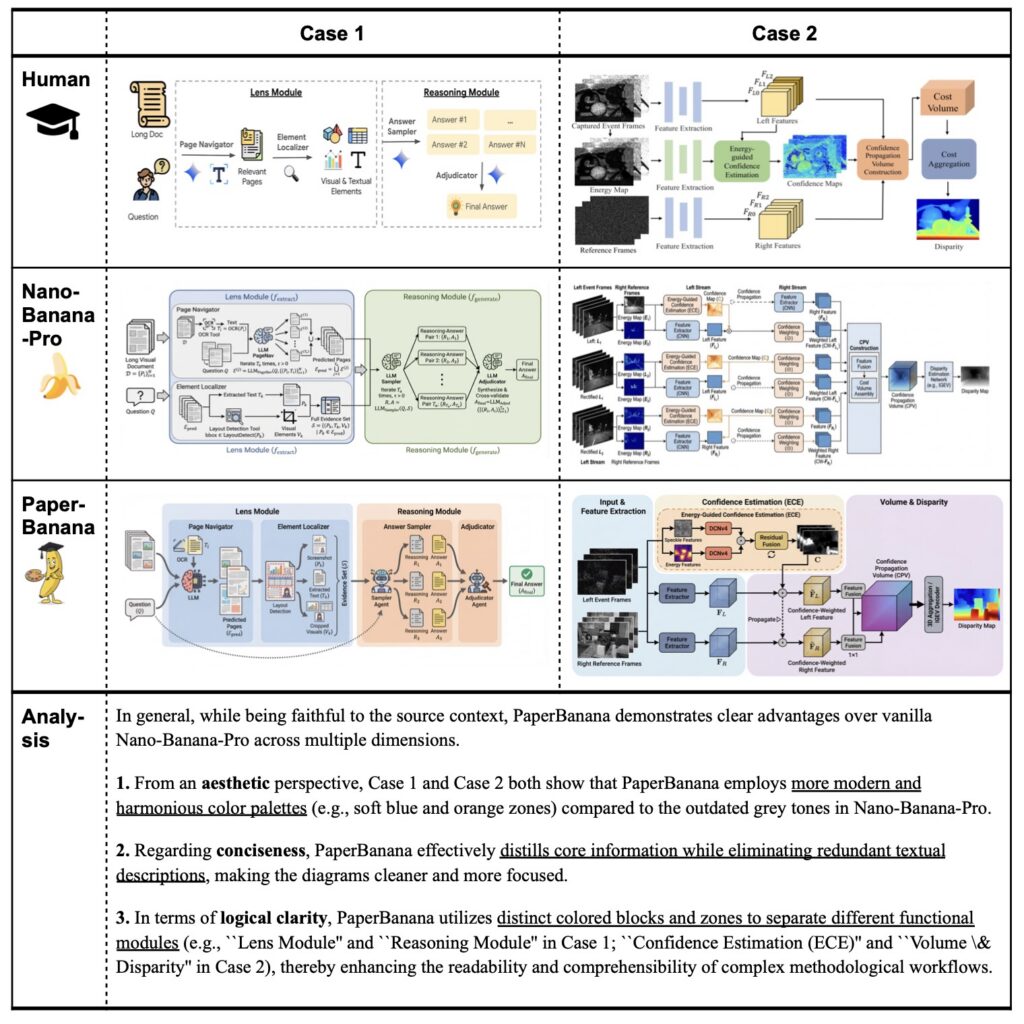
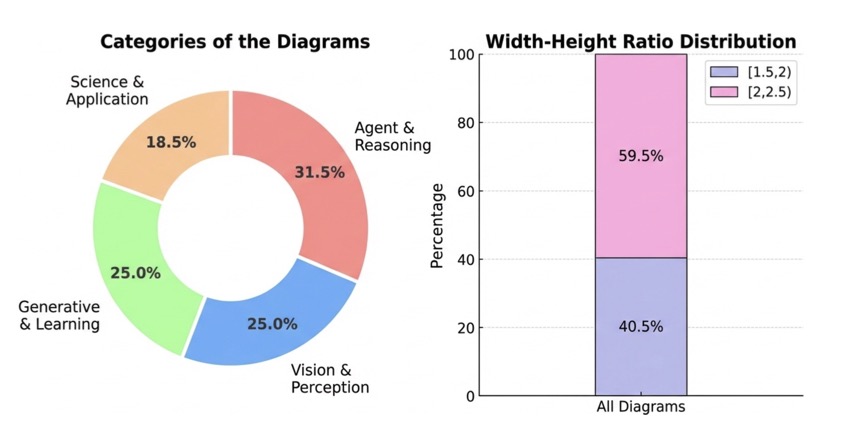
The development team didn’t just build a theoretical tool; they subjected it to intense scrutiny. To rigorously evaluate the framework, they introduced PaperBananaBench, a comprehensive benchmark comprising 292 highly diverse test cases for methodology diagrams, all curated from top-tier NeurIPS 2025 publications. Through extensive experiments, PaperBanana consistently outperformed leading baselines across critical metrics: faithfulness to the text, conciseness, readability, and overall aesthetics. Furthermore, the framework demonstrated remarkable versatility by successfully extending its capabilities to generate high-quality statistical plots.
As a pioneering framework, PaperBanana naturally faces certain limitations that outline an exciting roadmap for the future of AI illustration.
The most prominent hurdle is the challenge of editability. Academic publishing heavily favors vector graphics for their infinite scalability and precision, but PaperBanana currently outputs raster images. While generating these images at a stunning 4K resolution masks the issue visually, it makes post-generation modification inherently difficult. To bridge this gap, researchers envision a three-tiered solution. For minor adjustments, cutting-edge image editing models like Nano-Banana-Pro can be deployed. For structural changes, reconstruction pipelines—such as Paper2Any and Edit Banana—could utilize Optical Character Recognition (OCR) and SAM3 segmentation to extract elements and reassemble them into editable presentation slides (like Python-PPTX). Ultimately, the most advanced solution lies in developing GUI Agents capable of autonomously operating professional vector design software, such as Adobe Illustrator, to natively generate fully editable graphics.
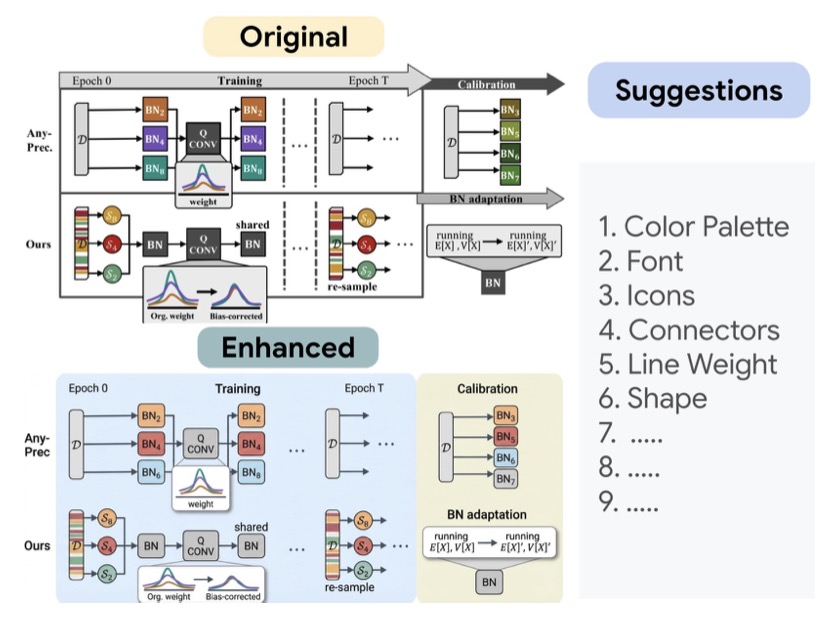
Beyond editability, the framework grapples with the delicate trade-off between style standardization and artistic diversity. While PaperBanana utilizes a unified style guide to guarantee rigid compliance with academic standards, this inherently restricts stylistic variety. Future iterations will need to explore dynamic style adaptation mechanisms that allow for broader, more personalized aesthetic choices without sacrificing professional rigor.
There is also the nuanced challenge of fine-grained faithfulness. While PaperBanana creates beautiful images, human experts still maintain an edge in structural precision. Current VLM critic models sometimes miss subtle connectivity errors, such as misaligned start/end points or backwards arrows in complex diagrams. Closing this performance gap will require significant advancements in the fine-grained visual perception capabilities of foundational VLMs.
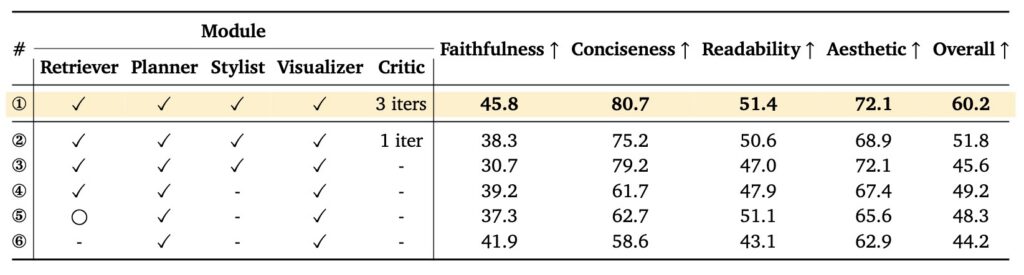
Evaluating these advancements introduces its own set of challenges. The current standard relies on a “VLM-as-a-Judge” setup, which struggles to perfectly quantify subtle structural correctness or align with human subjective aesthetics. The next generation of evaluation protocols will likely shift toward highly precise structure-based metrics, complex rubrics, and custom-trained reward models designed to perfectly map AI outputs to human aesthetic preferences. Furthermore, because art is inherently subjective, future frameworks will likely adopt “test-time scaling.” Instead of generating a single image, the AI would produce a spectrum of stylistic candidates, enabling users to select the perfect illustration for their specific needs.
The impact of PaperBanana extends far beyond the realm of academic publishing. By leveraging a reference-driven approach—using retrieval to teach the model what to generate and style summarization to teach it how to generate it—the framework successfully decouples structural planning from aesthetic rendering. This innovative paradigm completely bypasses the need for expensive, domain-specific fine-tuning. In the near future, the foundational logic of PaperBanana could easily be adapted to automate illustrations in UI/UX design, patent drafting, and complex industrial schematics, marking a monumental leap forward in how AI helps us visualize the world.