

With sub-second latency, industry-topping accuracy, and millions of daily deployments across Tesla and SpaceX, the world’s most intelligent speech-to-speech model has arrived.
- Unmatched Fluidity and Speed: Grok Voice 3.0 tops independent benchmarks with class-leading, sub-second latency and a 97% score on natural conversation dynamics, effortlessly navigating pauses and interruptions.
- Proven at Industrial Scale: The model already manages millions of hands-free tasks in Tesla vehicles daily and independently resolves 70% of multilingual customer support calls at Starlink.
- Cost-Effective Enterprise Power: Available immediately via the API for just $0.08 per minute, it outperforms competitors like GPT-Live-1 in both capability and running costs while maintaining the same pricing structure as its predecessor.
The landscape of human-computer interaction is undergoing a massive shift, moving away from rigid, keyword-based voice assistants toward fluid, dynamic conversational agents. Leading this charge is the newly announced Grok Voice 3.0. Billed as the world’s most intelligent speech-to-speech model, it effectively bridges the gap between raw artificial intelligence and the nuanced, rapid-fire reality of human speech. By setting a new record for resolving customer support calls and boasting class-leading latency of under one second, Grok Voice 3.0 represents a major leap forward in how enterprises and consumers will interact with AI.
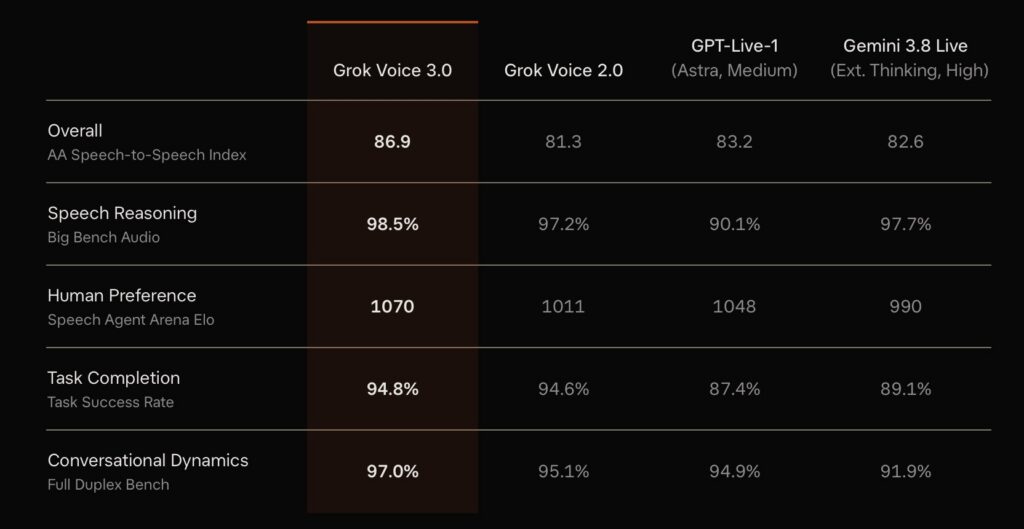
At the core of this breakthrough is the model’s sheer performance in rigorous independent testing. According to Artificial Analysis, Grok Voice 3.0 currently ranks first on the Speech-to-Speech Index with a score of 86.9. This index is a comprehensive measure that evaluates speech reasoning alongside preference and task success from blind, head-to-head calls. Furthermore, true conversational intelligence requires an understanding of human rhythm—when to speak, when to listen, and how to handle being cut off. On the Full Duplex Bench, which measures a model’s ability to naturally handle pauses, turn-taking, and sudden interruptions, Grok Voice 3.0 achieves an exceptional 97%.
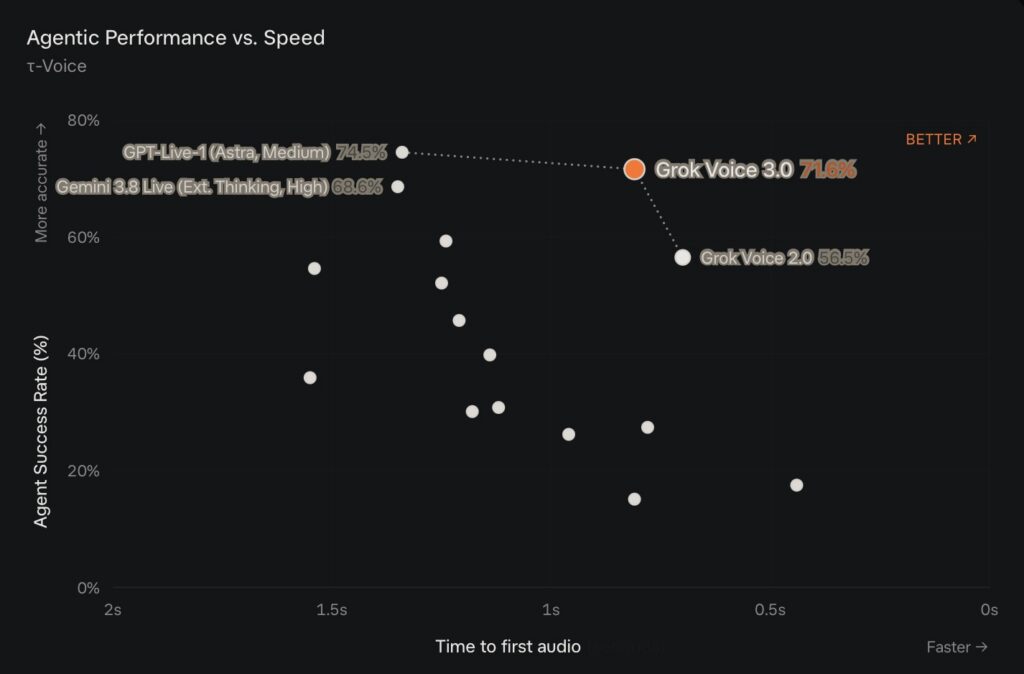
Real-world environments are inherently noisy and unpredictable, a challenge that Grok Voice 3.0 was explicitly designed to conquer. On the τ-Voice metric, which evaluates how well agents handle support calls heavily layered with diverse accents, background noise, and constant interruptions, the model scores 71.6%. While this accuracy is comparable to leading models like GPT-Live-1 (Astra), Grok Voice 3.0 achieves it with 40% lower latency. This critical reduction in delay sets a new frontier in the balance between an agent’s deep intelligence and its real-time responsiveness.
This technical dominance extends directly into enterprise applications. On ServiceNow’s EVA-Bench—an open-source benchmark that scores voice agents across more than 200 realistic enterprise scenarios—Grok Voice 3.0 secures the highest accuracy score at 74%. It also stands as the best-performing model when evaluated jointly on accuracy and overall customer experience. Nitin Aggarwal, Senior Director of Product Management for Agentic Evals and RAI at ServiceNow, noted that the model “sets a new Pareto frontier on EVA-Bench,” adding that its ability to pair top-tier accuracy with a natural, responsive conversational style “sets a new standard for what enterprises can expect from AI on the front line of customer service.”
Beyond controlled benchmarks, Grok Voice 3.0 is already battle-tested at an unprecedented scale within the Elon Musk ecosystem. Every day, the model seamlessly handles millions of conversations inside Tesla vehicles. Drivers utilize Connectors for simple, hands-free requests like checking calendars or drafting emails, while relying on the Grok Bot voice mode for more complex tasks like booking dinner reservations or ordering a coffee.
In the high-stakes environment of customer support, the model is proving to be highly autonomous and lucrative. Starlink call centers currently deploy Grok Voice to answer 20,000 customer calls daily across multiple languages. The operational impact is staggering: roughly 70% of these interactions are fully resolved with no human in the loop. The model is capable of verifying customer identities, troubleshooting complex hardware issues, issuing financial credits, and even executing the shipping of replacement equipment. Moreover, it is a proven revenue driver, with one in four sales calls ending in a successful purchase before the customer hangs up the phone.
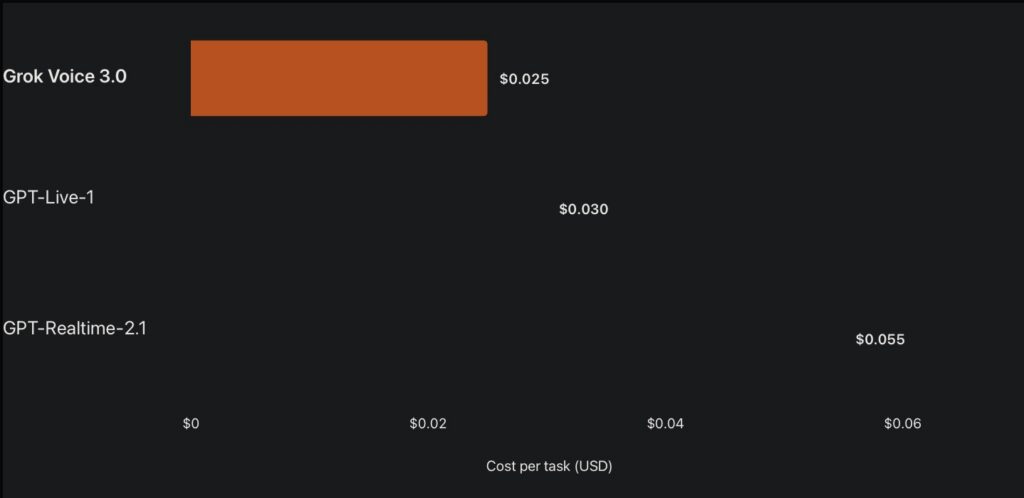
Despite its frontier-level capabilities, Grok Voice 3.0 is highly economical. Artificial Analysis metrics evaluating the cost to complete tasks in the Big Bench Audio run confirm that Grok Voice 3.0 is cheaper to operate than both GPT-Live-1 (Astra, Medium) and GPT-Realtime-2.1. It is available today for developers in the Speech-to-Speech API at $0.08 per minute ($4.80 per hour)—the exact same price as its predecessor, Grok Voice 2.0. For existing users, the transition is completely frictionless; applications using the grok-voice-latest endpoint have already been automatically upgraded to 3.0, instantly granting them access to the fastest, smartest voice model on the market with zero code changes required.