

By stripping away hidden bottlenecks in video diffusion, Apple’s new open-source models turn sluggish frame generation into fluid, interactive visual experiences.
- A Major Open-Source Drop: Apple has released FastFrames on Hugging Face, featuring two autoregressive, two-step 480p video diffusion models—FastFrames-S (1.3B) and FastFrames-L (14B)—alongside an optimized version of LingBot 1.3B that runs 16x faster than the official release.
- Solving the Hidden Bottleneck: By profiling state-of-the-art video pipelines, Apple researchers discovered that VAE decoding and KV cache updates accounted for over half of end-to-end latency, prompting them to replace these “fixed” components with lightweight alternatives.
- True Interactive Performance: Reaching up to 28 responses per second (36 ms per frame) on NVIDIA B200 hardware without sacrificing visual fidelity, FastFrames unlocks real-time, camera-conditioned and physics-conditioned video generation.
For the past few years, generative AI video has largely been a waiting game. Creators type a prompt, step away from the keyboard, and wait minutes for a few seconds of pre-rendered footage to appear. While impressive for passive filmmaking, that kind of delay makes true interactivity impossible. With its surprise release of FastFrames on Hugging Face, Apple is signaling that the era of prompt-and-wait video is giving way to something far more dynamic: real-time,interactive visual worlds.
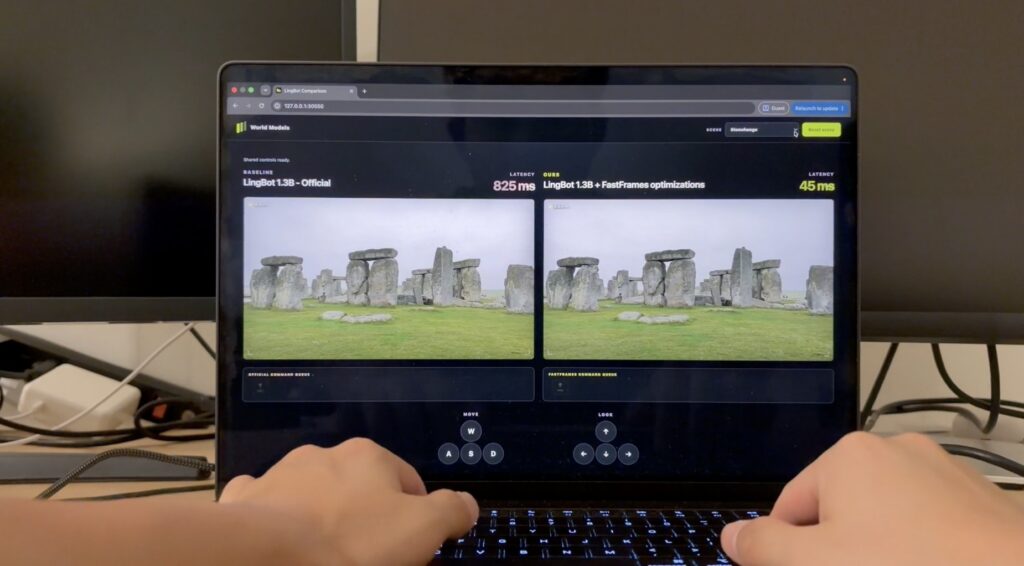
At the core of the release are two new autoregressive, two-step video diffusion models designed to generate 480p video at interactive latency: FastFrames-S, a nimble 1.3-billion-parameter model, and FastFrames-L, a heavyweight 14-billion-parameter counterpart. Unlike traditional video models that render an entire clip in one static pass, autoregressive models generate frames sequentially based on new observations and live inputs. That makes them the ideal foundation for responsive visual experiences—provided they can run fast enough. To sweeten the release for the open-source community, Apple also dropped an optimized version of LingBot 1.3B that runs a staggering 16 times faster than the official model, enabling fluid, camera-conditioned control right out of the box.
Until now, autoregressive video diffusion models were simply orders of magnitude too slow for seamless human interaction. Rather than trying to brute-force the problem with bigger clusters or heavily degraded video quality, Apple’s researchers took a classic systems-engineering approach: they profiled the entire inference pipeline of state-of-the-art models to see where the milliseconds were actually going. What they found challenged conventional wisdom in the field.Operations that developers routinely treat as fixed, untouchable implementation details—specifically VAE (Variational Autoencoder) decoding and KV (Key-Value) cache updates—were quietly eating up more than half of the total end-to-end inference latency. By questioning the assumption that these heavy components were indispensable and swapping them out for lightweight alternatives, the team unlocked massive speed gains without compromising visual quality.
The resulting performance benchmarks push generative video squarely into real-time territory. Running on a single NVIDIA B200 GPU, the compact FastFrames-S (1.3B) clocks in at just 36 milliseconds per frame, or 28 responses per second (RPS)—effectively matching the generation quality of state-of-the-art models that are nearly eight times slower.For applications demanding higher fidelity, the larger FastFrames-L (14B) runs at 45 milliseconds per frame, or 22 RPS,on an 8x B200 GPU node, delivering significantly richer visual quality and realism while still maintaining the responsiveness required for live interaction.

Zooming out, the implications of FastFrames stretch far beyond generating quick clips on social media. When a video model can respond to inputs in 36 to 45 milliseconds, it stops behaving like a video renderer and starts behaving like a real-time graphics engine. Apple’s research highlights two immediate frontiers: camera-conditioned and physics-conditioned video generation. In practice, this means a user can pan, tilt, or move a virtual camera through an AI-generated scene and watch the world adapt instantaneously, or interact with objects that obey simulated physical laws on the fly. For industries ranging from gaming and spatial computing to robotics training and virtual prototyping, this kind of latency is the missing link.
Apple’s decision to publish the official implementation and weights openly on Hugging Face also underscores a broader shift in how the AI race is being won. While much of the industry remains fixated on scaling parameter counts,FastFrames proves that ruthless efficiency and architectural pragmatism can be just as transformative. By rethinking the plumbing of video diffusion, Apple hasn’t just made AI video faster—it has laid the groundwork for a future where generated video is something you don’t just watch, but actively step into and control.