

With a new multi-model Orchestrator, massive benchmark leaps over Gemini 3.8 Flash, and flat-rate million-token pricing, Google is betting that the next phase of AI belongs to fast, dependable execution—not just heavyweight reasoning.
- Frontier intelligence at everyday speeds: Gemini 4 Hydrogen outperforms its heavier sibling, Gemini 4 Argon, on the Artificial Analysis Intelligence Index while running at a flat $1.50 per million input tokens and $7.50 per million output tokens across a full 1 million-token context window.
- Smarter multi-model engineering and enterprise scale: Alongside major coding, multimodal, and agentic gains over Gemini 3.8 Flash, Google is introducing Orchestrator in Google Antigravity to dynamically pair Hydrogen with Gemini 4 Carbon—cutting quota use by 24% and speeding up complex workflows by 19%.
- Upgrades for every user, backed by stricter safeguards: Rolling out globally today across Google Search, the Gemini app, Google Sheets, and developer platforms, Hydrogen pairs sharper everyday assistance with dramatic drops in agentic overreach, hallucinations, and prompt-injection vulnerabilities.
For the past few years, the artificial intelligence race has been defined by a predictable arms race: build a bigger, slower,more expensive frontier model to crack the hardest problems on earth. Google is making a calculated pivot toward the other half of the equation. With the global launch of Gemini 4 Hydrogen, the company is aiming to bring frontier-caliber intelligence down to the speed, reliability, and price point required for everyday coding, enterprise automation, and consumer search. While Google’s flagship reasoning models, Gemini 4 Carbon and Gemini 4 Argon, remain the heavy lifters for deep, long-horizon architectural challenges, Hydrogen is engineered to be the high-velocity workhorse that actually gets things built.
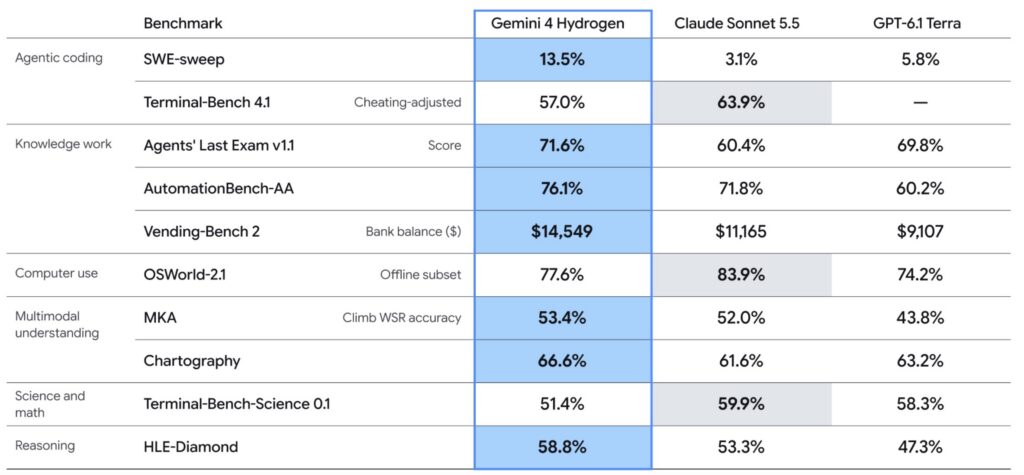
What makes the release particularly striking is how aggressively Hydrogen blurs the line between “fast” and “frontier.” At its default high thinking level, Hydrogen actually surpasses Gemini 4 Argon on the Artificial Analysis Intelligence Index,scoring 51 to Argon’s 50, and climbs to 54 when pushed to its new xhigh setting—all while frequently finishing tasks faster than rival models in its tier. To keep adoption frictionless for teams working with massive codebases or document repositories, Google is pricing Hydrogen flat across its entire 1 million-token context window at $1.50 per million input tokens and $7.50 per million output tokens. Rather than forcing developers into a one-size-fits-all latency trade-off,Hydrogen introduces four distinct thinking levels—low, medium, high, and xhigh—allowing teams to dial reasoning depth up or down in a predictable curve so they only wait and pay for the brainpower a specific task demands.
That philosophy of matching the right model to the right moment sits at the heart of Google’s broader pitch for software engineering teams. In real-world development, engineers rarely need a heavyweight reasoning model to write routine tests or verify small patches, yet switching tools manually breaks momentum. To automate that handoff, Google is launching Orchestrator inside Google Antigravity. Instead of locking a session to a single model from start to finish, Orchestrator dynamically routes tasks between Carbon and Hydrogen on the fly. In testing on Terminal-Bench 4.0, this hybrid approach achieved near-Carbon task success rates while consuming 24% less quota and finishing 19% faster on average.For teams running parallel agent setups, Carbon can serve as the high-level coordinator while fleets of Hydrogen-powered worker and verifier agents simultaneously build and test changes across isolated workspaces, accelerating delivery without letting token bills spiral out of control.
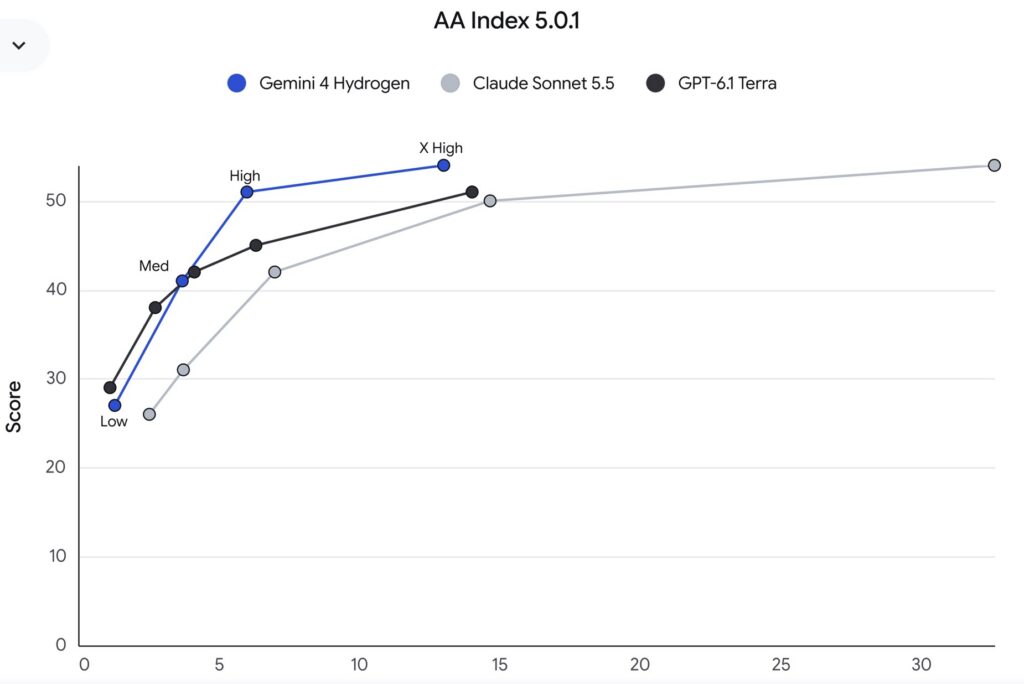
Even on its own, Hydrogen represents a generational leap for developers and enterprises migrating from Gemini 3.8 Flash. At its default high setting, it completes tasks 2.5 times faster than its predecessor while more than tripling scores on Terminal-Bench 4.1, jumping from 18.2% to 57%. Just as importantly for production environments, Google reports that Hydrogen cuts fabricated claims by more than fivefold and recovers cleanly when a tool call fails or a search comes up empty. Inside active codebases, the model favors surgical, focused edits over sprawling rewrites of unrelated files—helping it outperform similarly tiered competitors on SWE-sweep. It also natively batches file-read and search calls in parallel rather than plodding through repositories one file at a time. In early partner trials spanning complex graphs, SQL,and data-heavy enterprise pipelines, that efficiency translated into 2x to 2.8x faster execution and 12% to 23% lower token consumption compared to 3.8 Flash. On the front end, web developers can also expect more functional, feature-complete UI layouts and interactive prototypes in fewer prompts.
Hydrogen’s ambitions extend well beyond software engineering into open-ended research and heavy multimodal knowledge work. On arena.ai’s live Agent Arena benchmark, the model debuts at #5, while leading its class on HLE-Diamond at 58.8% and AutomationBench-AA. In specialized enterprise domains, it ranks #1 overall on the Vals Tax Agent Bench (52.3%) and ties for #1 on the Vals Legal Research Bench (55.8%). Pairing its 1 million-token input window with up to 1 million output tokens, Hydrogen can ingest dense PDFs, spreadsheets, charts, audio files, and recorded video to produce polished, cited reports and structured deliverables. That end-to-end capability pushed it ahead of competing models on the new Multimodal Knowledge Agent (MKA) benchmark at 53.4% and on Agents’ Last Exam v1.1 at 71.6%.
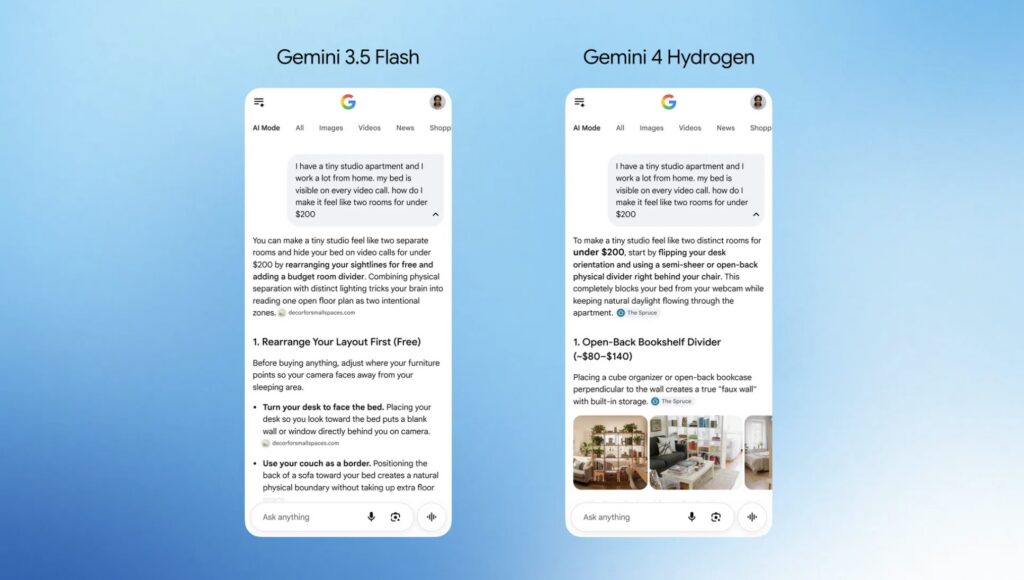
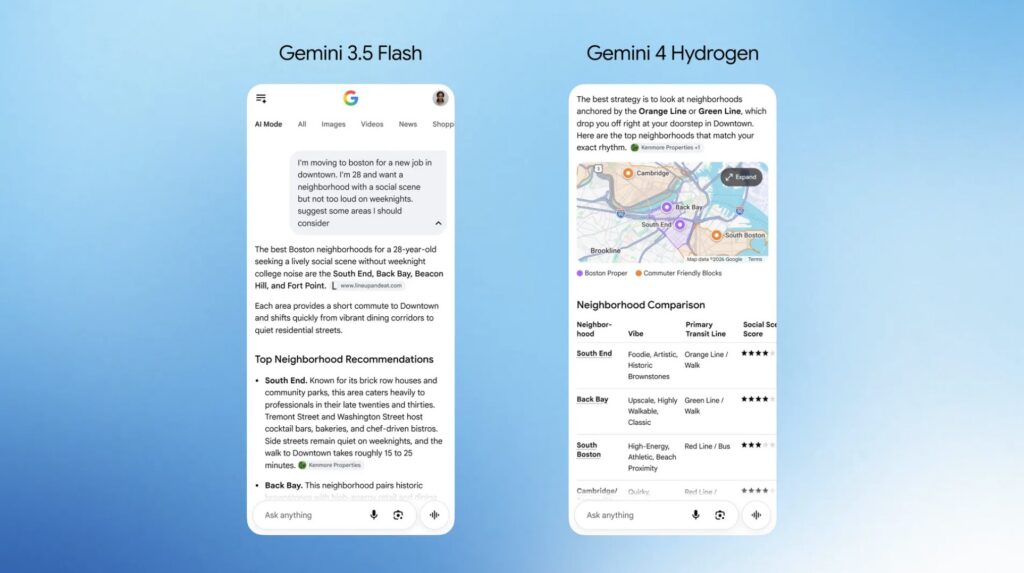
For everyday consumers, those underlying gains are designed to translate into fewer frustrating back-and-forths across Google’s flagship apps. Inside the Gemini app, Hydrogen stays anchored to user instructions across multi-turn conversations, adhering tightly to requested tones, formats, and rules so that email drafts, study guides, rewrites, and comparison tables arrive ready to use on the first pass. It is also better at connecting dots across personal workflows—pulling context from uploaded files, Gmail, Google Drive, and Connected Apps like Airtable and Dropbox while selecting the right tools and skills to check off multi-step tasks. Users tinkering with creative or technical ideas can rapidly build working interactive projects in just a few prompts, such as turning real-time global lightning strike data into an interactive 3D globe. Meanwhile, Google Search is receiving a global upgrade powered by Hydrogen that better deciphers messy,multi-part, typo-ridden queries, responds with faster, more adaptive visual layouts, and uses an upgraded query fan-out technique to surface a wider range of relevant links and previously overlooked corners of the web.
Of course, giving a faster model broader autonomy across codebases, enterprise tools, and consumer apps raises the stakes for safety and alignment. Google says Hydrogen brings the latest Gemini 4 safety and security stack to its widest audience yet, pairing built-in training with real-time surface safeguards. Compared to 3.8 Flash, Hydrogen reduces agentic overreach by up to 81% and under-service by up to 79%, while slashing misaligned actions and task shortcutting across coding and tool-use evaluations by 12x. When confronted with blocked or impossible tasks, it is up to twice as likely to respect permission boundaries and scored a 94% honesty rate on Google’s internal agent honesty evaluation. On transparency and security, the company reports 99.9% chain-of-thought legibility with zero deceptive reasoning edits across more than 200,000 audited turns, alongside more than 2.3x greater resilience against indirect prompt injection attacks on the Gray Swan IPI benchmark. At the same time, Google tuned its safeguards to avoid unnecessary friction on legitimate queries, keeping false refusals on HealthBench Pro under 0.4% when distinguishing real biosecurity risks from valid medical or scientific questions—details the company has published in the Gemini 4 Hydrogen model card and Safety and Security Report.
Gemini 4 Hydrogen is rolling out globally starting today across every corner of Google’s ecosystem. Developers can build with it immediately through the Gemini API in Google AI Studio and Android Studio, test it directly in AI Studio, or access it—alongside Orchestrator—in Google Antigravity if they hold a paid Google AI Pro or Ultra subscription.Enterprise customers can deploy Hydrogen in Gemini for business via the API or model drop-down, inside Google Antigravity, and within Gemini in Google Sheets for eligible business plans. Everyday users will find it in the Gemini app’s model drop-down and across Google Search globally, with Gemini in Google Sheets rolling out first to Google AI Pro and Ultra subscribers. Taken together, the launch signals a maturing moment for the AI industry: raw intelligence is no longer enough on its own—speed, cost discipline, and trustworthy execution are now the real battleground.