How a radically new 125B-parameter MoE model is rewriting the rules of AI cost-efficiency, memory management, and training stability.
- Unmatched Efficiency: Features 125B main parameters and 51B N-gram embeddings, yet activates only 6B parameters per token—delivering top-tier performance at just 1/9 the training cost of Qwen3.7-Plus.
- Next-Gen Architecture: Previews the foundational tech for the upcoming Qwen4, introducing a GDN + QSA hybrid attention mechanism, Gated Residuals, N-gram Embeddings, and the Muon optimizer.
- Massive Context & Availability: Natively supports 262K tokens (extensible to 1M via YaRN) and is available now as open-weight on Hugging Face and ModelScope, or via the QwenCloud API at highly disruptive pricing.
The artificial intelligence landscape is in a constant race for greater capability, but the true frontier has shifted toward cost-efficiency and architectural elegance. Enter Qwen3.8-Flash and its open-weight sibling, Qwen3.8-Flash-Next.
Serving as a multimodal Mixture-of-Experts (MoE) model, Qwen3.8-Flash-Next is more than just an incremental update; it is an early, fully transparent preview of the architecture that will power the highly anticipated Qwen4 family. By releasing these architectural changes early—much like the role Qwen3-Next played for the 3.5 series—the developers are inviting the community to explore a paradigm shift in how large language models handle memory, context, and training optimization.
The Big Picture: Doing More with Vastly Less
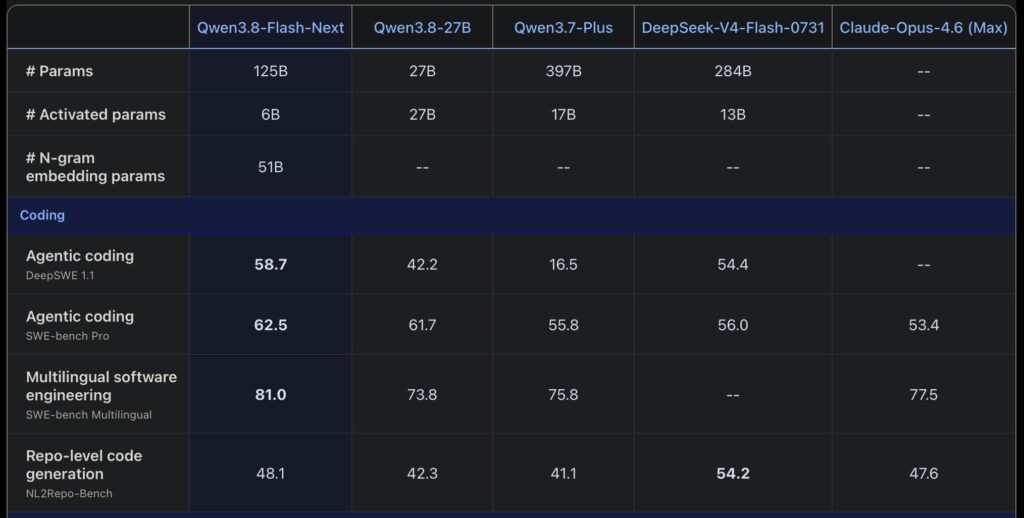
At the heart of Qwen3.8-Flash-Next is a staggering leap in computational economy. The model boasts a 125-billion-parameter main network, supplemented by 51 billion N-gram embeddings. However, thanks to its ultra-sparse MoE design, it activates a mere 6 billion parameters per token.
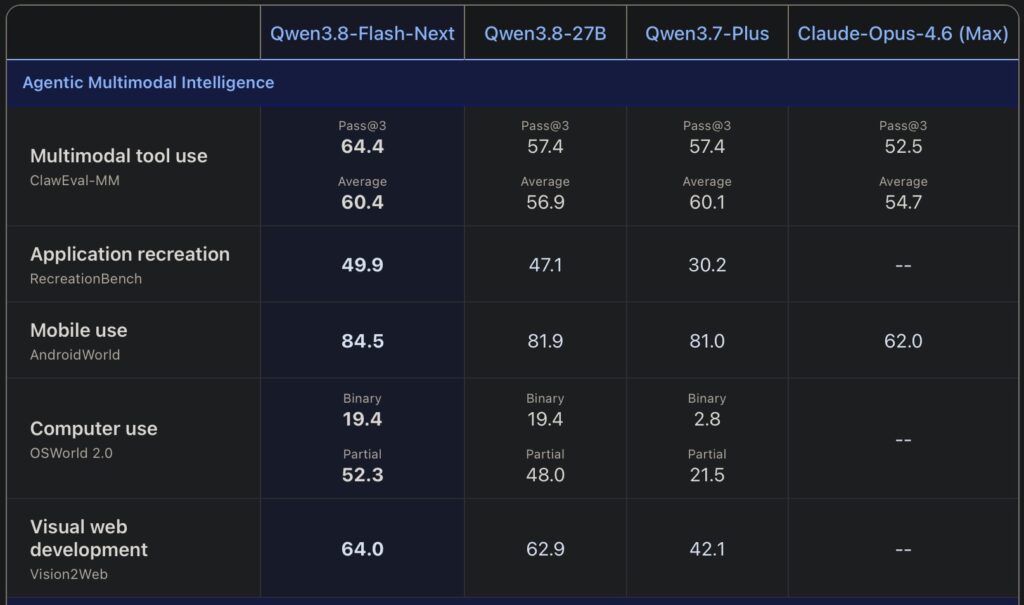
This extreme sparsity pays massive dividends. Compared to its predecessor, Qwen3.7-Plus, the new architecture requires only about 11% (1/9) of the training cost, yet it outperforms the older model across the board. The gains are especially pronounced in coding and office tasks, boasting formidable benchmark scores:
- DeepSWE 1.1: 58.7
- SWE-bench Pro: 62.5
- CoWorkBench: 73.9
- AndroidWorld: 84.5
- MathVision (with CI): 95.7
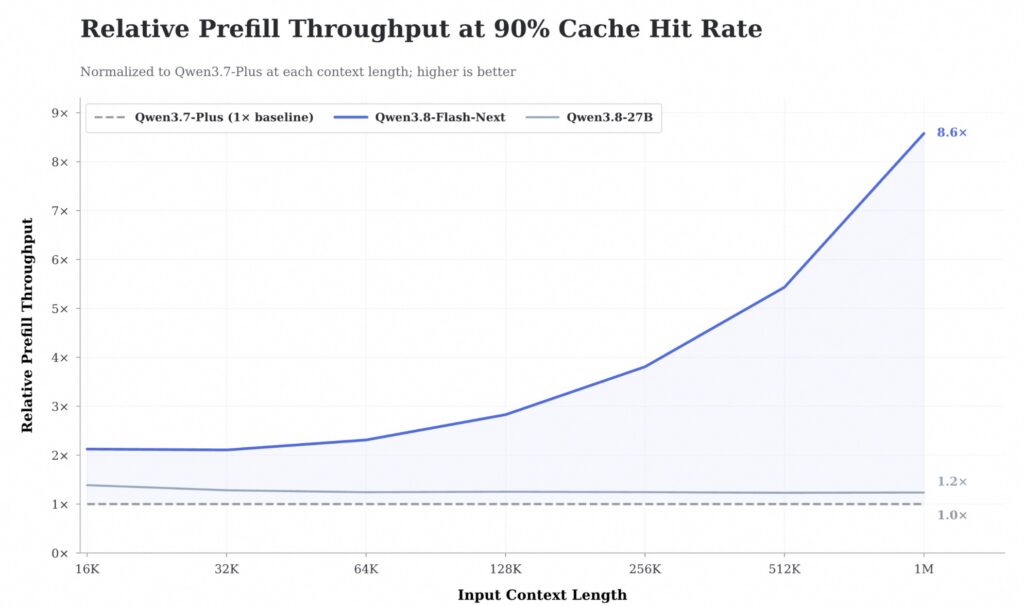
To support enterprise workloads, the model natively processes up to 262,144 tokens of context, which can be extended to a massive 1,000,000 tokens using YaRN.
The Four Pillars of the Qwen4 Architecture
Qwen3.8-Flash-Next achieves its leap in capabilities by systematically overhauling the model across four core dimensions: Attention, Residuals, Embeddings, and Optimization.
1. Attention: The GDN + QSA Hybrid
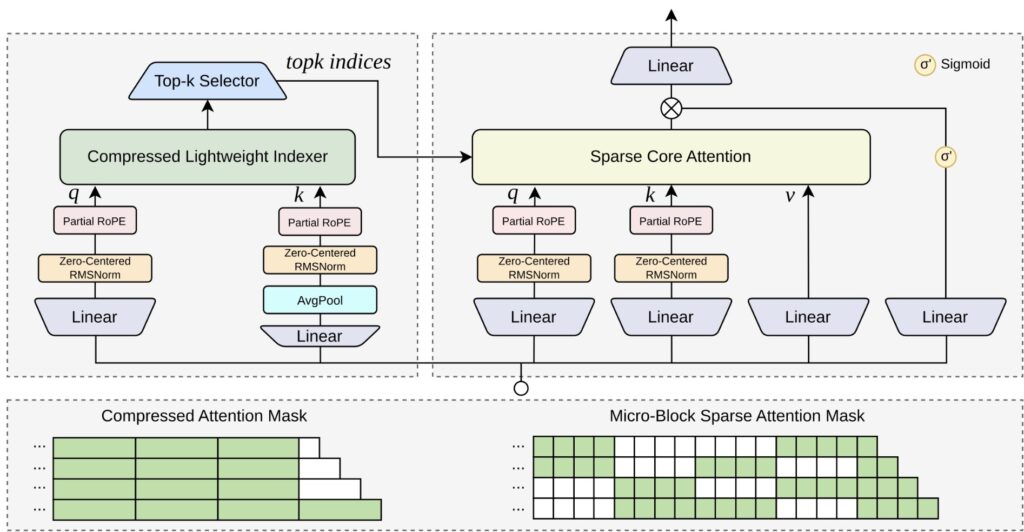
Traditional Full Attention mechanisms are memory-hungry; as context grows, computing power and KV Cache requirements skyrocket. Qwen3.8-Flash-Next solves this by interleaving two different mechanisms:
- Gated DeltaNet (GDN): Used in three out of every four layers, GDN continuously compresses historical context into a fixed-size state, aggressively cutting down memory overhead.
- Qwen Sparse Attention (QSA): The remaining layer uses a global attention mechanism, but with a twist. QSA introduces a lightweight indexer that groups sequences into micro-blocks. It estimates importance at the block level rather than the token level, selecting only the most vital regions for Attention. Because this compression happens independently within each layer, it is perfectly suited for this hybrid architecture.
2. Gated Residuals: Widening the Information Highway
In standard Transformers, deep neural networks often suffer from signal dilution—early features get lost as they are repeatedly overwritten in a single residual stream.
Qwen3.8-Flash-Next introduces Gated Residual (GR), expanding the original single information channel into four parallel pathways. A dynamic gate controls how much data is read from and written to each branch. This allows some branches to handle local processing while others bypass the noise, carrying early information deep into the network. This gating mechanism also suppresses activation outliers, stabilizes training, and allows the model to utilize highly efficient FP8 storage.
3. N-gram Embeddings: Free Capacity Upgrades
Taking inspiration from recent advancements in layer embeddings, the new architecture integrates an additional 51 billion N-gram Embedding parameters.
Instead of looking up a single token, N-gram Embeddings look up local context (the current token plus preceding ones), effectively giving the model a massive “local-pattern memory.” Because these lookup locations are known in advance, the 51B parameters can be offloaded to standard Host Memory and prefetched asynchronously. The result? A massive boost in model capacity with virtually zero extra computational cost per token.
4. Optimization: Mastering Muon
Architecture is only as good as the optimizer that trains it. Qwen3.8-Flash-Next utilizes a co-designed approach featuring the Muon optimizer alongside AdamW.
By strategically assigning parameters—Muon handles true two-dimensional linear maps (like Attention and GDN weights), while AdamW handles embeddings and MoE routers—the team refitted the scaling laws to achieve remarkable stability. The model can now handle larger Learning Rates and Batch Sizes. In fact, the team discovered that traditional “Batch Size Warmup” is entirely unnecessary for this architecture, saving 18.8% in optimizer steps by jumping straight to the target batch size.
Beyond the Core: MoE and Training Stability
The refinements don’t stop at the four main pillars. The model utilizes an Ultra-sparse MoE with global load balancing, utilizing a large expert pool but routing to very few experts per token, alongside one shared expert.
Additionally, a Multi-Token Prediction (MTP) module (which also utilizes QSA instead of full attention) helps maintain consistency between training and inference, boosting speculative decoding speeds in real-world deployments. Foundational stability choices—like Zero-centered RMSNorm, attention output gating, and normalized MoE router initialization—ensure that both small-scale testing and massive-scale training run without a hitch.
Access and Availability
True to its open-source roots, the weights for Qwen3.8-Flash-Next are available right now on Hugging Face and ModelScope for researchers and developers to dissect and deploy.
For developers looking for production-ready solutions, the official Qwen3.8-Flash (featuring a default 1M context window and built-in tools) is rolling out on the QwenCloud API. Priced at just $0.16 per million input tokens and $0.47 per million output tokens, it is positioned to be one of the most accessible and powerful frontier models on the market today.