

The new multimodal powerhouse matches elite text reasoning while granting AI agents the gift of sight—bridging the gap between data and visual reality.
- A Leap in Multimodal Performance: The newly launched
deepseek-v4-flash-vision-expmodel matches its predecessor’s text capabilities while delivering a massive upgrade in multimodal benchmarks, bringing its performance remarkably close to Opus-4.8.
- Unlocking New Agent Workflows: By integrating visual understanding with digital tools, the model empowers AI to read screenshots, analyze charts, and interact with the physical and digital world in highly practical ways.
- Seamless Developer Integration: Supported out-of-the-box by DeepSeek Harness 0.1.1, the API offers flexible image inputs (Base64, URLs, or Files API) with cost-effective tokenization capped at just 384 tokens per image.
The landscape of artificial intelligence is rapidly shifting from text-bound conversationalists to perceptive, multimodal agents. For a long time, large language models could elegantly describe the world, but they could not actually see it. That barrier is crumbling. The DeepSeek API Platform has officially launched its newest experimental model, deepseek-v4-flash-vision-exp, marking a significant evolution in how machines interact with mixed media. By introducing advanced vision capabilities, DeepSeek is pushing the boundaries of what automated agents can accomplish in real-world scenarios.
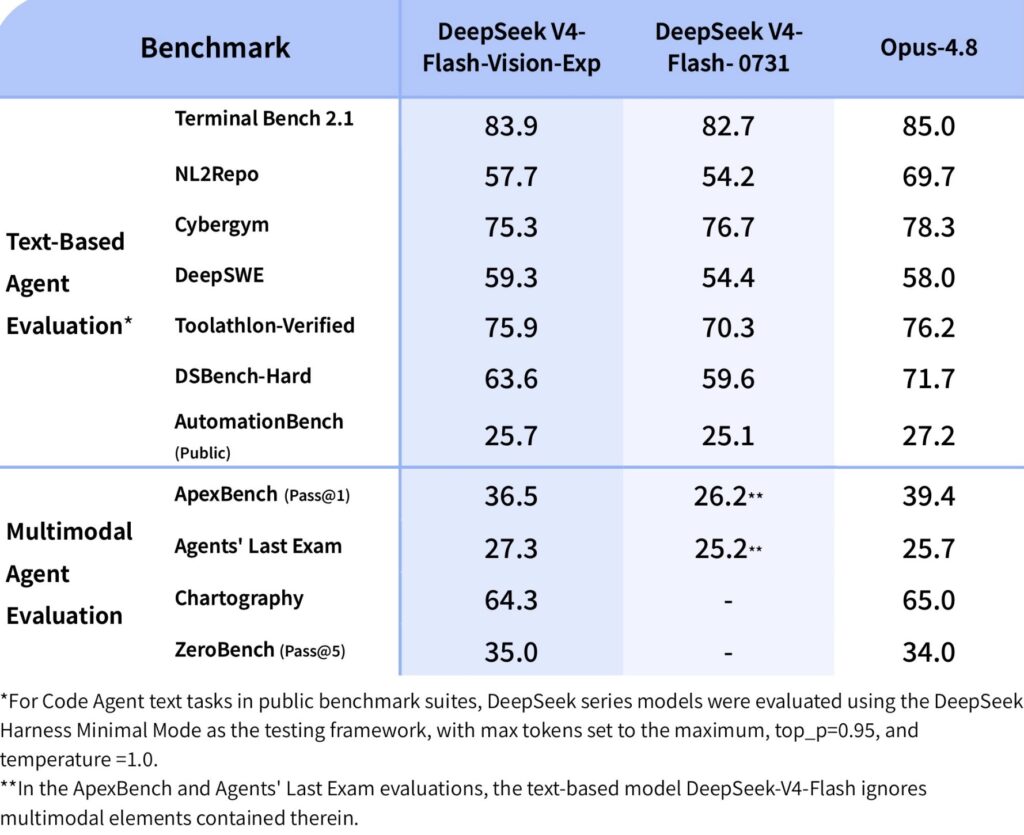
At its core, the new experimental model refuses to compromise on the foundational intelligence that developers have come to expect. It fully matches the DeepSeek-V4-Flash model on all text-based capabilities, including complex reasoning, broad world knowledge, and agent-driven tasks. However, where this release truly shines is in its newfound multimodality. On multimodal agent benchmarks, V4-Flash-Vision-Exp makes a staggering leap over the standard V4-Flash. Its ability to process and interpret visual data alongside text brings its multimodal agent performance striking distance to elite models like Opus-4.8, positioning it as a formidable tool for enterprise and creative applications alike.
This visual integration is the key to unlocking the next generation of AI agent use cases. When an AI can only read text, its utility in a highly visual digital workspace is inherently limited. Now, because deepseek-v4-flash-vision-exp accepts images alongside text, users can simply ask the model to describe complex pictures, extract and read text directly from interface screenshots, or analyze dense corporate charts. V4-Flash-Vision-Exp works smoothly across various agent frameworks, elegantly combining this deep visual understanding with a wide range of digital tools to unlock practical, end-to-end workflows that were previously impossible. To further accelerate this ecosystem, DeepSeek Harness 0.1.1 was also released today, providing out-of-the-box support for the new model.
For developers eager to build with these new tools, the technical integration is designed to be highly intuitive. The model supports a wide array of endpoints, including Chat Completions, Messages, and the Responses API. Importantly, it seamlessly handles mixed inputs, allowing developers to pass standard text arrays alongside image blocks. The system intelligently detects supported image formats—JPEG, PNG, GIF, and WebP—directly from the actual file content rather than relying on potentially inaccurate file names or declared MIME types.
DeepSeek has also optimized the economic and architectural aspects of this multimodal leap. Images are highly efficient to process; they are tokenized for billing at a maximum of just 384 tokens each, retaining the attractive V4-Flash pricing structure. When sending these images, developers are given the flexibility of three distinct methods within the standard OpenAI-compatible format. They can use external URLs, upload via the Files API, or embed Base64-encoded images directly inline as a data: URL. The Base64 method is particularly convenient for processing local files, though developers must keep in mind that the encoded data counts toward the platform’s standard 48 MiB request body limit.
The release of deepseek-v4-flash-vision-exp is more than just a version bump; it is a fundamental expansion of the model’s sensory inputs. By giving high-reasoning agents the ability to perceive and analyze the visual world, DeepSeek is paving the way for software that doesn’t just compute, but truly observes.