

The latest open-source release transforms Ryzen AI PCs into secure, self-contained AI powerhouses with a robust set of strictly local capabilities.
- Strictly Local Processing: AMD’s GAIA 0.17 introduces a new, privacy-first Agent UI, allowing users to analyze documents, execute commands, and manage complex workflows entirely on their local hardware without any reliance on cloud-based AI.
- Optimized for Ryzen AI: Designed to leverage the NPU and iGPU of AMD Ryzen AI 300 Series Processors, the framework ensures faster, lower-power processing using the open-source Lemonade SDK for models like Llama and Phi.
- Unprecedented User Control: The update features robust security guardrails requiring user approval for tool execution, remote mobile access via built-in ngrok tunnels, and a suite of specialized agents powered by advanced Retrieval-Augmented Generation (RAG).

As the world grows increasingly reliant on artificial intelligence, a growing contingent of power users and developers are demanding a computing environment where their data never has to leave their machine. Addressing this crucial need for privacy and local processing, AMD has rolled out a significant update to its open-source AI project. Originally standing for “Generative AI Is Awesome”—a moniker the company has quietly stepped back from heavily promoting—GAIA (pronounced /ˈɡaɪ.ə/) has evolved into a formidable application designed to run private and local large language models directly on Windows PCs. With the release of version 0.17, AMD is drastically enhancing the user experience by introducing Agent UI, a sophisticated, privacy-first web application built specifically for local AI agents.
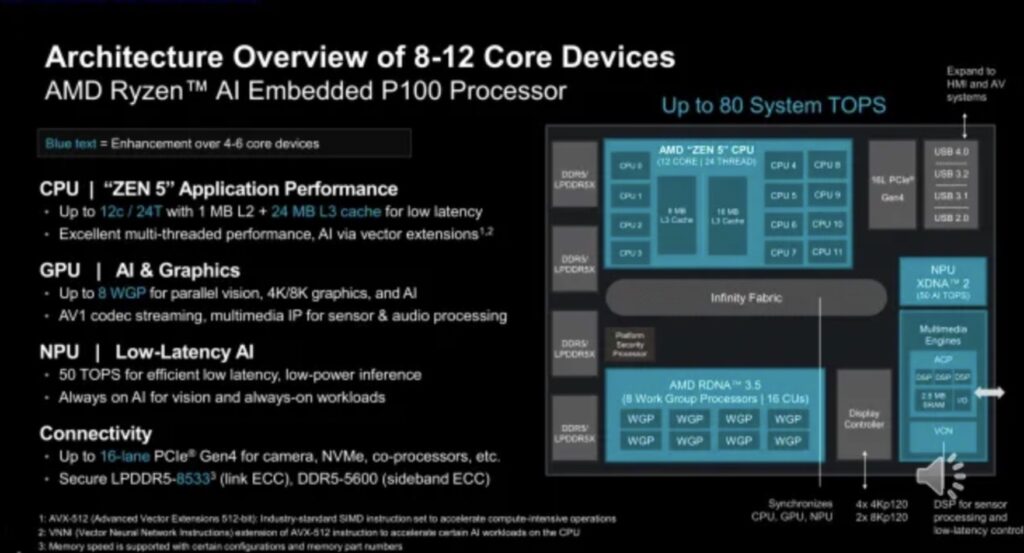
The core philosophy behind GAIA Agent UI is absolute privacy without sacrificing functionality. Built with a responsive React and TypeScript front-end wrapped in an Electron shell, the interface looks and feels like a modern web application, but every single operation happens strictly locally. There are no silent pings to cloud servers and no external data harvesting. Users can effortlessly drag and drop over fifty-three different file formats—including PDFs and Word documents—into the interface. The local agent then analyzes these documents, providing intelligent answers backed by precise, page-level citations using a local Retrieval-Augmented Generation (RAG) pipeline. Furthermore, the UI allows users to seamlessly search and browse files, explore directories, and locate content across entire project folders right from the chat interface.
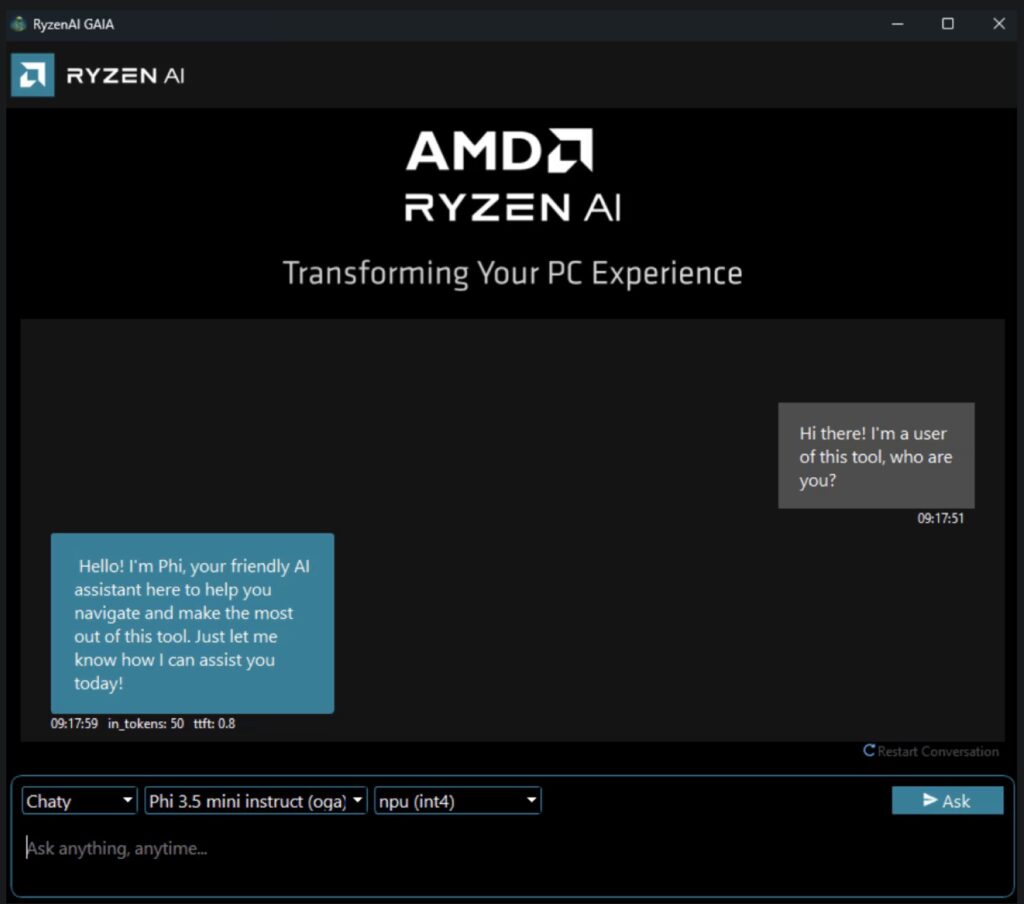
A major focus of the 0.17 update is transparency and safe execution. As AI agents become more autonomous, the potential for unintended system actions increases. To mitigate this, AMD has implemented strict tool execution guardrails. While the GAIA agent is highly capable of running shell commands, writing files, and utilizing Model Context Protocol (MCP) tools, it cannot do so autonomously; it explicitly requires the user to approve or deny each action before it is executed. While the agent works, users can watch it “think” through real-time streaming, with block rendering that displays the reasoning process inline. Performance monitoring is also deeply integrated, allowing users to simply hover over tooltips to view real-time token counts, latency, and throughput metrics for every response. Sessions are fully persistent, meaning you can create, switch between, and pick up past conversations with your full history intact. Surprisingly, this local-first approach does not tie you to your desk; a built-in ngrok tunnel allows you to securely access your local GAIA instance from your smartphone or any other device.
Beneath this polished interface lies a highly optimized engine designed to squeeze every ounce of performance out of modern hardware. GAIA is specifically optimized for AMD Ryzen AI hardware, particularly the Ryzen AI 300 Series Processors. By interacting directly with the system’s Neural Processing Unit (NPU) and integrated GPU (iGPU), GAIA achieves incredibly fast inference while drawing significantly less power than traditional CPU-bound tasks. This is made possible through the open-source Lemonade (LLM-Aid) SDK from ONNX TurnkeyML. Version 0.17 furthers this synergy with improved Ryzen AI and Radeon hardware detection, alongside system prompt optimizations, better messaging, and a host of under-the-hood fixes. It expertly supports a variety of popular local LLMs, including tailored derivatives of Llama and Phi, making it highly adaptable for complex reasoning, summarization, and interactive tasks.
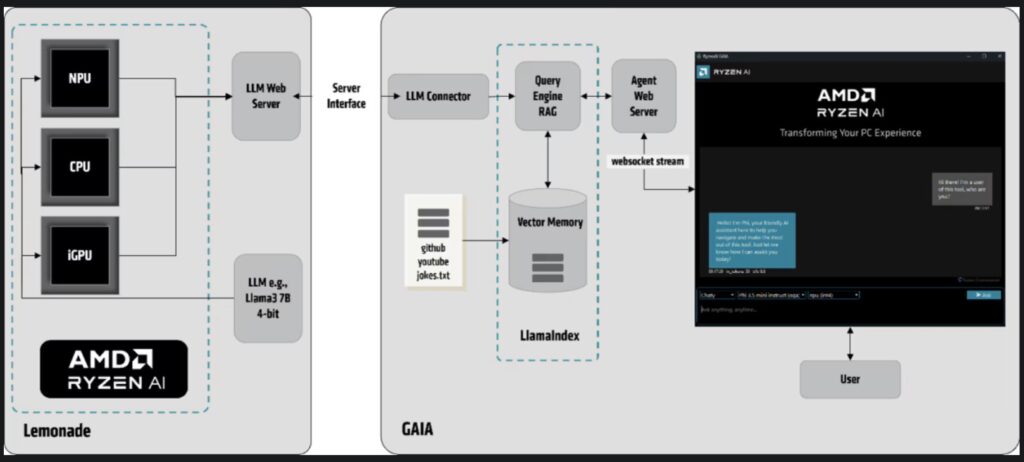
Getting started with this personal AI ecosystem is surprisingly frictionless, generally taking less than ten minutes to set up. AMD offers two installation paths: a standard GAIA Installer that works on any Windows PC, and a GAIA Hybrid Installer built specifically to harness the NPU and iGPU of Ryzen AI PCs for maximum performance. Once up and running, users can dive into a rich ecosystem of specialized agents driven by GAIA’s robust RAG pipeline, which intelligently pairs an LLM with external knowledge bases. Users can test raw models using the “Simple Prompt Completion” mode, converse naturally with a history-aware chatbot named “Chaty,” utilize “Clip” for an agentic YouTube search and Q&A experience, or even lighten the mood with “Joker,” a RAG-powered joke generator. By merging powerful hardware optimizations with a secure, feature-rich interface, AMD’s GAIA 0.17 proves that the future of generative AI can be truly awesome, and more importantly, truly yours.