From orbiting data centers to agentic operating systems and physical robots, CEO Jensen Huang unveils the next generation of accelerated computing.
- A Generational Hardware Leap: NVIDIA introduced its next-generation Vera Rubin and Feynman architectures, signaling a massive leap in agentic AI capabilities with entirely new CPUs, LPUs, and networking frameworks.
- The Era of Physical and Agentic AI: The company is aggressively moving AI into the physical and autonomous realms, highlighted by broad partnerships in robotics, autonomous driving, and the integration of the open-source OpenClaw agentic operating system.
- Unprecedented Growth and Galactic Ambitions: Projecting a staggering $1 trillion in revenue between 2025 and 2027 driven by a million-fold increase in computing demand, NVIDIA is literally reaching for the stars with plans to deploy AI data centers in orbit.

A 20-Year Flywheel and a Trillion-Dollar Horizon
To a capacity crowd at San Jose’s SAP Center, the message at NVIDIA GTC 2026 was immediately clear: the “token” has officially become the fundamental building block of the modern world. Opening a keynote that promised to cover every tier of the “five-layer cake of artificial intelligence,” NVIDIA founder and CEO Jensen Huang took the stage to roaring applause. What followed was a sweeping vision of the future, detailing how the company plans to transition AI from chatbots and digital assistants into scientific engines, autonomous agents, and physical entities that walk among us. NVIDIA’s dominance in the AI sector is no accident, a fact Huang reinforced by celebrating the 20th anniversary of CUDA. He described the programming model as the “flywheel” of accelerated computing. Paying homage to the company’s roots—calling NVIDIA “the house that GeForce made”—Huang introduced DLSS 5. This new iteration utilizes 3D-guided neural rendering to achieve real-time, photoreal 4K performance on local hardware. But gaming is just the beginning. Noting that computing demand has surged by 1 million times in recent years and fueled by a massive $150 billion wave of venture capital flowing into “AI natives” like OpenAI and Anthropic, Huang projected an astonishing $1 trillion in revenue for NVIDIA from 2025 through 2027.
Silicon Synergy: The Dawn of Vera Rubin and Rosa
To meet this off-the-charts demand, NVIDIA is leaning into what Huang calls “extreme codesign”—developing software and silicon in tandem. The immediate result is the NVIDIA Vera Rubin platform. Built specifically for agentic AI, this full-stack computing powerhouse features seven chips, five rack-scale systems, and a new supercomputer, anchored by the Vera CPU and BlueField-4 STX storage architecture. Looking even further ahead, Huang offered a glimpse of the Feynman architecture. Feynman will introduce the NVIDIA Rosa CPU—named after pioneering scientist Rosalind Franklin—and the LP40, NVIDIA’s next-generation LPU. Connected via cutting-edge Kyber and Spectrum-class optical scale-out technologies, Feynman is designed to advance every pillar of the AI factory.

From Virtual Factories to Orbiting Data Centers
Building these massive AI factories requires extreme foresight, which NVIDIA is addressing through the Vera Rubin DSX AI Factory reference design and the Omniverse DSX Blueprint. The DSX Air software allows companies to simulate massive data centers virtually before pouring a single drop of concrete. And in perhaps the most stunning hardware announcement of the day, Huang revealed Space-1 Vera Rubin: a bold initiative to deploy AI data centers in orbit, extending NVIDIA’s accelerated computing footprint from the Earth to the stars.
The Software Brain: OpenClaw and the Nemotron Coalition
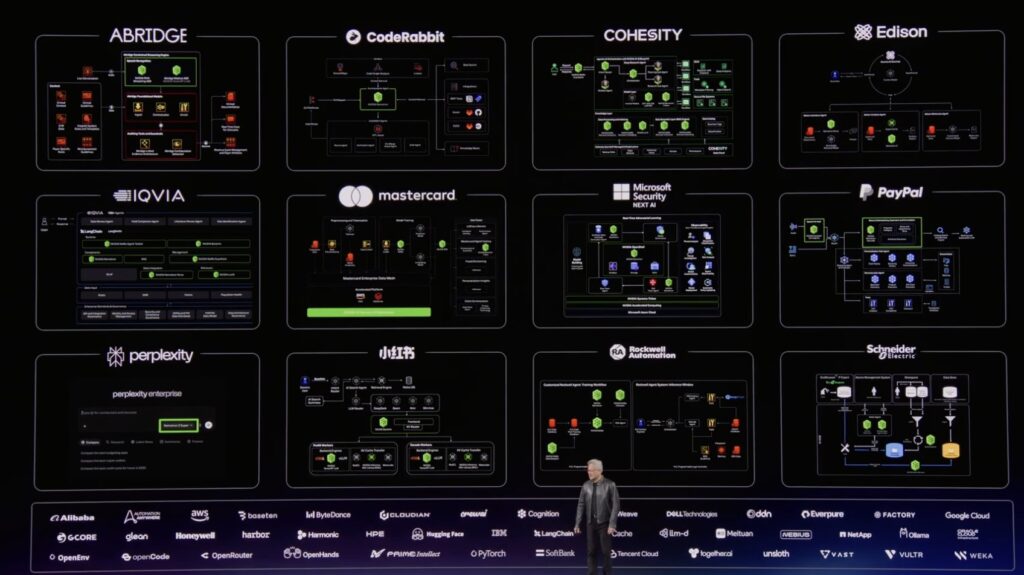
But powerful hardware requires an equally sophisticated software ecosystem. Enter OpenClaw, an open-source project by Peter Steinberger that Huang praised as the operating system for agentic computers. Recognizing the shift toward personal, autonomous agents, NVIDIA is fully integrating OpenClaw across its platforms. To ensure these agents operate safely within enterprise environments, NVIDIA launched the OpenShell runtime and the NemoClaw stack, providing necessary policy enforcement, network guardrails, and privacy routing. Complementing this is the Nemotron Coalition, a new initiative rallying partners around six frontier model families tailored for everything from language and reasoning (Nemotron) and weather (Earth-2) to biology (BioNeMo) and autonomous driving (Alpaymayo).
Breaking Out of the Box: AI Hits the Streets and Factory Floors
The ultimate destination for all this intelligence is the physical world. NVIDIA is rapidly expanding its physical AI footprint, drawing in automakers like BYD, Hyundai, Nissan, and Geely, and partnering with Uber to deploy a robotaxi-ready platform. Industrial robotics leaders such as ABB, Universal Robots, and KUKA are integrating NVIDIA’s physical AI and simulation tools for smarter manufacturing, while telecommunications giants like T-Mobile are transforming base stations into edge AI platforms.

The Grand Finale: When Simulated Snowmen Walk the Stage
The keynote’s grand finale perfectly encapsulated this bridge between the digital and physical. Huang was joined on stage by a physical, waddling manifestation of Olaf, the snowman from Disney’s Frozen. Powered by NVIDIA’s Jetson computer in his “tummy” and trained inside the Omniverse using the Newton physics engine, Olaf was entirely simulated and driven by physical AI in real-time. As Huang exited stage left, leaving behind a bizarre but brilliant musical ensemble featuring singing robots, a digital avatar of himself, and an animated lobster, one thing was incredibly clear: NVIDIA is no longer just powering the future; they are actively building the world it inhabits.