
How the newly open-sourced, agentic coding model is redefining end-to-end task completion, slashing token bloat, and setting new benchmarks for developers.
- Massive Performance Leaps: Kimi-K2.7-Code delivers double-digit percentage improvements across major coding benchmarks while drastically reducing token consumption by 30% through optimized reasoning.
- Agentic by Design: Built for long-horizon software workflows, the model features an un-disableable “Preserve Thinking” mode that maintains full reasoning context across multi-turn interactions and tool calls.
- Developer-Ready Deployment: Open-sourced today with native INT4 quantization and seamless architectural compatibility with its predecessors, making integration straightforward for existing users.
The landscape of artificial intelligence in software development is rapidly shifting from simple code autocomplete functions to sophisticated, autonomous systems capable of executing complex, multi-step engineering workflows. Marking a significant milestone in this evolution, the highly anticipated Kimi-K2.7-Code model has officially been released and open-sourced. Built upon the robust foundation of Kimi K2.6, this new iteration is not just an incremental update; it is a specialized, agentic model designed explicitly to tackle real-world, long-horizon coding tasks. Available today via the Kimi API and Kimi Code, it provides a powerful new engine for coding agent frameworks aiming to achieve higher end-to-end task success rates.
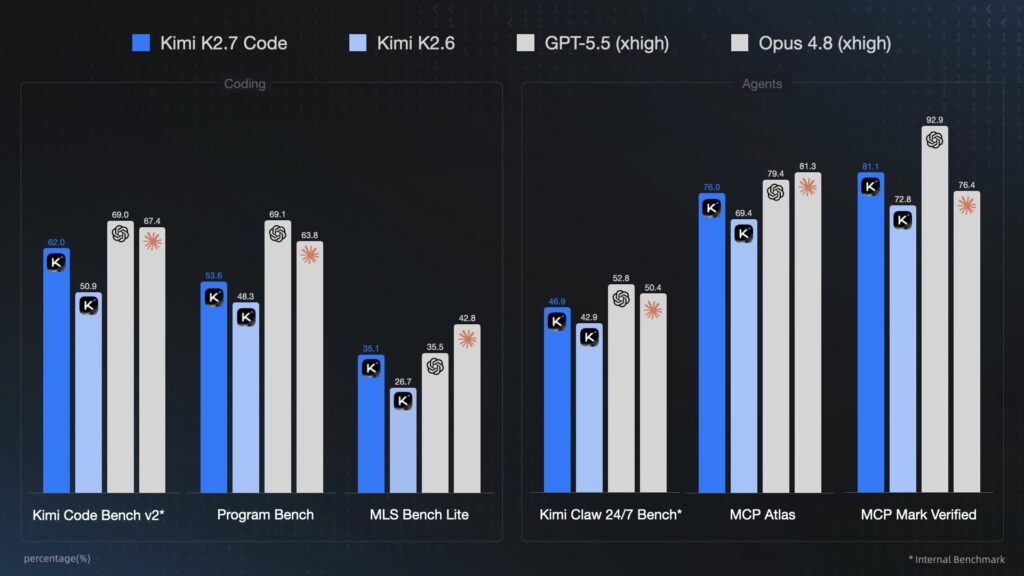
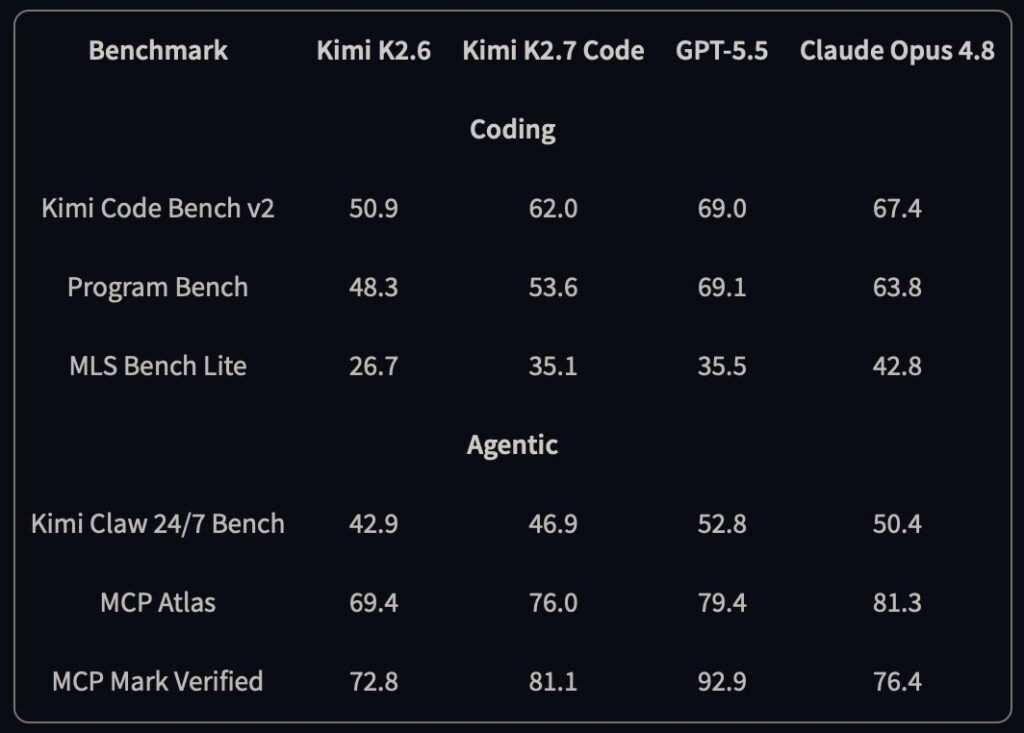
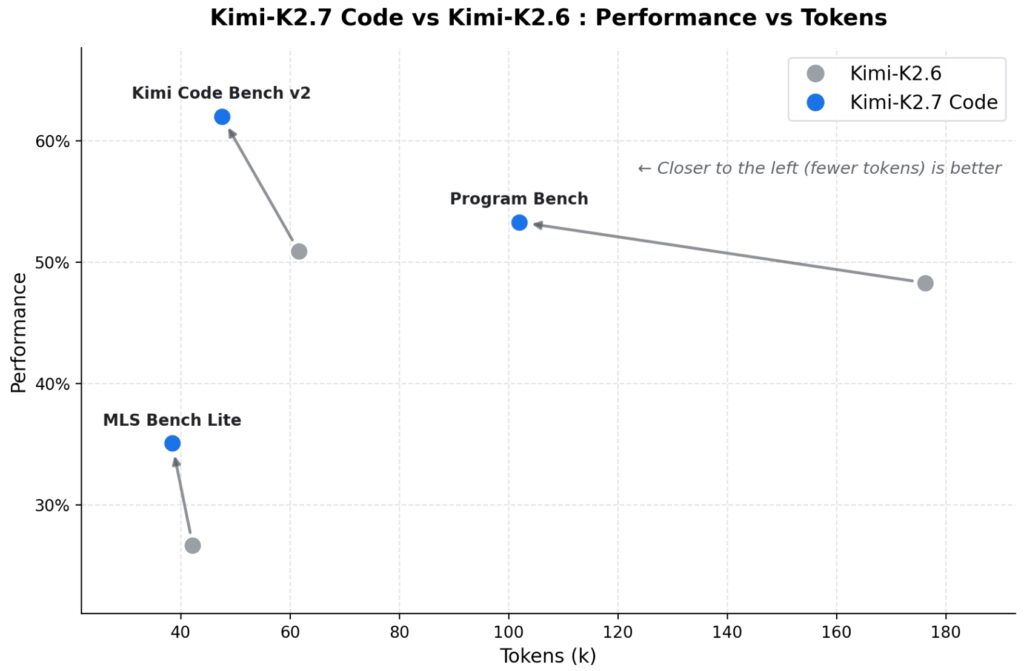
At the core of Kimi-K2.7-Code’s appeal is a staggering improvement in both performance and efficiency. Developers and engineers will notice a massive leap in benchmark testing, boasting a 21.8% increase on Kimi Code Bench v2, an 11.0% rise on Program Bench, and an impressive 31.5% surge on MLS Bench Lite compared to its predecessor. However, raw power is only half the story. The engineering team has successfully tackled the persistent issue of “overthinking” in large language models. By refining its reasoning efficiency, Kimi-K2.7-Code utilizes 30% fewer reasoning tokens than K2.6. This means the model reaches accurate, executable conclusions faster and cheaper, without wandering down unnecessary computational rabbit holes. Furthermore, users can look forward to a promised 6x High-Speed Mode, which is currently in development and slated for release soon.
What truly separates Kimi-K2.7-Code from traditional models is its uncompromising approach to continuous context, a necessity for true agentic behavior. The model strictly forces both a standard “thinking” state and a mandatory “preserve_thinking” mode, which cannot be disabled. This architectural choice is intentional; by retaining the full reasoning context across multi-turn interactions, the model drastically enhances its performance in complex coding agent scenarios. When combined with its inherited K2-Thinking design features—such as Interleaved Thinking and Multi-Step Tool Calls—the model demonstrates an unparalleled ability to follow intricate instructions and execute end-to-end software engineering tasks smoothly.
From a technical and deployment perspective, transitioning to Kimi-K2.7-Code is designed to be frictionless for current users. Because it shares the exact same underlying architecture as Kimi-K2.5 and Kimi-K2.6, existing deployment methods can be directly reused. It also adopts the same native INT4 quantization method found in Kimi-K2-Thinking, ensuring optimal hardware utilization. Developers ready to integrate the model simply need to ensure their HuggingFace transformers library is updated to a version between 4.57.1 and 5.0.0, with full deployment examples readily available in the official Model Deployment Guide.
When deploying the model into production, especially via third-party APIs using vLLM or SGLang, developers should note a few strict usage parameters designed to guarantee the model’s stability. To achieve the best results in its mandatory Thinking mode, the temperature should be set to 1.0, paired with a top_p value of 0.95. It is also important to note that traditional “Instant mode” is not supported by this architecture, as it fundamentally relies on its deep-reasoning loops. Additionally, while the model is pushing boundaries with new experimental features like chatting with video content, this specific capability remains exclusive to the official API for the time being. Ultimately, Kimi-K2.7-Code stands as a testament to the future of AI-assisted development, offering a smarter, more efficient, and deeply context-aware partner for the next generation of software engineering.