

How advanced dynamic quantization shrank Moonshot AI’s strongest open model by 62%, bringing frontier-level capabilities to consumer hardware.
- Frontier Intelligence at Home: Kimi K3, a massive 2.8-trillion parameter model rivaling top-tier proprietary AIs like Claude 4.8 Opus and GPT-5.6, can now be executed entirely locally on hardware as accessible as a Mac Studio.
- Revolutionary Compression: Through cutting-edge dynamic quantization, the model’s footprint was slashed by 62%—from a staggering 1.56 TB down to 594 GB—while impressively retaining approximately 78.9% of its top-1 accuracy in a 1-bit format.
- Unprecedented Multimodal Power: Built on a novel architecture featuring Kimi Delta Attention and Stable LatentMoE, the model excels in long-horizon coding, deep research, and native vision-in-the-loop tasks within a massive 1-million-token context window.
The landscape of open-weight artificial intelligence has just experienced a seismic shift. Moonshot AI has introduced Kimi K3, an absolute behemoth of a model boasting 2.8 trillion parameters with 104 billion active at any given time. Designed for state-of-the-art coding, agentic workflows, long-context comprehension, and dynamic chat workloads, it officially stands as the strongest open model to date. With capabilities that comfortably rival industry giants like Claude 4.8 Opus and GPT-5.6, Kimi K3 brings a 1-million-token context window and native vision to the table. Most remarkably, what was once thought impossible for a model of this magnitude—running it locally—is now a reality. Through rigorous quantization and engineering ingenuity, the barrier to entry for running the world’s first open 3T-class model has been dramatically lowered.
The secret to this newfound accessibility lies in aggressive, highly calibrated compression. In its full-precision MXFP4 format, Kimi K3 demands a massive 1.56 TB of storage, effectively gating it behind massive data centers. However, by leveraging Unsloth Dynamic GGUF, developers have managed to shrink the model by 62%, resulting in a 1-bit Kimi K3 that requires just 594 GB. This dynamic 1-bit quantization successfully retains about 78.9% of its top-1 accuracy, transforming it into a highly usable tool that can run on a Mac Studio equipped with 128GB RAM or an NVIDIA DGX Station. For those seeking slightly higher fidelity, the dynamic 2-bit version requires 861.3 GB (a 45% size reduction) and reaches roughly 90% accuracy. Engineers are still actively investigating ways to push the model under a strict 512 GiB threshold without causing irreparable damage to the neural network, noting that the raw dynamic 1-bit tensor data currently sits at 553.2 GiB.
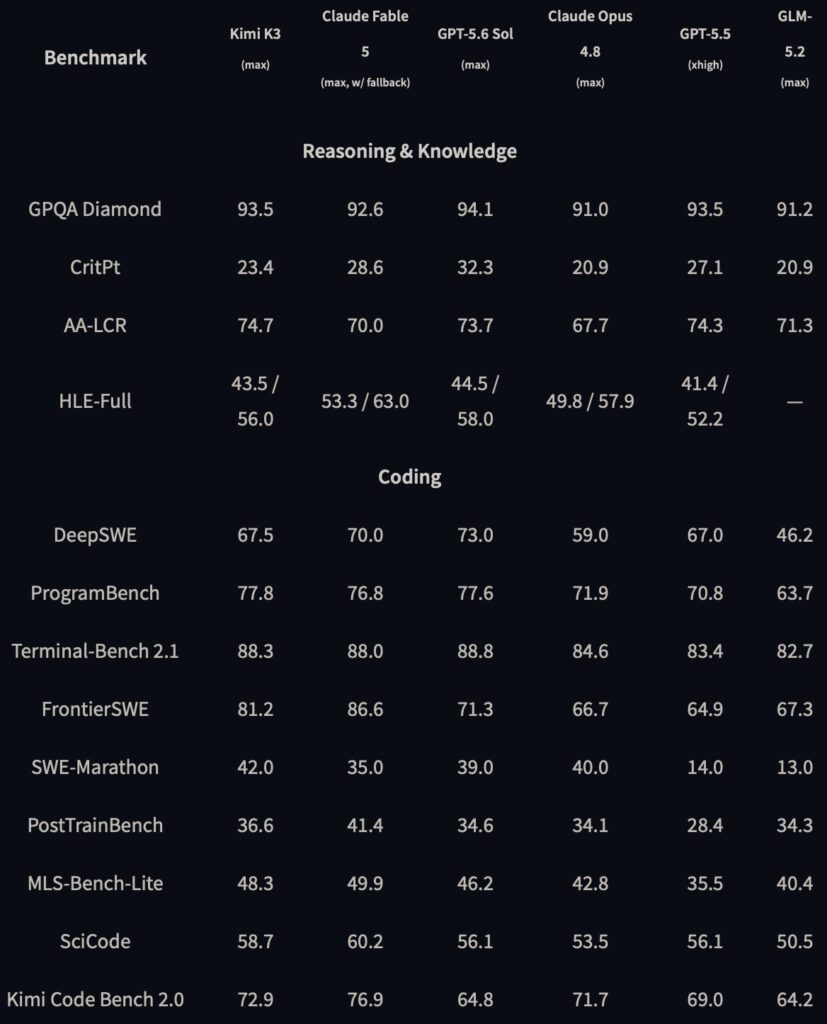
Under the hood, Kimi K3 is an architectural marvel. It moves away from standard designs by utilizing Kimi Delta Attention (KDA) and Attention Residuals (AttnRes), scaling up its Mixture of Experts (MoE) sparsity through a Stable LatentMoE framework. By activating only 16 out of 896 experts per token, it yields an approximate 2.5-fold improvement in overall scaling efficiency compared to its predecessor, Kimi K2. This architecture enables truly agentic knowledge work and long-horizon coding. Operating with minimal human oversight, Kimi K3 can sustain prolonged engineering sessions, navigate massive code repositories, and orchestrate terminal tools. Its capabilities span from intricate GPU kernel optimization and compiler development to CAD, chip design, and vision-in-the-loop game development. Furthermore, its native multimodality means it inherently understands text, images, and video simultaneously, allowing it to produce deep research complete with interactive dashboards, motion design, and video editing.
Bringing this powerhouse to a local environment required significant implementation breakthroughs, specifically by building upon a specialized fork of llama.cpp that includes crucial bug fixes and native vision support. The mmproj (vision tower) functions similarly to the Kimi-K2.5 tower but introduces key modifications: it uses RMSNorm, drops biases, employs a non-square fused QKV (where the QKV width does not equal n_embd), and relies on a post-norm projector. During the porting process, developers discovered that standard memory budgets failed under large batch sizes, necessitating an increase from the standard n_tokens * 40 budget to n_tokens * 160. The Kimi chat template was also converted to a Jinja format for wider compatibility. Crucially, Kimi K3 is trained by default with its “preserved thinking” enabled, meaning all internal reasoning traces are kept intact and rendered during inference, rather than being deleted.
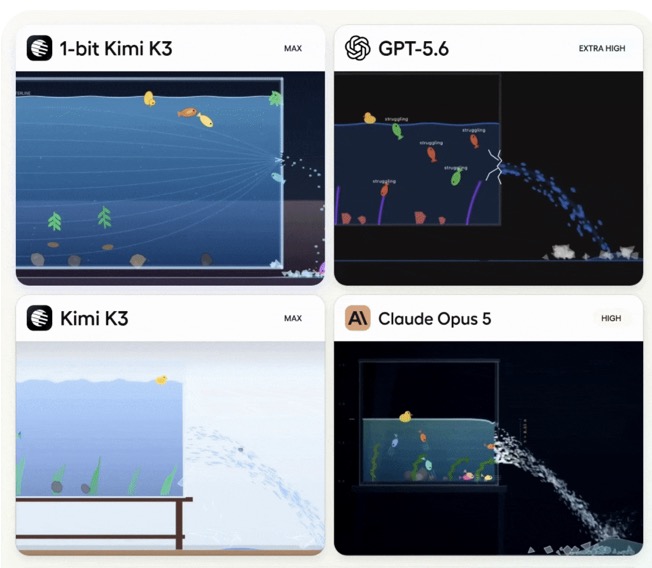
The success of this local deployment is a testament to the supremacy of dynamic quantization over older, static methods. Like the K2.6 and K2.7 models, Kimi K3’s UD-Q8_K_XL quantization is virtually lossless. This is because Kimi naturally uses MXFP4 for its MoE weights and BF16 for everything else, a structure that the Q8_K_XL format mirrors exactly. During calibration, this 1.56 TB lossless model achieved a perplexity of 1.4581. The resulting dynamic 1-bit quantization impressively maintained a perplexity of just 2.58. The importance of proper calibration becomes glaringly obvious when compared to other community-driven quants. For instance, a community IQ1_M quant sits at a larger 618.9 GB but sees its perplexity skyrocket to 54.56—a 21-fold degradation compared to the Unsloth dynamic version. The pattern continues with the 2-bit IQ2_XXS, which balloons to 725 GB with a perplexity of 96, performing 45 times worse than the properly calibrated dynamic model (which boasts a 2.12 PPL at 711 GB). By releasing the full model weights under the Kimi K3 License, Moonshot AI has not only pushed the boundaries of frontier intelligence but, through the power of advanced quantization, has delivered it directly to the hands of the open-source community.