

With free access to premium features, direct links to state standards, and strict privacy protections, “Claude for Teachers” hopes to shift the focus from endless prep work back to student engagement.
- Free Premium Access: Verified K-12 educators in the U.S. can now utilize premium Claude AI features at no cost, specifically designed to automate time-consuming lesson planning and administrative tasks.
- Curriculum & Ecosystem Integration: The platform links directly to all 50 states’ academic standards and integrates seamlessly with popular K-12 ed-tech tools, allowing teachers to instantly generate aligned, highly differentiated classroom materials.
- Strict Privacy Standards: Backed by partnerships with major educational organizations, the tool complies with FERPA regulations and strictly prohibits the use of any teacher or student data for AI model training.
For decades, educational research has consistently pointed to the same foundational truths: practices like differentiated instruction, mastery-based learning, and small-group attention are the most reliable ways to improve student achievement. Yet, the modern educational landscape rarely affords teachers the time or resources to implement these strategies effectively. Faced with stretched budgets, oversized classrooms, and planning periods that inevitably spill over into late evenings, educators—especially those in under-resourced schools—are experiencing unprecedented levels of burnout.
In a bid to close the persistent gap between educational best practices and the reality of a teacher’s grueling weekly schedule, Anthropic has unveiled “Claude for Teachers.” The newly launched initiative provides verified K-12 educators in the United States with free access to premium Claude capabilities, a comprehensive library of teaching skills, and a direct connection to evidence-based curricula. The stated goal of the platform is simple: support the intricate craft of teaching while protecting the time educators value most—the hours spent directly with their students.
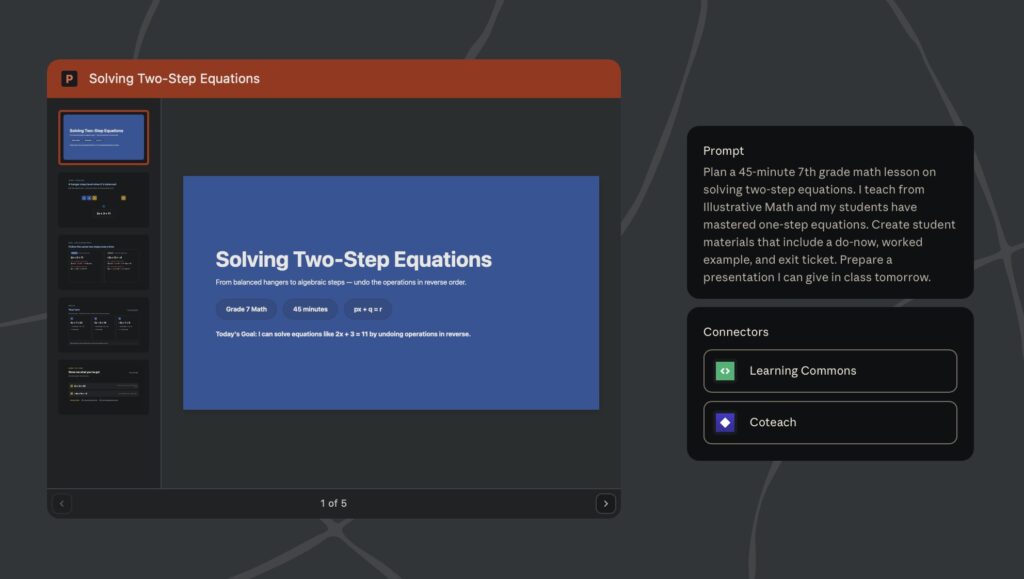
What separates this rollout from a standard AI chatbot is its deep integration into the existing K-12 ecosystem. Through a connection to Learning Commons, Claude has been granted access to academic standards across all 50 states. It understands not just the broad standards, but the specific, granular learning competencies and typical progressions that build up to them. When a teacher asks the platform to draft a lesson plan, the AI draws upon trusted, evidence-based curricular resources like OpenSciEd and Illustrative Mathematics (IM v.360) to ensure the output is rigorous, scaffolded, and fully aligned with local teaching standards.
Furthermore, the launch brings Claude into a massive ecosystem of specialized educational tools. Teachers can now connect the AI to platforms like ASSISTments to generate auto-scored math problems, Brisk Teaching for interactive activities, and Canva Education to turn lesson materials into visually engaging designs. Other integrated tools include Coteach for math diagrams, Diffit for adapting instructional materials, Eedi for diagnostic questioning in English and Spanish, MagicSchool, Snorkl for student progress insights, and TeachFX for personalized instructional feedback.
The practical applications of the platform were refined through early feedback from classroom educators, including those at Prospect Schools in Brooklyn. The resulting toolset allows teachers to easily plan lessons from high-quality materials and immediately differentiate them for every learner in the room. A teacher can simply ask Claude to adapt a reading passage or worksheet for various readiness levels, and the system will produce a differentiation plan along with personalized materials that scaffold struggling students while appropriately challenging advanced ones.
Perhaps the most futuristic elements of the rollout are the inclusion of “Claude Code” and “Cowork,” features that allow the AI to carry work forward autonomously. Teachers can hand the system a secure folder of class data—such as rosters, diagnostics, attendance records, and personal notes—and Claude will build a comprehensive picture of student progress to help tailor future instruction. Furthermore, educators can schedule repeated tasks. For instance, a teacher could instruct Claude to review the day’s exit tickets every afternoon at 4:00 PM to assess student mastery, automatically adapting the next day’s lesson plan while the teacher commutes home.

Naturally, the introduction of autonomous AI into the classroom raises immediate concerns regarding student data privacy. Anthropic has addressed this by ensuring Claude for Teachers operates strictly for educators, maintaining the company’s 18-and-over policy. The platform operates under its own K-12 Data Processing Addendum written to comply with FERPA guidelines. Crucially, the company guarantees that no data shared by teachers—including student information—is ever used to train their AI models.
This robust approach to privacy has garnered the support of the American Federation of Teachers (AFT). Randi Weingarten, President of the AFT, noted that the union has been working with Anthropic on a “Gold Standard” of industry best practices for K-12 safety and privacy. “It’s important that Anthropic is committing to these principles in their new Claude for Teachers,” Weingarten stated, emphasizing that the tool is designed by and for educators to give them more time for the vital human relationships at the heart of learning.
Beyond the software itself, the rollout is accompanied by public goods aimed at fostering broader AI literacy. A newly released “AI Fluency for PK-12 Teachers” course, co-created with Teach For America, and a train-the-trainer module developed with the AFT, offer model-agnostic, practical guidance on how to use AI responsibly.
Anthropic is also open-sourcing its repository of teaching skills and partnering with the Gates Foundation to co-develop tools that improve educational outcomes. Moving forward, the company plans to pilot an evaluation of the platform in the Detroit Public Schools Community District to study its real-world impact on educator wellbeing. Meanwhile, Playlab will support a national network of lab schools to help educators transition from merely consuming AI tools to actively building the ones used in their classrooms.
If early evidence holds true—that AI tools for teachers can significantly strengthen instructional practice—initiatives like this may finally offer educators a way to cut through the administrative noise and get back to why they started teaching in the first place.