

By abandoning bloated 100,000-chunk vocabularies in favor of 256 raw bytes, Meta’s new models aren’t just surviving—they’re dominating state-of-the-art AI.
- – The Token Era is Ending: Meta’s new research proves that forcing AI to process raw bytes (a vocabulary of just 256 values) ultimately surpasses the performance of traditional, heavily optimized token-based models.
- – David Beats Goliath: Distilled 1-billion-parameter byte models asymptotically outperform state-of-the-art models like Llama 3.2-1B and Gemma-3-1B, matching traditional model performance using just one-sixth of the training data.
- – A Structural Revolution: By introducing an exact “End-Of-Token” conversion method, Meta slashed logit storage costs to roughly one-fifth and eliminated the need for complex top-k truncation, fundamentally changing how we build, train, and deploy language models.
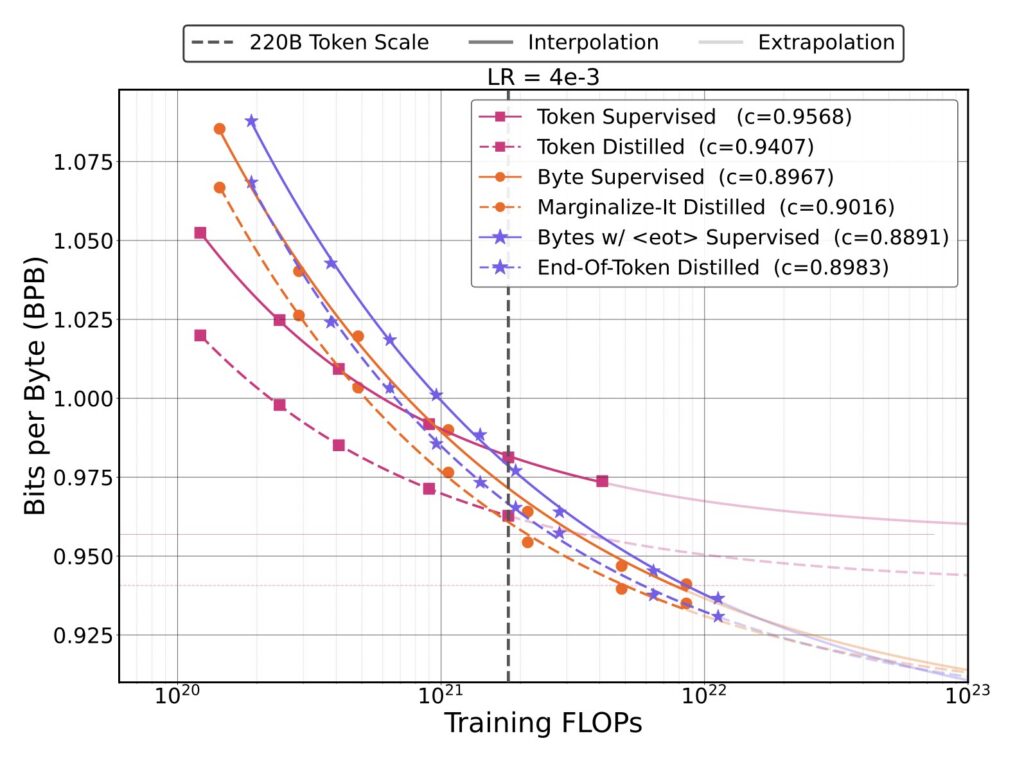
For the past five years, the artificial intelligence industry has been obsessively optimizing a fundamental speed limit: the tokenizer. Every major AI model you use today—from ChatGPT to Claude to Gemini—reads text exactly the same way. It chops your words into arbitrary chunks called tokens, relying on a massive, bloated vocabulary of around 100,000 specific pieces just to understand a basic sentence.
We assumed this was the only viable way to build language models. We were wrong.
Meta recently published a groundbreaking paper titled “Breaking the Token Ceiling,” and it threatens to end the current LLM era entirely. By ditching tokens and forcing the AI to process raw bytes—reducing the vocabulary to a mere 256 fundamental values—Meta has rewritten the rules of model efficiency, data scaling, and artificial intelligence architectures.
The Problem with Tokens
Until now, scaling laws in deep learning suggested that models needed these vast, pre-packaged text chunks to learn efficiently. Operating over raw bytes was considered computationally expensive and practically inferior.
Meta challenged this by conducting the first large-scale study of overtraining decoder-only dense transformer models, varying both the tokenization scheme and the training objective. They pushed layer-parameter-matched models with roughly 1 billion parameters up to 1 trillion bytes of data. The results were clear: the bottleneck wasn’t the intelligence of the neural network. It was the tokenizer acting as a crutch, preventing models from learning the fundamental relationships between raw data.
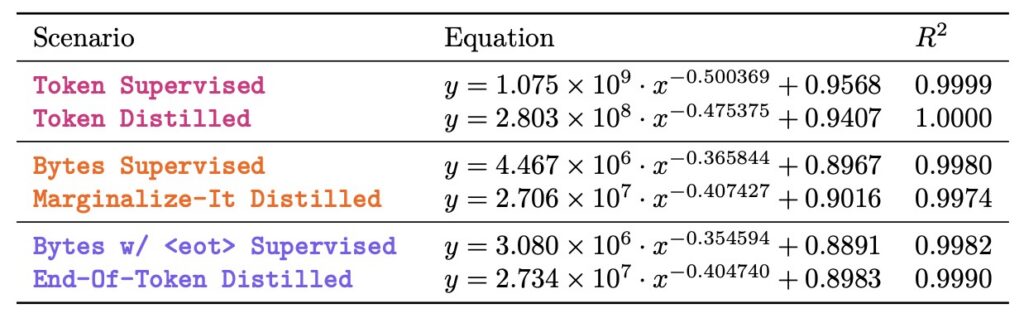
The Distillation Secret: Marginalize-It vs. End-Of-Token
To make this transition work, small byte models were made more capable through distillation—learning from a larger model that shares a tokenization scheme. But how do you translate token knowledge into byte knowledge?
Meta introduced two efficient variants to convert token logits to Byte Logits:
- Marginalize-It: An approximate method that marginalizes prefix-matched token distributions.
- End-Of-Token: An exact method that perfectly preserves the teacher’s distribution by injecting a special
<eot>token into the vocabulary and sequences.
The models tested featured distinct vocabulary sizes: 128,256 for the traditional Token-1B, 260 for standard Bytes-1B, and 261 for the End-Of-Token-1B.
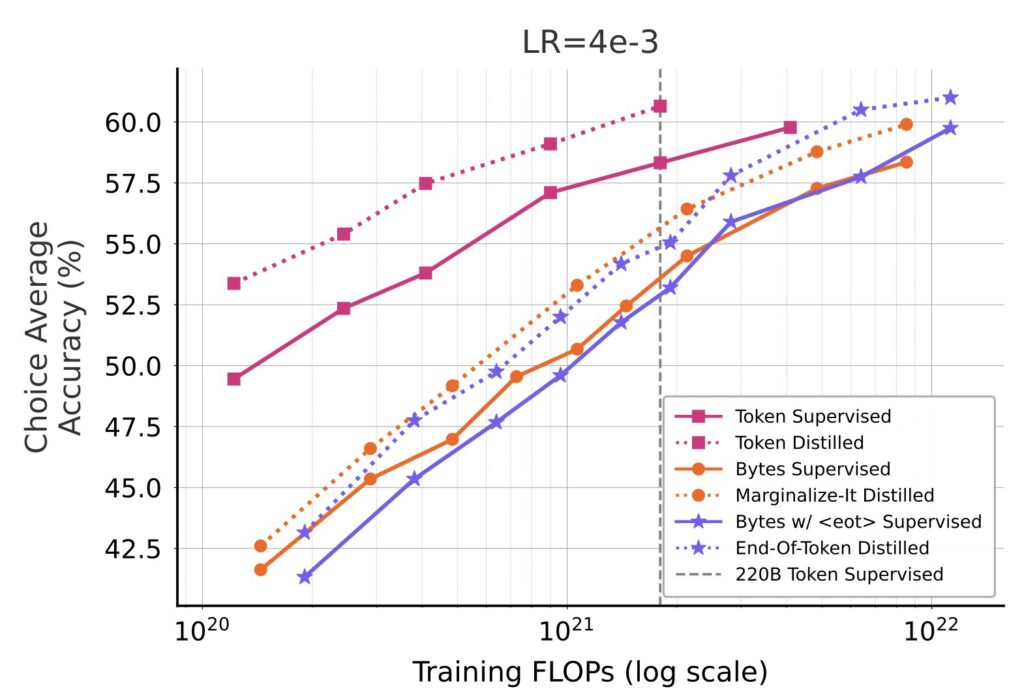
The Performance Flip
When evaluated across eight benchmarks spanning Multiple Choice QA, Language Generation, and Machine Translation, a fascinating scaling trend emerged. In the low-FLOP (compute) regime, the traditional Token-1B model outperformed the byte models. However, token models eventually hit a rigid performance plateau.
Byte models, while starting slower, proved to be late bloomers with a vastly higher ceiling. As compute scaled, distilled byte models surpassed the Token-1B models. Meta’s scaling laws predict that, asymptotically, the distilled End-Of-Token-1B outperforms its token-based counterpart by up to 4% on averaged downstream task performance.
The secret sauce lies in the sequence length. By adding an <eot> token every roughly 4.5 bytes, the model spends about 30.94% additional compute on a fixed amount of data. This increased sequence length at a fixed context allows the model to deeply internalize the structural relationships of the data.
Doing More with Less
The efficiency gains of this byte-level approach are staggering. Meta’s distilled byte models proved to be far more data-efficient, matching the performance of a distilled Token-1B model using only one-sixth of the training data.
Furthermore, the engineering overhead plummets. Operating over a tiny vocabulary of roughly 256 bytes instead of 100,000 tokens completely circumvents the need for top-k truncation during logit dumping. It also reduces logit storage costs to roughly one-fifth of traditional requirements.
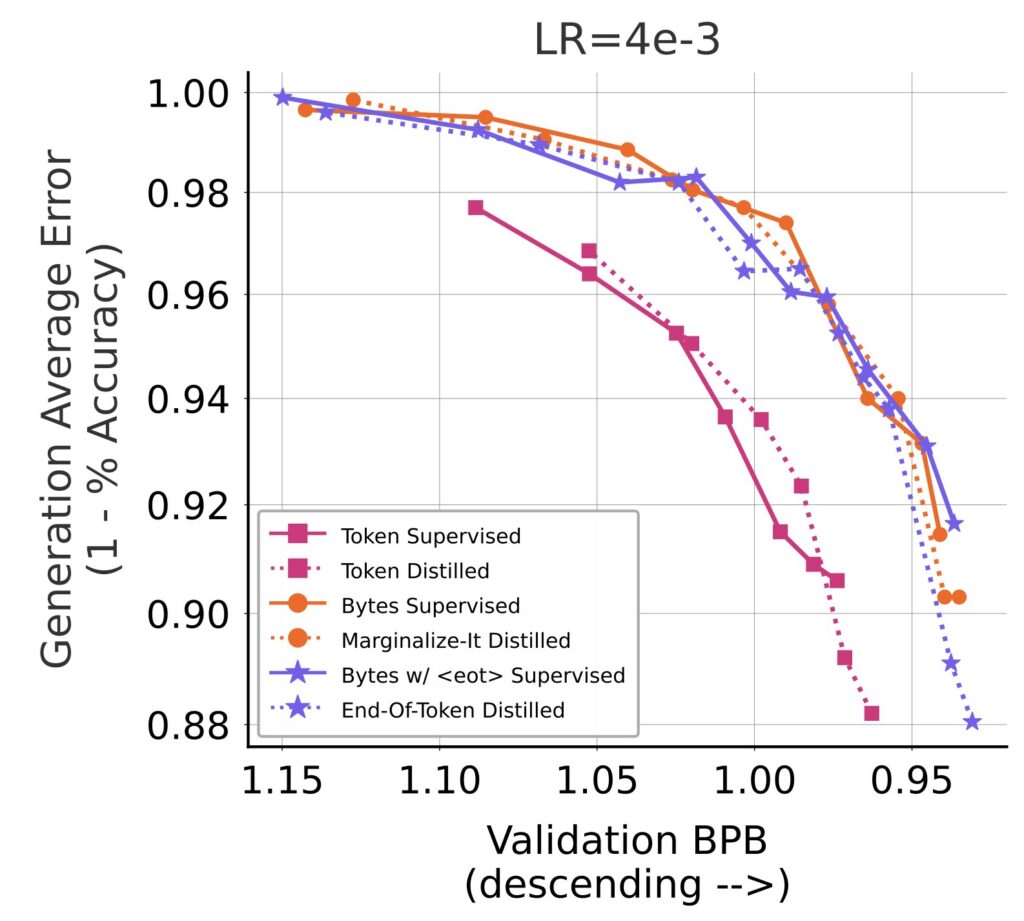
Toppling the Giants
The implications of “Breaking the Token Ceiling” extend far beyond theoretical scaling laws. When extrapolated, Meta’s downstream performance scaling laws predict that their distilled End-Of-Token-1B models asymptotically surpass current state-of-the-art token models in the 1-to-2-billion parameter class.
The models are projected to beat Llama 3.2-1B by up to 6.5%, Gemma-3-1B-pt by 8.1%, and Gemma 2B by 2.1% on averaged downstream tasks.
By forcing the model to actually learn the fundamental relationships between raw data instead of relying on pre-packaged text chunks, Meta has unlocked a new paradigm. The tokenizer is no longer a necessity; it is legacy tech. For developers, researchers, and anyone deploying AI, the future isn’t in parsing words. The future is in the bytes.