

OpenAI’s newest models deliver the groundbreaking intelligence of Astra at a fraction of the cost, making advanced AI practical for everyday workflows.
- Scalable Intelligence: Sol and Luna inherit the cutting-edge architecture of GPT‑6 Astra, bringing state-of-the-art capabilities in reasoning, coding, and factuality to faster, more affordable tiers.
- Unmatched Cost Efficiency: With a 50% price reduction from GPT‑5.6 and massive savings compared to competitors, the new models dominate professional benchmarks—often outperforming rivals like Claude for pennies on the dollar.
- Enhanced Developer Experience: Major upgrades to prompt caching, a refined, jargon-free communication style, and tighter safety alignment make these models vastly more efficient to build upon at scale.
Earlier this month, the tech world was introduced to GPT‑6 Astra, an uncompromising flagship model that redefined the boundaries of artificial intelligence. But while Astra is the undisputed heavyweight champion for humanity’s most demanding projects, not every task requires a sledgehammer. Work happens at different rhythms, scales, and budgets. Recognizing this reality, the GPT‑6 universe is expanding. Enter GPT‑6 Sol and Luna: a new generation of models designed to distribute the immense benefits of frontier intelligence by pushing the absolute limits of cost efficiency. Trained using the same methods that gave Astra its state-of-the-art prowess, Sol and Luna bring elite capabilities in professional workflows, factuality, coding, and computer use directly to the everyday user.
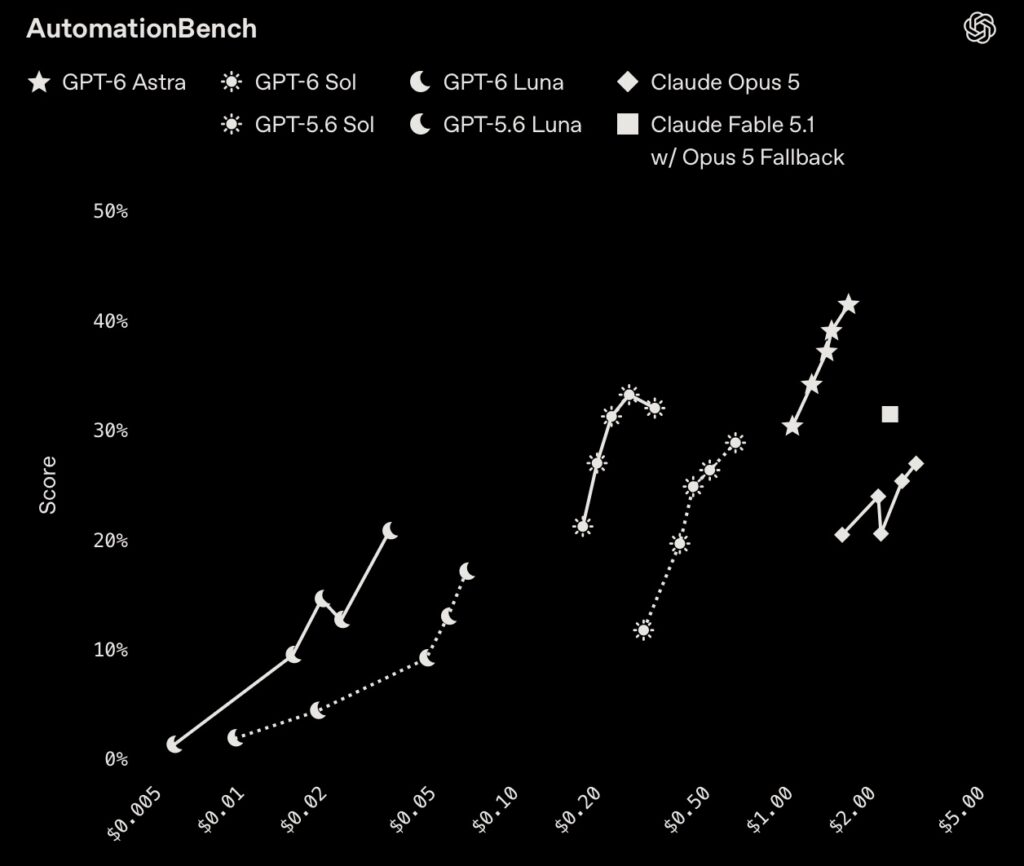
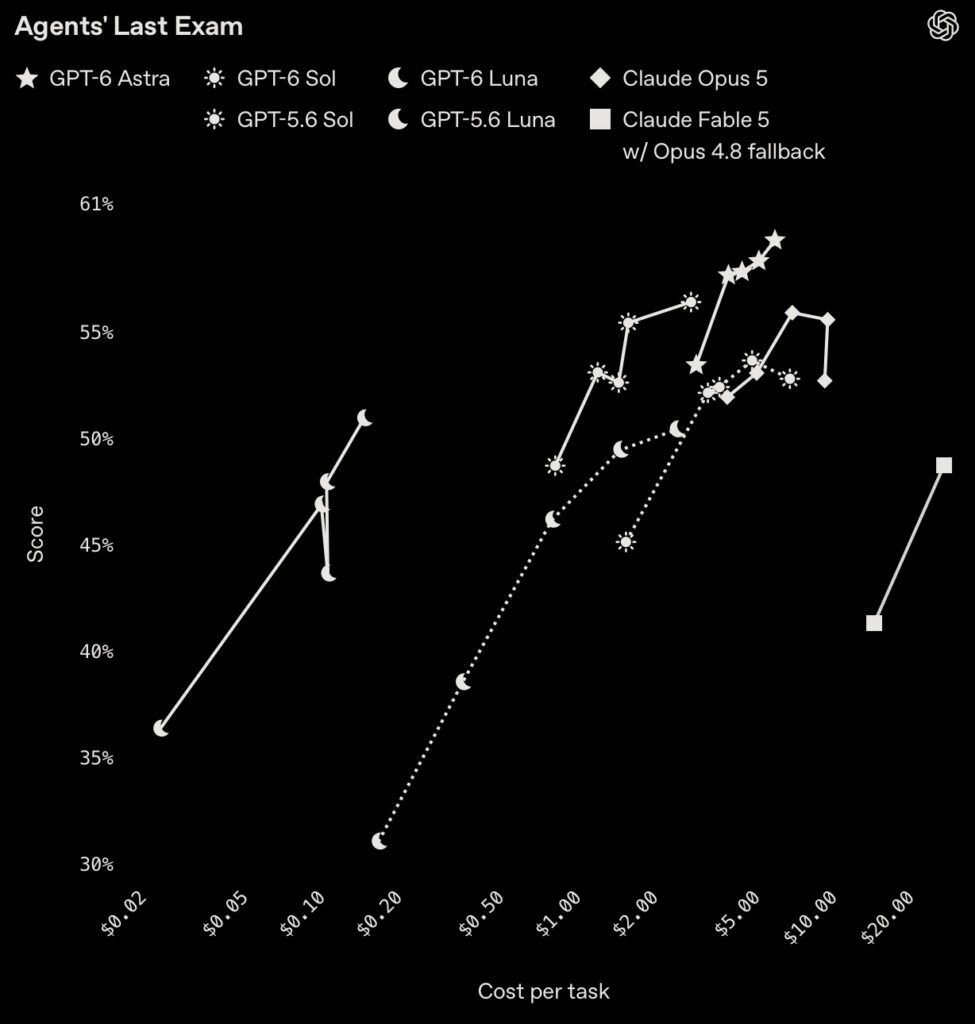
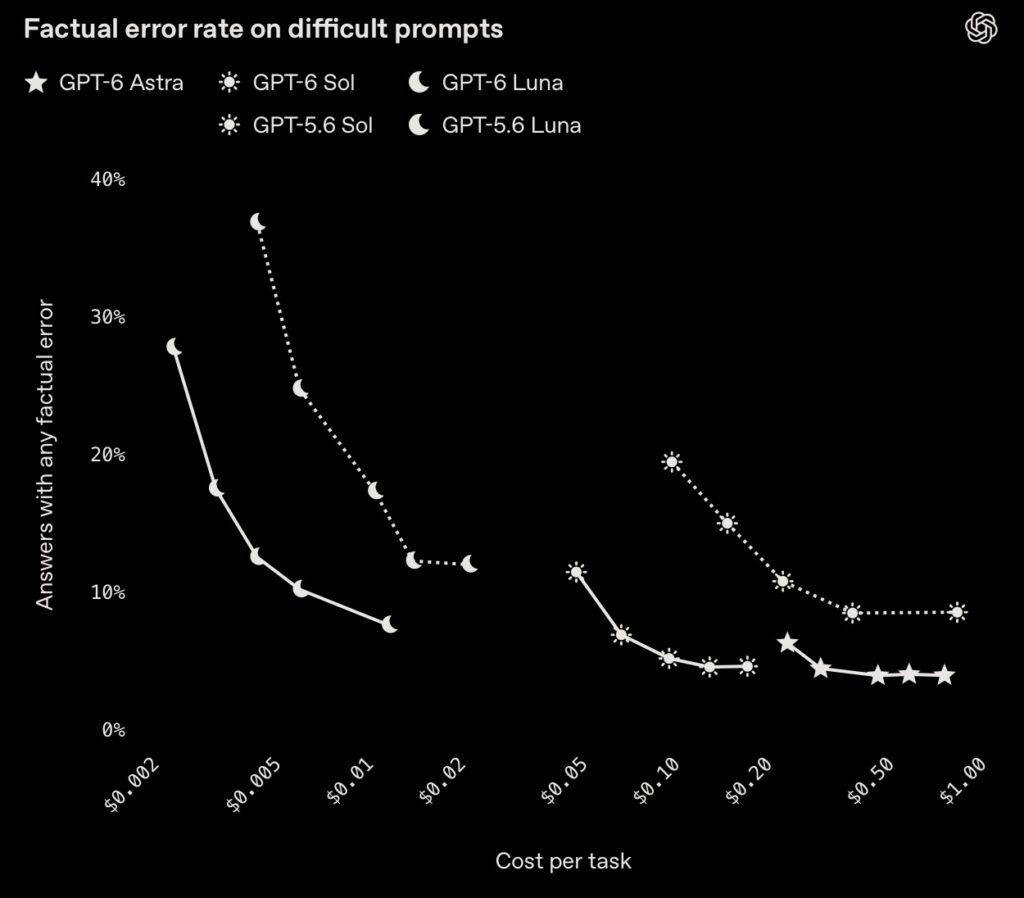
The true magic of Sol and Luna lies in their unprecedented position on the cost-intelligence curve. Through significant improvements in inference and caching infrastructure, these models are being served at radically lower costs—savings that are passed straight to users via a 50% reduction in API prices compared to GPT‑5.6 promotional rates. In professional environments, GPT‑6 Sol effortlessly tackles complex business workflows. On the AutomationBench evaluation, Sol operating at high effort outright outperforms Claude Opus 5 (at max effort) for just 9% of the cost per task. Meanwhile, Luna improves upon its predecessor by 5.4 percentage points while slashing costs by 58%. Whether evaluating agents on Agents’ Last Exam—where Sol easily bests Opus 5 for 60% less money—or measuring factual reliability, the results are staggering. Sol approaches Astra-level factuality by making half as many mistakes as previous generations, while Luna achieves GPT‑5.6 Sol’s reliability for a mere hundredth of the cost.
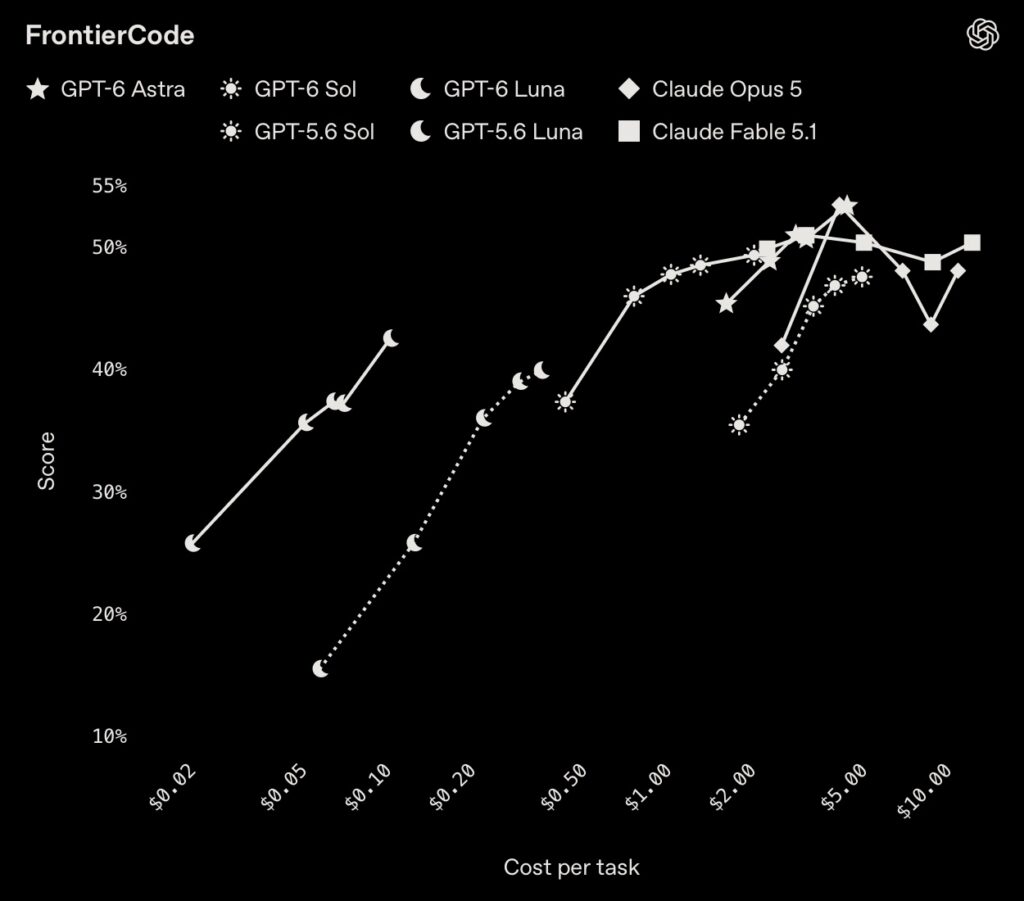
Nowhere is this cost-efficiency more critical than in software development. As coding agents take on tasks of increasing complexity and duration, token usage has skyrocketed; internal metrics show daily usage exceeding $7,000 for top-percentile researchers. Sol and Luna solve this bottleneck by combining formidable coding performance with aggressive pricing, giving development teams the financial runway to be highly ambitious. On FrontierCode, Sol matches Claude Fable 5.1 at a fraction of the price. In real-world software engineering tests like DeepSWE v1.1, a maximum-effort Sol scores within a hair (1.1 percentage points) of Claude Fable 5’s absolute best, but costs approximately 80% less per task. Luna also goes toe-to-toe with medium-effort Claude Opus 5 and Fable 5, delivering comparable scores for 93% to 96% less cost. This dynamic extends seamlessly into computer use capabilities, where Sol matches Opus 5’s OSWorld 2.0 offline performance for 80% less money, and Luna exceeds GPT‑5.6 Sol for a tenth of the price.
Beyond raw numbers, the day-to-day experience of interacting with these models has been vastly refined. Inheriting Astra’s polished collaboration style, Sol and Luna offer technical conversations characterized by enhanced clarity, reduced jargon, and an absence of low-value filler—resulting in punchier, more substantial answers. For developers, the financial and operational friction of managing long context windows has been heavily mitigated through breakthrough caching features. A generous 90% discount on cached input-token reads is now supported by intuitive tools, including a new Prompt Caching Dashboard and advanced diagnostics. Developers can now adjust reasoning effort and toggle tool availability mid-task without breaking the cache, or use explicit breakpoints to precisely control cache reuse. These aren’t just theoretical perks; platforms like GitHub report that these very improvements have slashed the need for fresh token processing by over 50% across billions of Copilot requests.
Underpinning this explosive leap in accessibility is a steadfast commitment to safety. Sol and Luna build upon the robust alignment frameworks pioneered by Astra, demonstrating marked improvements over their GPT‑5.6 counterparts—most notably by reducing the rate of misleading claims during complex coding tasks. By successfully scaling the intellectual heights of a flagship model down to highly affordable, lightning-fast tiers, the AI landscape has fundamentally shifted. GPT‑6 Astra remains the uncompromising titan for those who need it, but Sol and Luna ensure that frontier-level intelligence is no longer a luxury. It is the new, brilliantly efficient standard for the work we do every single day.