

How the invisible pathways connecting text, audio, and video in modern diffusion models create “semantic leakage”—and how researchers are learning to steer them.
- The “Attention Triangle” Dilemma: In modern audio-video AI models, text, sound, and visual content are coordinated through a three-way cross-attention mechanism. While powerful, this soft mixing of data causes “semantic leakage,” where attributes unintentionally blend and spread beyond their intended targets.
- The Audio-Video Vulnerability: Research identifies the bidirectional link between audio and video as a primary culprit for errors. Because audio data encodes time but not physical space, models rely heavily on ingrained biases, often overriding user text prompts to produce stereotypical, yet incorrect, visuals.
- The “Attention Lesson” and Its Solution: Counterintuitively, strengthening cross-modal connections can actually amplify bias. However, by extracting and manipulating attention signals at generation time, researchers can diagnose these misalignments and intervene, improving the AI’s accuracy without sacrificing video quality.

Recent breakthroughs in artificial intelligence, particularly driven by Diffusion Transformers (DiT), have unlocked astonishing capabilities in media generation. At the heart of these models is “attention”—a central architectural mechanism that acts as the brain’s switchboard. By leveraging cross-attention, these models can take conditional signals, like a text prompt, and weave them into an evolving visual representation. This process captures semantic associations and propagates them throughout the denoising phase, resulting in highly expressive and compositional generation. However, this same brilliant mechanism harbors a fundamental flaw: it mixes information softly and globally. Without strict boundaries or exclusivity constraints, details can easily bleed into one another.
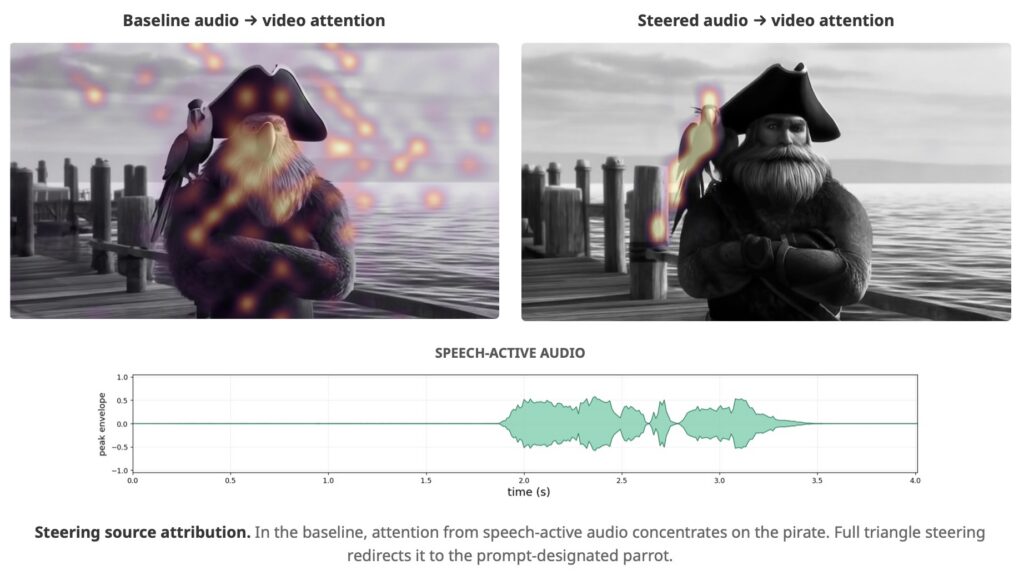
This bleeding effect, known as semantic leakage, produces attribute entanglement and unstable bindings over time. If you ask an AI to generate a video of a blue car honking and a red dog barking, the model’s global attention might accidentally give you a red car or a barking machine. These limitations become exponentially more complex in the realm of audio-video generation, where the AI isn’t just matching text to an image, but jointly mediating a delicate dance between text, audio, and video modalities.
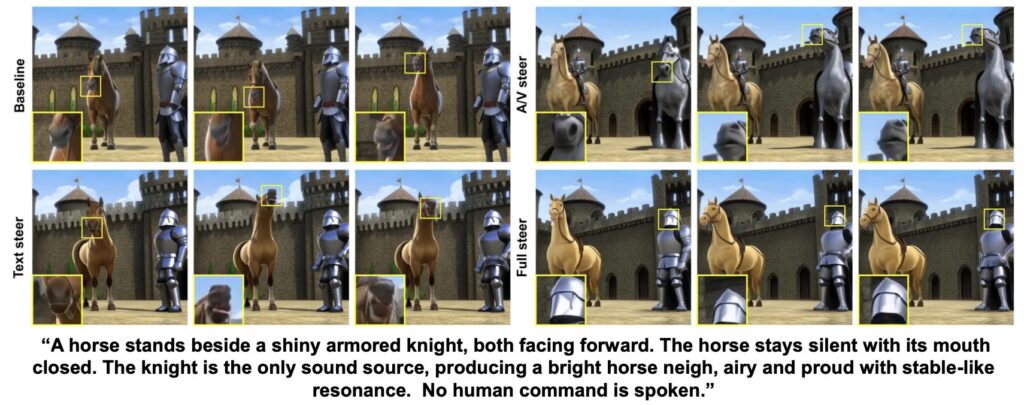
This tri-modal ecosystem can be conceptualized as the “attention triangle.” In this intricate web, the three streams—text, audio, and video—are connected by cross-attention edges. Each modality continuously influences and constrains the others. Unlike simpler bimodal generation (like text-to-image), alignment here is no longer a straightforward pairwise matching. Instead, the model is tasked with a Herculean balancing act: it must reconcile the user’s semantic intent from the text prompt, respect the temporal rhythm and structure of the audio, and seamlessly manifest both into a spatiotemporal reality on video. Because these constraints are tightly coupled, they often produce competing signals. One modality might dominate the others, or associations might become entangled, allowing an entirely different, incorrect interpretation to propagate through the attention network and shatter the global consistency of the output.
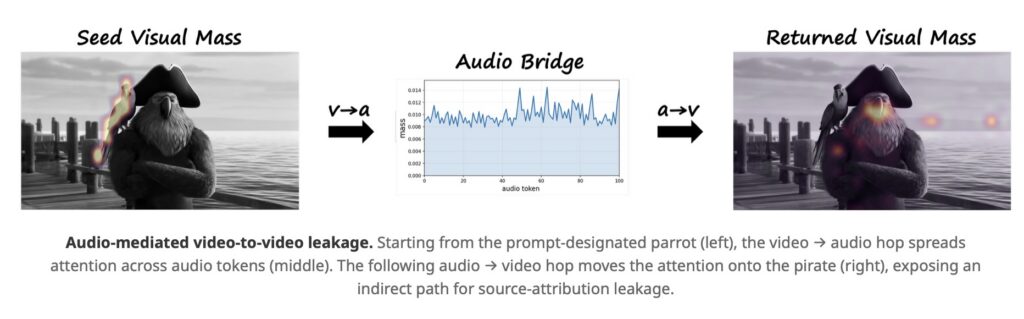
When probing the internal dynamics of this attention triangle, particularly within models like LTX-2, researchers have uncovered a fascinating vulnerability. The most volatile pathway is the audio-video edge. Analysis reveals that routing along this specific edge is deeply bidirectional: the audio stream actively shapes how the video is generated, while the video simultaneously alters the generation of the audio. This pathway emerges as a major contributor to semantic leakage. Why does this happen? The vulnerability stems partly from a fundamental mismatch in how the data is structured. Audio tokens inherently encode temporal position—they know when a sound happens—but they lack spatial position; they do not know where the sound is coming from.
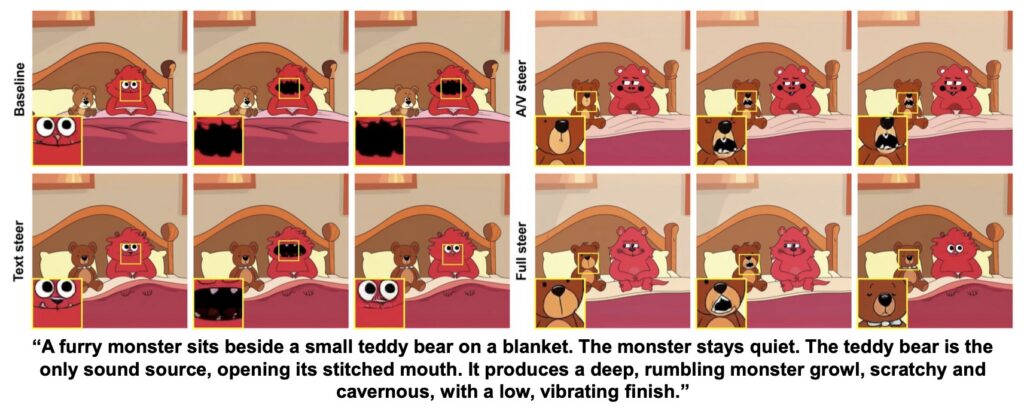
Because sound-source localization is left underconstrained, the model panics and falls back on its learned priors, or biases. When a user’s text prompt is in tension with what the AI considers “normal” based on its training data, these cross-modal interactions will often override the user’s intended instructions. The AI essentially reroutes the semantics toward a visually canonical, stereotypical outcome that it feels more comfortable with, even if it is factually incorrect based on the prompt. This reveals a critical insight: semantic artifacts are not just random glitches caused by attention spreading too thin. They are the result of structured, bias-driven interactions flowing along specific pathways.
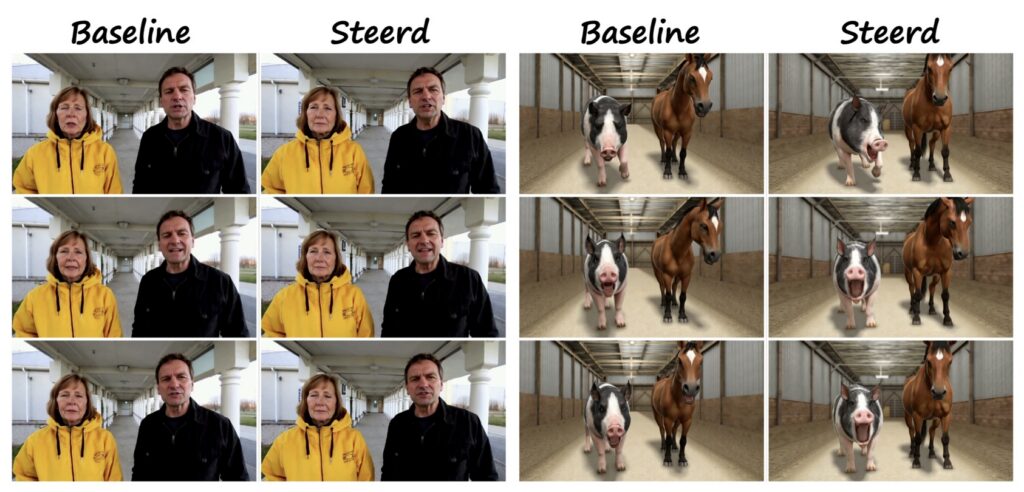
This phenomenon gives rise to what researchers call the “Attention Lesson.” We might intuitively assume that forcing tighter integration between text, audio, and video would solve these alignment issues. In reality, strengthening cross-modal coupling through attention can actually amplify bias-driven routing rather than resolve it, providing new, unintended routes for learned priors to hijack the generation process.
Fortunately, identifying this vulnerability is the first step toward fixing it. Building on this new perspective, researchers can now extract attention-derived signals that expose exactly how semantics are being distributed and grounded across the different modalities. This acts as a powerful diagnostic tool. By analyzing these signals, developers can deliberately trigger leakage under controlled conditions to study the internal dynamics of cross-modal routing and isolate the exact role of individual interactions. More importantly, these signals can be leveraged to guide inference-time interventions. By steering the attention mechanism while the video is being generated, researchers can encourage far more consistent cross-modal alignment, forcing the model to respect the text prompt over its own biases. Extensive experiments have proven that this approach significantly improves semantic grounding while perfectly preserving the high quality of the generated media.
This exploration of the attention triangle opens exciting new frontiers for generative AI. While the current evidence clearly establishes the vulnerabilities of the audio-video pathway in multi-stream architectures, future work will need to test these mechanisms further. Solutions may lie in developing spatial or pseudo-spatial audio representations that finally give sound a physical location in the AI’s mind, or in applying stronger grounding supervision during training. Furthermore, researchers must determine whether these same leakage patterns—and their ingenious interventions—transfer to single-stream architectures that process all modalities within a shared self-attention pool. As we continue to untangle the attention triangle, the dream of perfectly synchronized, fiercely accurate text-to-audio-video generation moves ever closer to reality.