
By allowing AI to rewrite its own operational code at test time, researchers are unlocking a new era of generalizable, self-improving language models.
- A New Paradigm for AI Workflows: “Harness learning” introduces a dual-model system where a “proposer” model actively rewrites the executable program (the harness) of a “solver” model based on real-time task feedback.
- Adaptation Without Retraining: This framework achieves true test-time adaptation, allowing an AI to dynamically improve its logic and tool use on entirely unseen tasks without altering any internal parameters or undergoing expensive weight updates.
- Punching Above Its Weight: The approach is highly efficient; through reinforcement learning, a compact 4B-parameter proposer model more than doubled its baseline performance, ultimately outperforming its massive 35B-parameter teacher in complex reasoning tasks.
When we interact with a modern language model agent, we are not just speaking to a neural network; we are engaging with a dual entity. An AI agent is defined both by its core model—the statistical brain generating text—and its “harness.” The harness is the executable program that organizes the model’s calls, dictates how it uses external tools, and manages the intricate flow of information. Historically, developers have hard-coded this harness, assuming a one-size-fits-all structure. However, because different tasks fundamentally require different ways of organizing these operations, a static workflow quickly becomes a bottleneck. To build truly generalizable AI, the harness itself needs to adapt dynamically using real-time feedback from the task at hand.
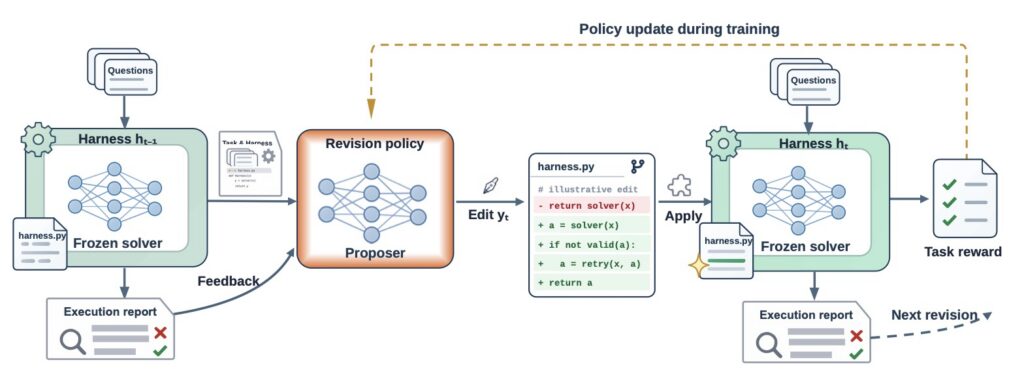
Enter the concept of harness learning, a breakthrough methodology that trains a specialized “proposer” model to actively revise a “solver’s” harness using execution feedback. Instead of treating the AI as a static piece of software, this process is formulated as meta-learning over executable programs. In this framework, the physical revisions made to the harness code play the exact same role that weight updates play in traditional gradient-based adaptation. The proposer is trained utilizing reinforcement learning, where the ultimate reward is simply the real-world task performance of the newly revised harnesses.
The true magic of harness learning reveals itself at test time. When faced with an entirely new, unseen task, the proposer uses the feedback generated from successive executions to refine and debug the harness. Crucially, it accomplishes this feat without performing a single parameter-space update. Both the proposer and the solver operate with fixed parameters, yet the system as a whole learns, adapts, and overcomes novel obstacles simply by rewriting its own operational instructions.
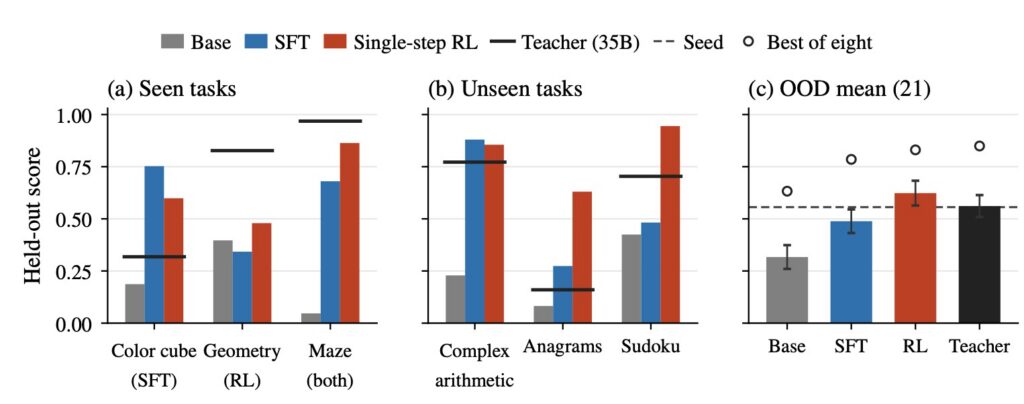
The empirical evidence supporting this approach is striking. Researchers put harness learning to the test across highly complex reasoning and multi-hop question-answering challenges. On 21 unseen Reasoning Gym families, applying Supervised Fine-Tuning (SFT) followed by Reinforcement Learning (RL) yielded massive improvements. The mean single-step revision scores skyrocketed from 0.32 with a base proposer to 0.62. Remarkably, a trained 4B-parameter proposer achieved such high proficiency in rewriting code that it outperformed its 35B-parameter teacher on average.
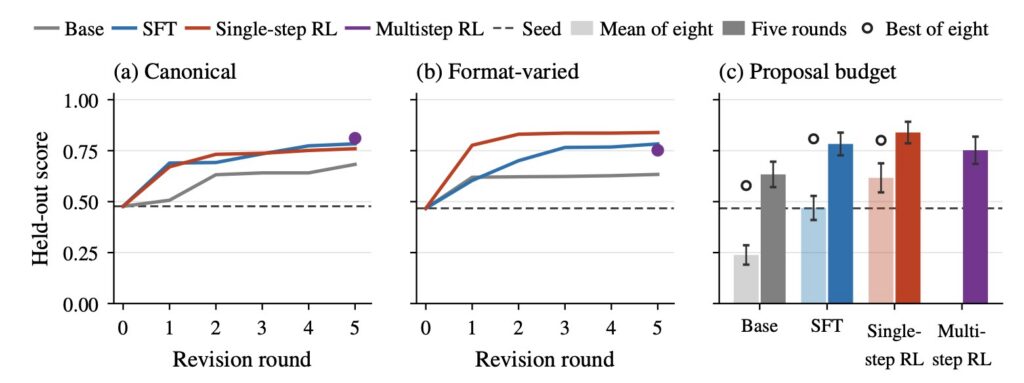
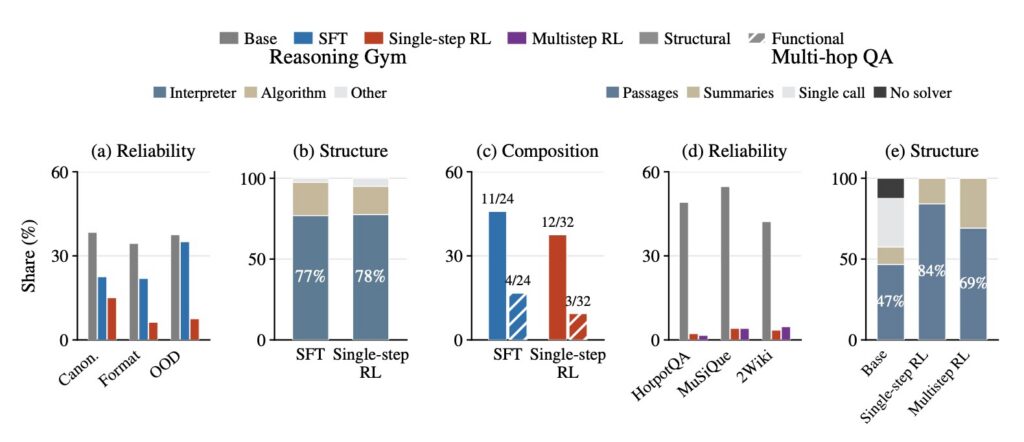
This success extends well beyond isolated reasoning puzzles. In multi-hop question answering, a proposer trained with RL from a baseline on the HotpotQA dataset successfully transferred its adaptation skills to entirely unseen benchmarks. Furthermore, policies that were trained on merely individual revisions demonstrated the ability to continue improving harnesses over multiple, compounding rounds. This indicates that the learned revision skills remain highly useful and robust even as the underlying harness continuously mutates, though the specific benefits of training on long revision sequences can vary depending on the setting.
While harness learning paints a promising picture of the future, the current framework does have distinct limitations that pave the way for exciting future work. Presently, the training process relies on prescribed revision prompts, utilizes a fixed solver model, and leans on a single teacher for Reasoning Gym supervision. To push this technology further, future research will likely explore the use of even stronger teachers or implement direct RL from models equipped with prior architectural knowledge of harness design. There is also immense potential in training tool-using proposers capable of autonomously inspecting and testing their own designs in sandbox environments, as well as jointly optimizing both the proposer and the solver in tandem. Ultimately, these findings lay the foundation for continually learning agents—AI systems capable of turning their accumulated daily experience into permanent, generalizable improvements.