A paradigm shift in AI infrastructure delivering 30x faster inference and unmatched scale through the revolutionary Nexus architecture.
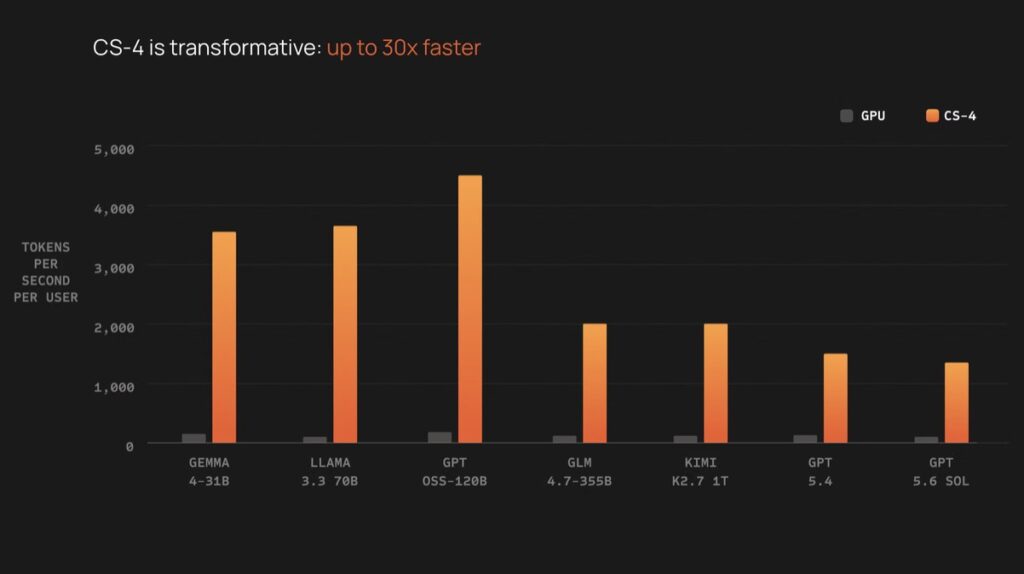
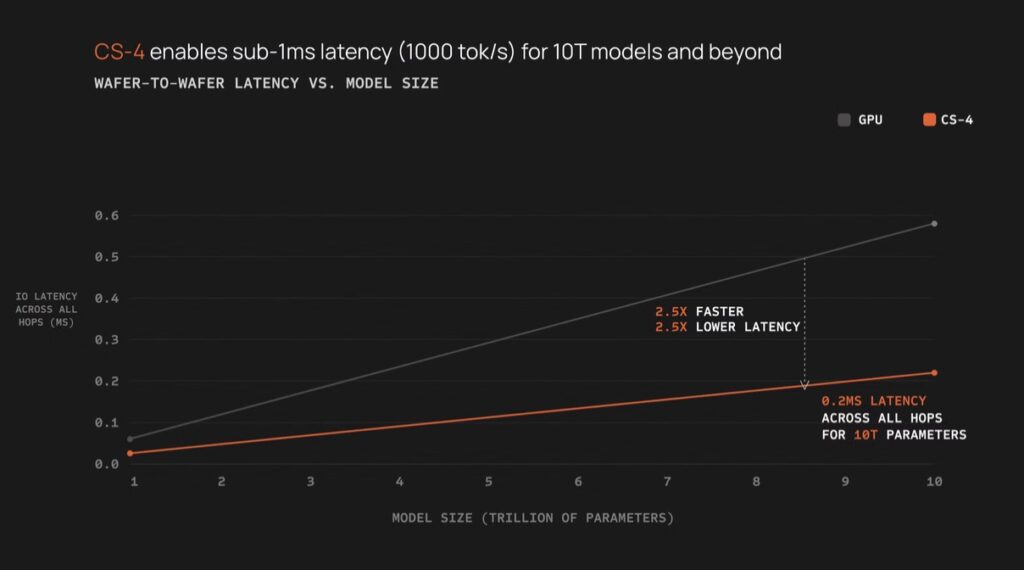
- Unprecedented Speed at Scale: Powered by three new WSE-3 Turbo processors, the CS-4 shatters existing bottlenecks, delivering up to 30 times faster inference than traditional GPU systems and generating over 1,000 tokens per second for colossal 10-trillion-parameter models.
- The Revolutionary Nexus Platform: Moving away from tightly coupled legacy designs, the CS-4 introduces a modular rack-scale architecture that decouples compute, power, and I/O. This cuts component count by 50% and reduces deployment time from days to mere hours.
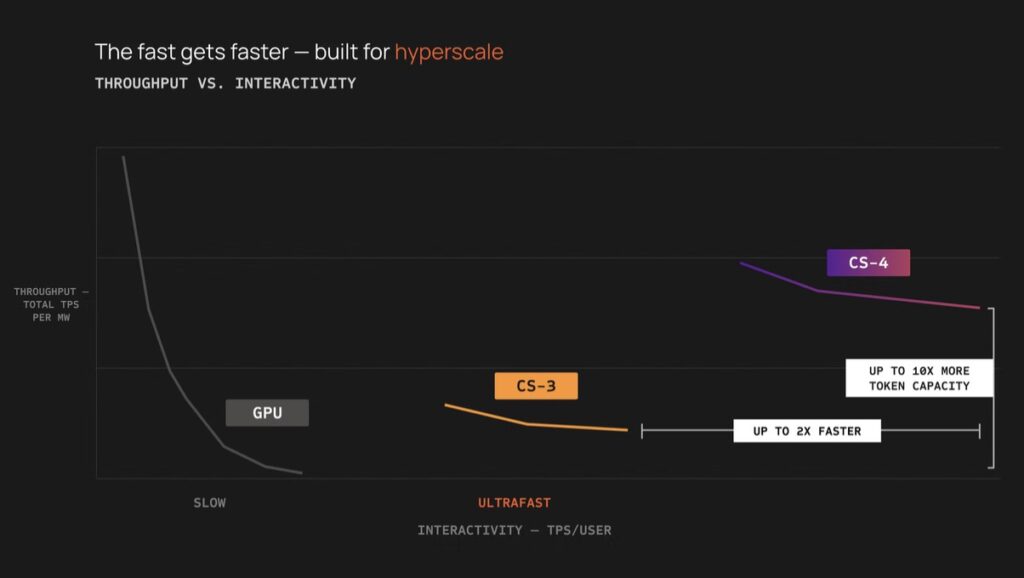
- Built for Frontier AI Economics: By supporting heterogeneous disaggregated inference and delivering up to 10 times more throughput per watt than its predecessor, the CS-4 maximizes both responsive interactivity for developers and gigawatt-scale profitability for operators.
The artificial intelligence landscape is evolving at a breakneck pace, and the infrastructure powering it is constantly racing to catch up. As developers push for highly interactive, agentic applications and data center operators grapple with power limits at the gigawatt scale, a simple truth has emerged: the next massive leap in AI cannot come from upgrading a single component in isolation. Compute, power, cooling, and network architecture must evolve together. Addressing this monumental challenge head-on, Cerebras has introduced its fourth-generation accelerator—the Cerebras CS-4. By fusing unprecedented processing power with a completely reimagined system design, the fastest AI in the industry just got significantly faster.
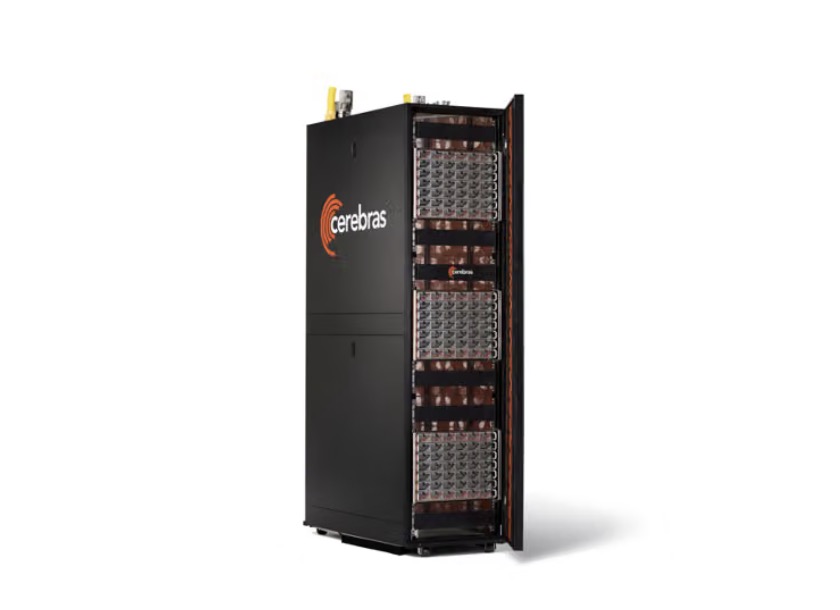
At the heart of this generational leap are three new Wafer Scale Engine 3 (WSE-3) Turbo processors. However, raw compute is only part of the equation. The CS-4 achieves its record-setting performance—up to 30 times faster inference than production GPU systems—through holistic, coordinated innovation across the entire system. In the past, AI infrastructure forced a painful compromise: operators had to choose between delivering high interactivity for individual users or high total throughput for the data center. The CS-4 effectively rewrites this Pareto frontier. It delivers up to 10 times more throughput per watt than the previous CS-3 generation, generating fast, high-value tokens while maximizing the total tokens produced within a strict power budget.
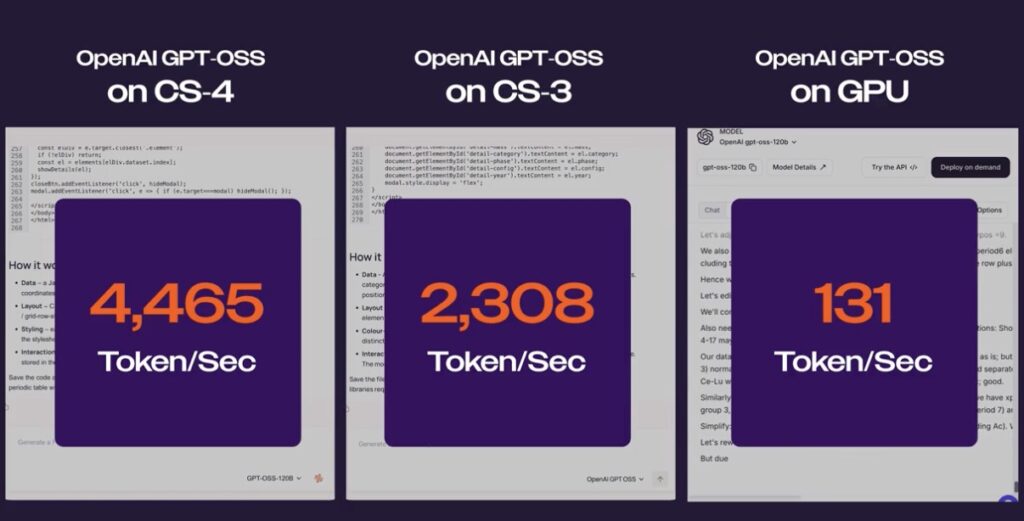
This speed extends across the entire spectrum of AI models. Serving massive, frontier-level models across multiple accelerators traditionally introduces lag as data moves between processors, destroying the interactive experience. The CS-4 solves this by reducing wafer-to-wafer interconnect latency to an astonishingly low two microseconds. Thanks to this ultrafast communication, the system can seamlessly deliver more than 1,000 tokens per second on models exceeding 10 trillion parameters. For developers, this means complex reasoning and agentic workflows happen in real-time; for operators, it translates to a vastly more profitable and capable data center.
Taking a broader architectural perspective, the CS-4 is not designed to operate in an isolated silo. It natively supports disaggregated inference, seamlessly integrating into heterogeneous computing environments. This modern approach splits the two primary phases of AI inference—prefill and decode—onto the hardware best suited for each task. Data centers can leverage purpose-built prefill platforms, such as AMD Helios, AWS Trainium, or other GPU/ASIC infrastructure, to process the incoming prompt and prepare the model state. That state is then handed off to the CS-4 for ultra-low-latency decoding. This allows providers to build highly differentiated, efficient inference pipelines tailored exactly to their workloads.
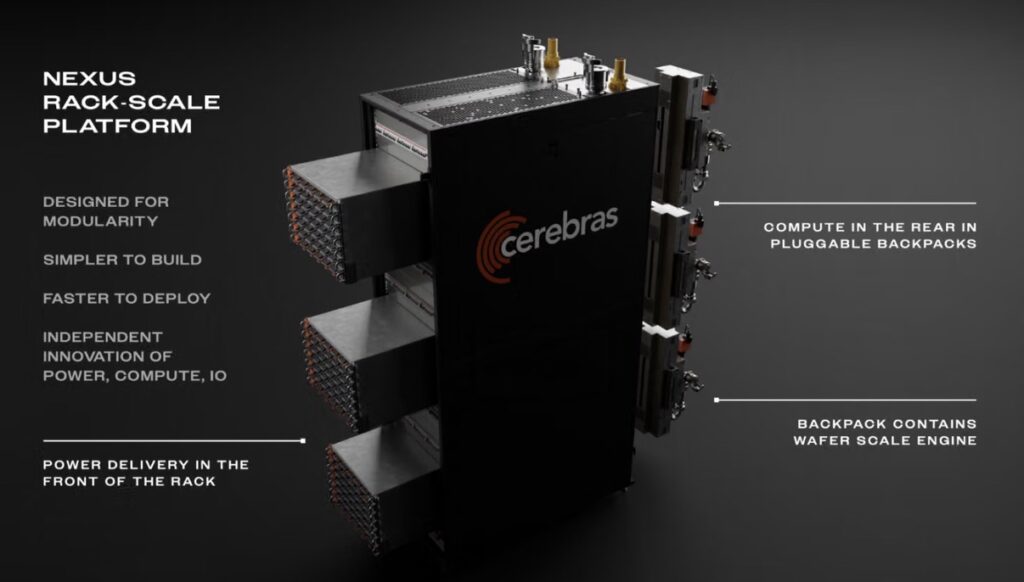
The physical foundation enabling this leap in performance is the all-new Cerebras Nexus Platform Architecture. Nexus fundamentally rethinks rack-scale engineering by treating the rack not as a cramped box of tightly coupled parts, but as a flexible platform of purpose-built modules. By separating compute, power, and I/O into self-contained assemblies, the Nexus design features 50 percent fewer components than prior generations and utilizes 60 percent more automated manufacturing. For neoclouds and hyperscalers, this modularity is a game-changer. It creates a seamless path from the factory floor to the data center, turning deployments that once took days into installations completed in hours, while ensuring future innovations can be integrated without a complete system redesign.
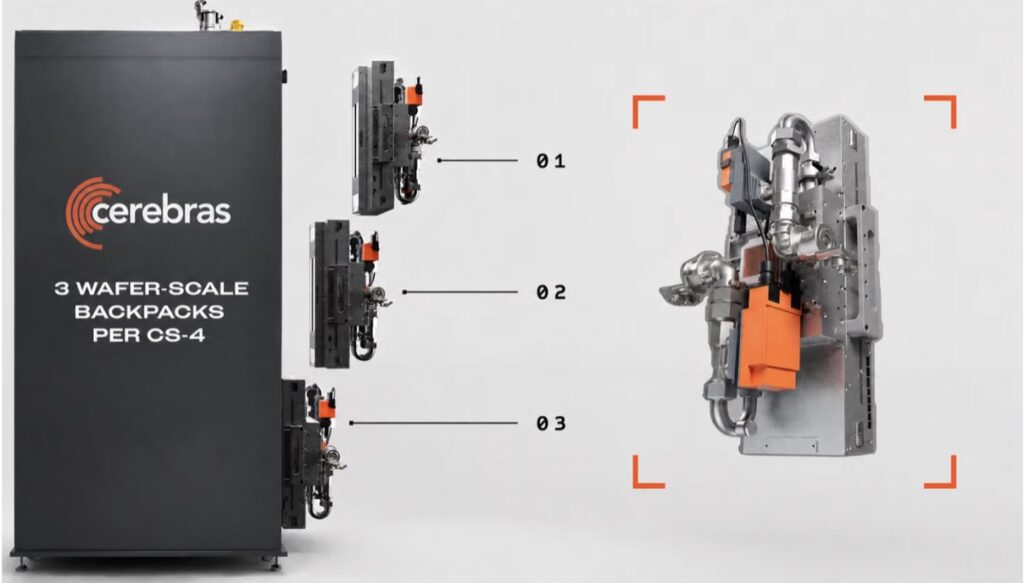
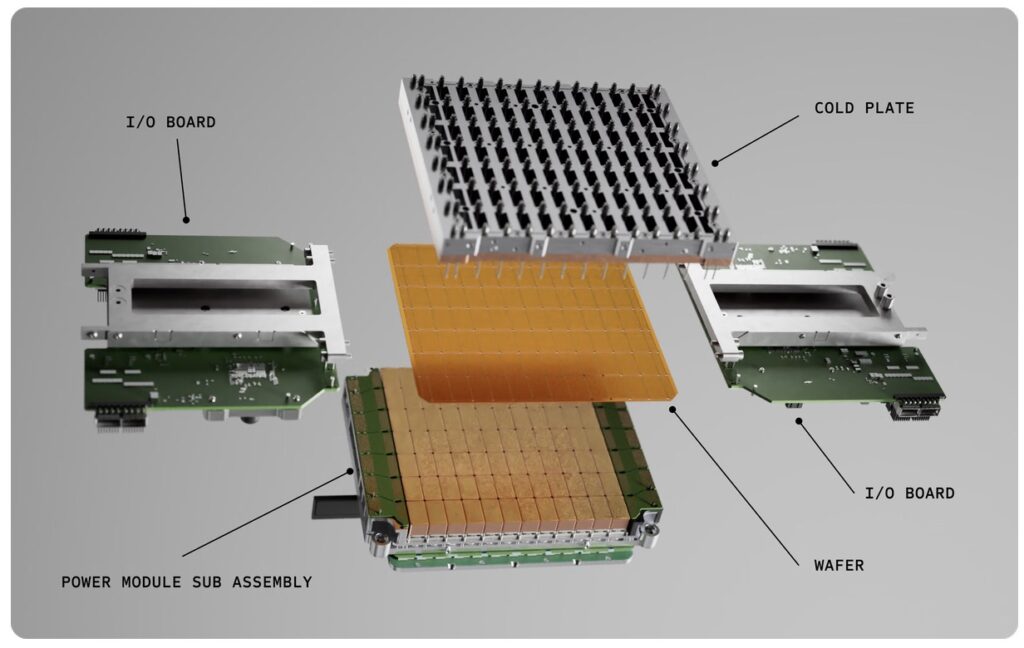
Zooming in on this modularity reveals incredible engineering density. The compute subsystem is now housed in a rear-mounted Wafer-Scale Backpack that attaches vertically to the power array. This three-dimensional package neatly folds direct liquid cooling, high-speed I/O, and control electronics directly around the wafer. Furthermore, the power delivery has been radically optimized. By moving power conversion 100 times closer to the processors compared to traditional GPU boards, board-level power loss is virtually eliminated. This efficiency enables the system to feed twice as much power to the WSE-3 Turbo, unlocking higher operating frequencies.
Finally, the network threading this massive power together has been entirely overhauled. The CS-4 features a programmable I/O subsystem that doubles bandwidth and slashes latency. Utilizing the Wafer I/O Module, the system supports standards-based RoCE v2 RDMA over Ethernet, ensuring the CS-4 plays nicely with existing ecosystem infrastructure. Simultaneously, Direct Wafer Links allow for blistering switch-free connections both within and across racks.
The Cerebras CS-4 is more than just a faster chip; it is a comprehensive reimagining of what an AI data center can be. By harmonizing processing power, high-density power delivery, liquid cooling, and modular design into a single rack-scale solution, the CS-4 provides the foundation needed for the next generation of frontier AI.