

A clever tweak to Bun’s garbage collector turns idle time into a massive performance win.
- Massive Efficiency Gain: Claude Code CLI achieved a 2x reduction in CPU usage at the 99th percentile (p99).
- The Hidden Bottleneck: Bun’s garbage collector was running on a fixed timer, interrupting the CLI during its most demanding tasks.
- The Elegant Solution: The system now waits for idle periods to reclaim memory, protecting vital processing power.
In the world of developer tools, speed and consistency are everything. Recently, the Claude Code Command Line Interface (CLI) scored a major victory by cutting CPU usage by a staggering factor of two at the 99th percentile (p99). By targeting “p99″—the most extreme, frustrating lag spikes users experience—the team smoothed out the roughest bumps in the software, guaranteeing a highly fluid experience.
The culprit behind those sudden CPU spikes was hidden within the application’s runtime environment, Bun. Like most modern runtimes, Bun relies on a garbage collector to sweep away discarded data and free up memory. However, this digital janitor was operating on a rigid, fixed timer, completely blind to the application’s actual workload. Consequently, it would frequently kick in mid-turn, ruthlessly stealing vital CPU cycles right when Claude Code was at its busiest processing code and generating AI responses.
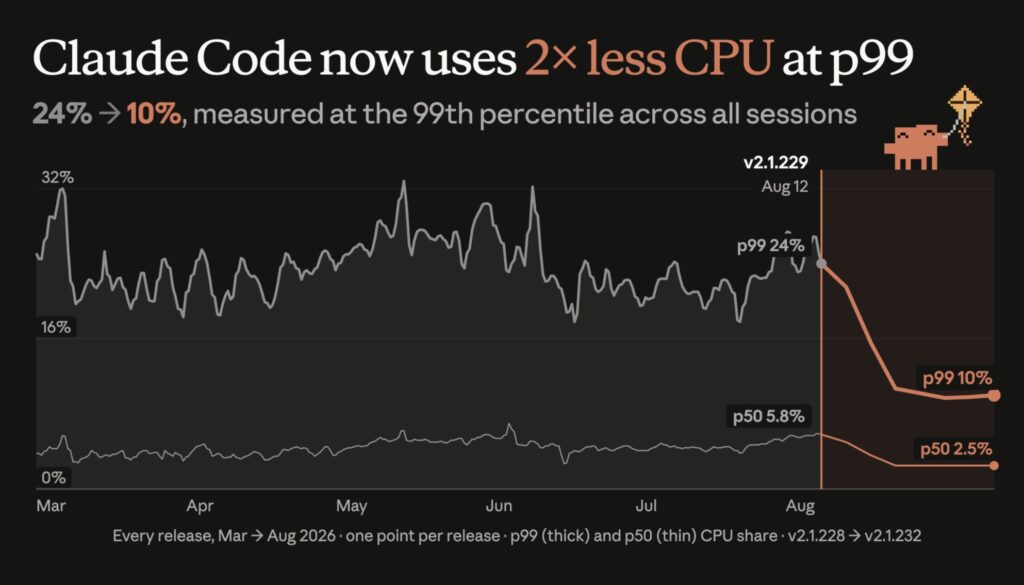
The fix was elegantly simple: teach the garbage collector some patience. Engineers adjusted the system so that instead of interrupting the CLI on a strict schedule, the memory cleanup process now actively waits until the application is idle.
The digital janitor waits until the room is empty before pulling out the broom. When a developer pauses to read a response, the CLI quietly cleans up its memory in the background. When the user hits “enter,” the system can dedicate 100% of its processing power to the task at hand. This smart resource orchestration ensures that developers stay in their state of “flow,” free from background interruptions and heavy hardware strain.