

Google’s newest Gemini launch is less about another chatbot upgrade and more about the infrastructure for AI agents that act across apps, code, search, and enterprise workflows.
- – Google says Gemini 3.5 Flash is available now in the Gemini app, AI Mode in Search, Gemini API, Google AI Studio, Android Studio, Antigravity, Gemini Enterprise Agent Platform, and Gemini Enterprise.
- – The company is positioning Gemini 3.5 Flash around long-horizon agentic tasks, coding work, subagents, and supervised multi-step workflows.
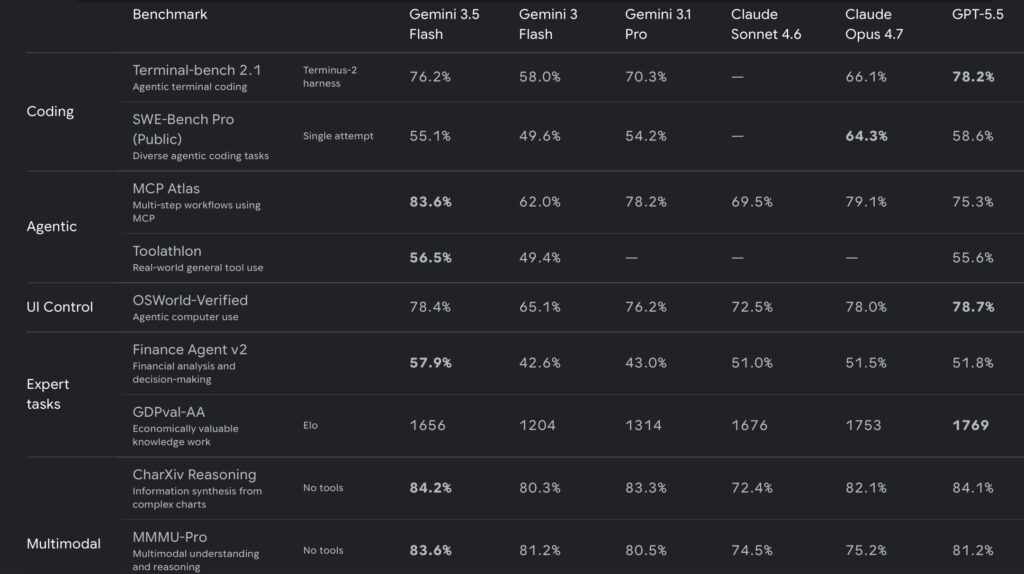
- – Benchmark and performance claims should stay attributed to Google because independent replication is not verified.
Google’s Gemini 3.5 Flash launch is a clear signal that the next phase of consumer and enterprise AI is being framed around agents, not only chat windows. In its announcement, Google says Gemini 3.5 is its latest family of models “combining frontier intelligence with action,” and says the series begins with 3.5 Flash.
The important part is where Google is putting the model. Gemini 3.5 Flash is not being held back as a narrow developer preview. Google says it is available to everyone through the Gemini app and AI Mode in Search, to developers through Antigravity and the Gemini API in Google AI Studio and Android Studio, and to enterprises through Gemini Enterprise Agent Platform and Gemini Enterprise.
Why Gemini 3.5 Flash Matters
For product teams, the launch points to a practical change in how AI features are being packaged. The selling point is no longer just a better answer to a prompt. Google is describing a model designed to execute complex workflows, plan across steps, and work with tools under user supervision.
Google says 3.5 Flash can help with long-horizon agentic tasks, including application development, codebase maintenance, and financial-document workflows. Those claims should be read as vendor-reported examples, not independent proof of production reliability across every customer environment.
Still, the deployment pattern matters. When the same model family appears inside Search, the Gemini app, developer APIs, IDE tooling, and enterprise agent platforms, Google is building a shared base layer for AI workflows instead of treating each product surface as a separate chatbot.
From Answers To Workflows
TechCrunch described the launch as Google betting its next AI wave on agents rather than chatbots, and reported that Gemini 3.5 Flash was introduced at Google I/O as a coding and agentic AI model. That framing matches Google’s own language around action, agentic tasks, Antigravity, and subagents.
This is also why AI Mode in Search matters. Search has historically been a question-and-answer interface. Google now says 3.5 Flash is the default model for AI Mode in Search globally, and its post links the model to information agents that can work on behalf of users.
For marketers and publishers, that means the search surface keeps moving away from ten blue links and toward AI-mediated task completion. For developers, it means the model layer and agent tooling are being tied more closely together. For enterprise buyers, it means the same vendor claim needs to be tested as a workflow system, not just as a model benchmark.
What Teams Should Watch Next
The biggest near-term question is not whether Gemini 3.5 Flash can produce impressive demos. It is whether teams can trust agentic systems to complete work reliably, cheaply, and safely when connected to real tools, private data, customer workflows, and codebases.
Google says Gemini 3.5 was developed under its Frontier Safety Framework and highlights cyber and CBRN safeguards. That safety positioning matters because the risks rise when models move from answering questions to taking actions. Agentic AI needs stronger monitoring, rollback plans, and clear human control points.
Google also says it is working on Gemini 3.5 Pro and plans to roll it out next month. If that happens, the model lineup may split into a planner-orchestrator layer and a faster execution layer. TechCrunch quoted Google DeepMind product lead Tulsee Doshi describing Pro as an orchestrator and planner that can leverage Flash as subagents.
That is the strategic shift: AI products are being organized around systems of models, tools, and agents. The winners will not only have the strongest chatbot. They will have the safest and most useful workflow layer.
Bottom Line
Gemini 3.5 Flash is not just another model announcement. It is Google’s latest move to make agentic AI available across consumer search, the Gemini app, developer tooling, and enterprise platforms at the same time. The promise is more useful AI workflows. The hard part will be proving that those workflows are dependable outside Google’s demos and vendor-reported benchmarks.