By leveraging Quantization-Aware Training, Google has drastically shrunk memory requirements, bringing GPT-4o and Opus 4-level performance directly to your everyday smartphones and laptops.
- Massive Memory Reduction: Google’s new Gemma 4 QAT models run with up to 3x less memory, utilizing Quantization-Aware Training to eliminate the typical quality drop associated with shrinking AI models.
- Flagship AI in Your Pocket: The Gemma 4 E4B model outperforms GPT-4o and runs entirely locally on a phone with just 2GB of RAM, while the highly optimized E2B model requires less than 1GB.
- Desktop Domination: The robust Gemma 4 31B model brings top-tier, Opus 4-level AI capabilities to consumer laptops, supported from day one by a massive ecosystem of developer tools like Ollama, LM Studio, and Hugging Face.
The landscape of artificial intelligence is experiencing a seismic shift. The days when running state-of-the-art AI required massive server farms, expensive hardware, and permanent cloud connectivity are rapidly coming to an end. Google has just dropped a massive update for the local AI community: the release of Gemma 4 QAT. Following their recent introductions of Multi-Token Prediction (MTP) for accelerated inference and a bridging 12B model, this new release optimizes model compression for unmatched mobile and laptop efficiency. It is a leap forward that means the kind of computational power we associate with industry giants can now reside comfortably in your pocket or backpack.
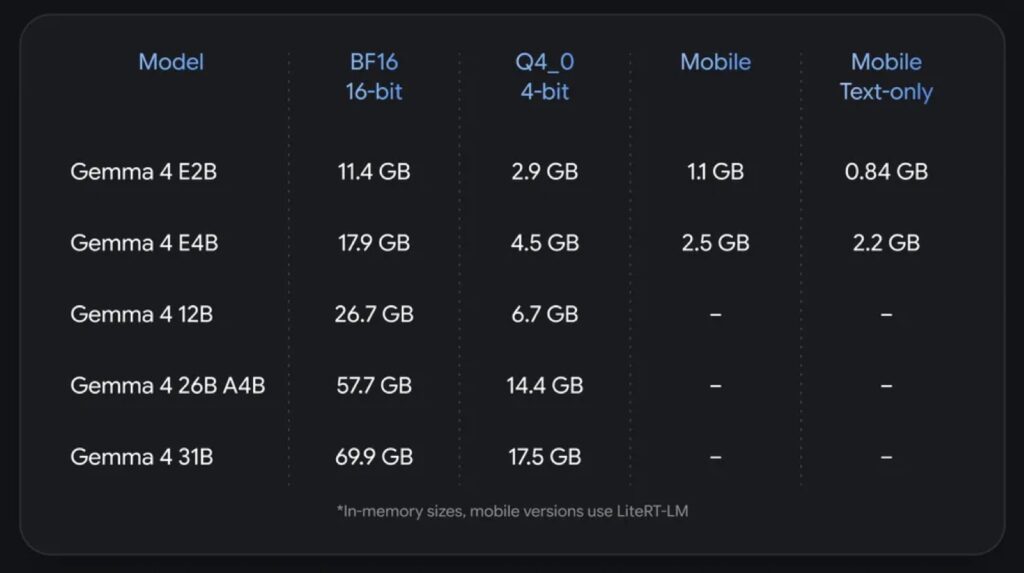
To understand the magnitude of this release, we must look at the benchmarks and practical applications. Remember the groundbreaking capabilities of GPT-4o? The new Gemma 4 E4B model not only surpasses it but does so while running entirely locally on an everyday mobile phone equipped with merely 2GB of RAM. For those tackling more complex reasoning tasks, the Gemma 4 31B model—which comfortably rivals the formidable Opus 4—can now be operated natively on a standard consumer laptop. This democratization of high-tier AI fundamentally changes the paradigm for developers, privacy advocates, and everyday users who require offline capabilities and zero-latency processing.
The secret to this drastic reduction in memory lies in Quantization-Aware Training (QAT). Traditionally, developers have relied on standard Post-Training Quantization (PTQ) to shrink large models into usable sizes. While effective at reducing a model’s footprint and accelerating decode speeds, PTQ often leads to a noticeable degradation in the AI’s reasoning quality because the model is essentially compressed after it has already learned everything. QAT, however, integrates the quantization process directly into the training phase. By simulating quantization while the model learns, QAT minimizes quality loss, yielding significantly higher overall performance compared to standard PTQ baselines. This release applies the QAT recipe to the popular Q4_0 format, maximizing efficiency for consumer GPUs.

For the edge models, specifically E2B and E4B, Google went a step further, recognizing that standard compression formats are often notoriously difficult for mobile processors to run efficiently. To solve this, Google engineered a custom mobile-quantization schema directly targeted at edge hardware. This involves pre-calculating data-scaling settings during training to create “static activations,” which drastically reduces the live workload and speeds up response times on mobile chips. They also restructured the compressed data for “channel-wise quantization,” allowing phones to run calculations natively without relying on sluggish software workarounds.
Google employed highly targeted 2-bit quantization, heavily compressing the specific parts of the model responsible for generating tokens while preserving the core reasoning layers at a higher precision. Combined with deep optimizations to the vocabulary list and the model’s short-term memory (KV cache), users can now maintain long conversations on their mobile devices without running out of active memory. Google has also embraced modularity to push efficiency to the absolute limit. Because audio and vision encoders are unnecessary for many use cases, developers can strip them away entirely. A text-only Gemma 4 E2B deployment, without per-layer embeddings, requires a shockingly low footprint of under 1GB.
To ensure these breakthroughs are immediately accessible, Google has partnered across the tech ecosystem. The Q4_0 and mobile-specific model weights are already available on Hugging Face, tailored for immediate integration. Everyday users can easily download and run these models locally on desktops using user-friendly interfaces like llama.cpp, Ollama, and LM Studio. For developers pushing the boundaries of edge deployment, Google’s LiteRT-LM runtime and Transformers.js offer seamless on-device and web integration. Meanwhile, tools like vLLM, SGLang, and MLX cater to those looking to serve larger models or optimize for specialized hardware like Apple Silicon. Developers can even use the MTP QAT checkpoints to maintain the speedups of Multi-Token Prediction, and fine-tune weights directly using Unsloth. The release of Gemma 4 QAT is not just a technical milestone; it is a fundamental shift that puts the future of hyper-intelligent, privacy-first AI directly into the hands of the masses.