

Google’s latest natively multimodal AI merges photorealism, interactive physics, and dynamic audio to create infinitely variable, steerable digital worlds.
- Genie 4 seamlessly integrates photorealistic visual rendering with native ambient sound and dynamic human dialogue, creating immersive environments that react instantly to user input.
- Powered by the reasoning capabilities of the Gemini model family, the system allows users to dynamically alter weather, camera angles, and character actions in real-time using natural language and standard keyboard controls.
- Currently in a research preview for trusted testers, Genie 4 offers transformative applications for filmmaking, game prototyping, and robotics training, all while employing strict safety guardrails and SynthID watermarking.

Understanding and simulating the physical world is a critical stepping stone toward artificial general intelligence, and Genie 4 represents a massive leap in that pursuit. As a newly announced generative world model, Genie 4 unlocks unprecedented realism by moving beyond silent, static generation into real-time, interactive simulation. Because it is natively multimodal, it generates a cohesive reality where visuals, ambient environmental noises like wind or ocean waves, and interactive human dialogue are all created simultaneously. Users can set an event in motion and watch as Genie 4 autonomously simulates what happens next—dictating how the environment responds, how the atmosphere sounds, and how the people within it move, react, and speak organically.

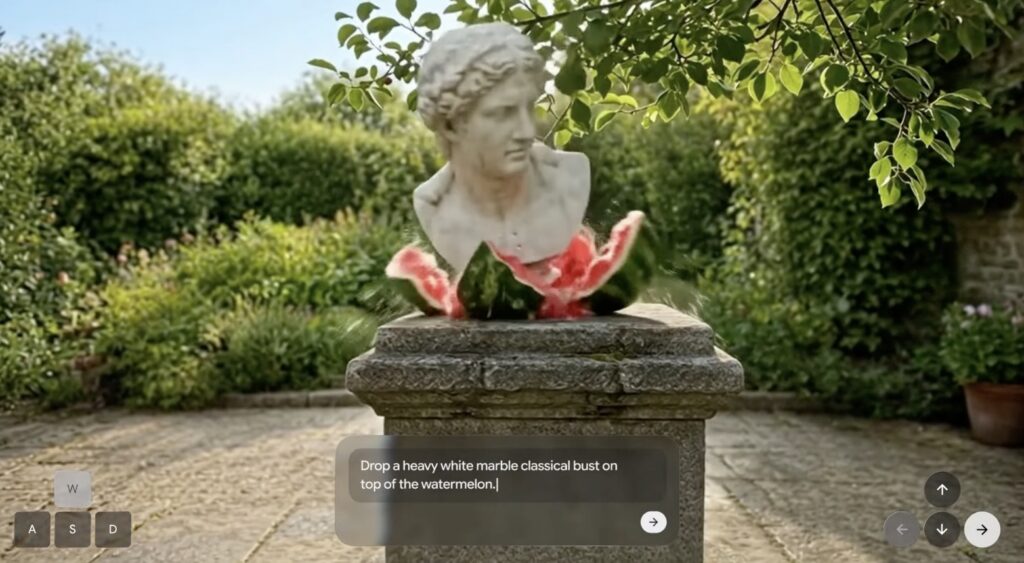
This deep level of interactive simulation is driven by advanced physical understanding and real-time steerability. Users navigate these digital environments using standard keyboard controls and camera movements, while simultaneously using natural language text prompts to shape the world as it evolves. You can instantly change the weather, introduce a new object, or alter a character’s trajectory, and the system contextually adapts the surrounding scene without breaking immersion. Genie 4 models complex real-world physics scenarios, encompassing aerodynamics and precise object collisions, but its most dramatic advancement lies in human simulation. Characters in these worlds move naturally, respond dynamically to environmental shifts, and engage in on-the-fly, interactive conversations that react directly to user interventions.

The architecture powering this seamless reality relies heavily on the integration of the Gemini model family, creating a hybrid approach that merges the logical reasoning of language models with pixel-level sensory rendering. Gemini Omni anchors these simulations by enforcing real-world appearance and behavioral norms, while other models maintain continuity and causality. To manage complex, multi-step events in real-time, Gemini 3.8 Flash operates as a guiding agent in the loop. It continuously observes the rendered scene, breaks user goals into sequential steps, verifies the success of each action, and instantly adapts its plan if the user intervenes or the world shifts. This integration extends into frontier robotics research as well, where Gemini 4 Argon works alongside Genie 4 to break down physical tasks into interleaved text captions, allowing AI systems to practice navigating and completing physical objectives in imagined, highly accurate environments before ever touching the real world.

While Genie 4 remains an early experimental model, cohorts of trusted testers are already utilizing it to redefine workflows across creative and engineering industries. In creative direction and filmmaking, technologists are using the model as a rapid “draft mode” for pre-visualization, stepping into a live simulation to run multiple takes, adjust lighting, and tweak dialogue on the fly. Photojournalists are transforming single 2D archival photographs into fully grounded, explorable 3D environments to visualize historical spaces or short-term environmental crises like flash floods. Game developers are bypassing traditional engine coding entirely, using natural language to prototype interactive mechanics, material aesthetics, and explorable levels in seconds. Meanwhile, enterprise partners are evaluating the system for rapid “zero-to-one” scenario generation for complex physical simulations.
Because merging real-time generation with photorealism introduces profound new capabilities, Google is prioritizing a responsible, secure rollout. All video and audio generated by the model includes SynthID, an imperceptible digital watermarking technology that identifies the content as AI-generated. The model has undergone rigorous internal evaluations to prevent the generation of malicious content. As an evolving area of research, Genie 4 still faces limitations; while short sessions remain highly coherent, longer simulations with complex prompt edits can experience object drift, shifting visual details, and challenges with real-time audio accuracy and legible text rendering. To learn alongside the community and refine these spatial and temporal consistency issues, Genie 4 is rolling out first as a research preview to trusted testers, with broader access coming soon to Google AI Ultra subscribers in Project Genie and early access partners utilizing the Gemini API and Google AI Studio.