

A new benchmark, StreamEval, reveals that while AI-generated video looks stunning, keeping it responsive and consistent in real-time remains a massive challenge.
- A New Standard for AI Video: StreamEval introduces a unified benchmark with 300 test cases across five interactive tasks to evaluate how well AI models handle real-time, streaming video generation.
- The Beauty vs. Brains Dilemma: While current AI models can produce high-quality visuals and retain basic identities, they struggle significantly with executing dynamic user requests and maintaining state consistency as a session evolves.
- A Clear Frontier for Improvement: Testing across 37 different models revealed critically low scores in complex tasks—such as a 15.00/100 for reference-based editing—highlighting request execution as the next major hurdle for omni-modal AI systems.
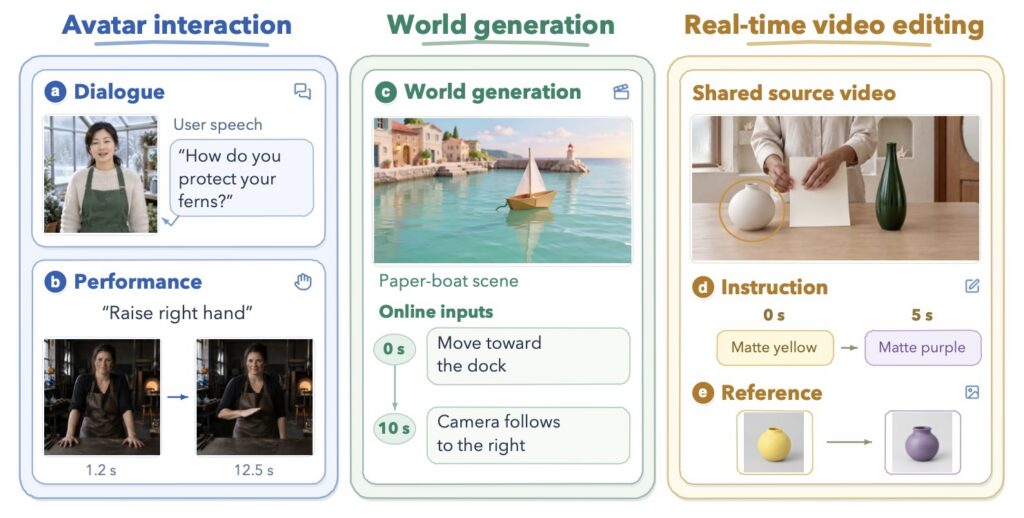
The rapid advancement of artificial intelligence has ushered in an era where generating highly realistic, high-definition video from a simple text prompt is becoming commonplace. However, as the novelty of static video generation wears off, the tech industry is turning its attention to the next frontier: real-time, interactive streaming video. Imagine conversational avatars that react to your expressions, virtual worlds you can control on the fly, or live video feeds you can edit with a spoken command. While the potential is staggering, a groundbreaking new benchmark known as StreamEval suggests that the reality of building these systems is far more complex than simply generating pretty pictures.
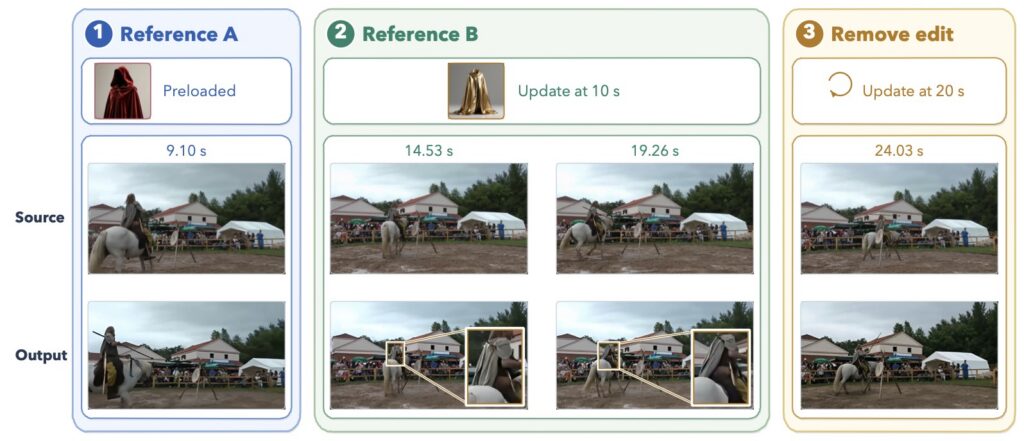
The core challenge of interactive video generation lies in the element of time. Systems that generate video incrementally must be able to accept and process new user inputs while a session is already in progress. In these dynamic settings, generating plausible individual frames is no longer enough. The AI must ensure that its responsive controls remain perfectly aligned with incoming inputs as the user’s requests and the surrounding context evolve. For instance, a conversational avatar must respond appropriately to a new topic without suddenly changing its face or forgetting the dialogue history. Similarly, a generated world must accommodate a user’s command to add a new object without morphing the rest of the unaffected scene. Every new request carries strict timing and scope requirements—dictating exactly when a change should occur, what it should alter, and critically, what must be left intact.
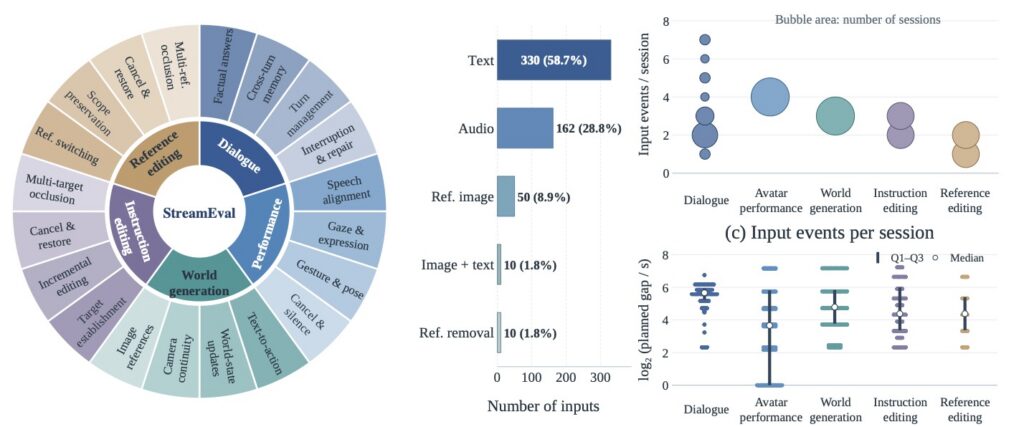
To systematically measure these capabilities, researchers have introduced StreamEval, a unified benchmark designed specifically for interactive streaming video generation. StreamEval spans five distinct tasks: avatar dialogue, avatar performance, world generation, instruction editing, and reference editing. The benchmark is exhaustive, comprising 300 meticulously scripted test cases that simulate interactive sessions lasting anywhere from 15 to 300 seconds. Each test case bundles initial assets—like a portrait, a starting scene, or a source video—with a sequence of timed user requests that arrive incrementally. The system is then judged on its ability to respond as the session unfolds, with explicit requirements for what must change and what must be preserved.
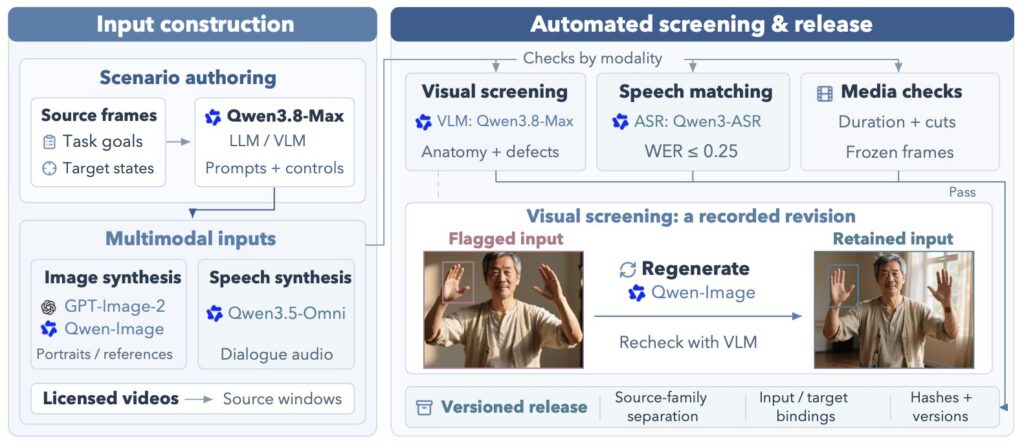
To provide a comprehensive assessment, StreamEval evaluates models across four complementary dimensions: task execution, state consistency, visual fidelity, and audiovisual coordination. These dimensions are quantified using ten task-specific metrics graded on a rigorous 0–100 scale. This structured framework bridges the gap left by previous benchmarks like VBench, T2V-CompBench, and WBench, which often focused on complementary but isolated aspects of video generation, such as visual quality, temporal behavior, or multi-turn control within limited contexts.
When the StreamEval framework was applied to 37 distinct state-of-the-art models, the results were both illuminating and sobering. The data revealed a stark disconnect in model capabilities: high visual quality and strong identity retention do not necessarily translate to reliable request execution or sustained state consistency. In simpler terms, an AI might generate a beautiful, consistent character, but it will likely fail to make that character perform a newly requested action at the right time.
The numbers highlight just how difficult real-time request execution remains. Among the seven models tested for avatar performance, the highest score for successfully “Following” a request was a mere 36.90 out of 100. Text-conditioned world generation models fared even worse, peaking at 25.93 for Following. The most complex task, reference-based editing, saw a top “Edit Success” score of just 15.00 out of 100.
Despite these low execution scores, StreamEval did identify specific models leading the charge in various niches. Vidu S2 Avatar emerged as a standout, securing the highest reported scores in digital-human dialogue and overall avatar performance. MemFlow took the lead in world generation, while Vidu S2 Editing topped both instruction and reference editing categories. Furthermore, individual metrics highlighted specialized strengths; for example, LiveTalk achieved the highest Quality score in avatar performance, and JoyAI-Video-Edit secured the best Preservation score during instruction editing.
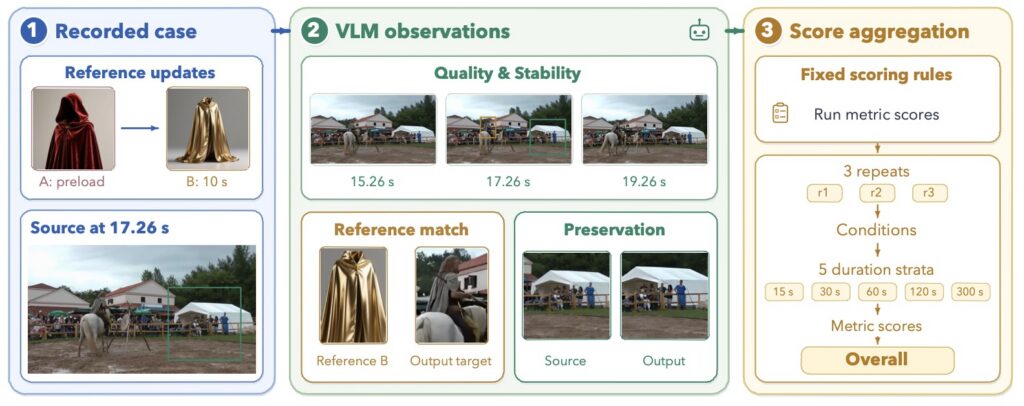
StreamEval serves as both a reality check and a roadmap for the future of AI video. It proves that reliable request execution—under strict timing and preservation constraints—is the central bottleneck for advancing omni-modal real-time systems. As researchers look ahead, the next natural step will involve collecting human pairwise judgments to see how closely human perception aligns with StreamEval’s rigorous automated metrics. By shining a light on the crucial balance between visual fidelity and state continuity, StreamEval is paving the way for a future where AI generated video is not just something we watch, but something we seamlessly and reliably interact with.