

Just 14 months after a massive AI overhaul, Meta Superintelligence Labs is pushing the frontier with new models designed to master complex, long-running personal and professional tasks.
- A New Frontier in AI: Meta has officially launched Muse Wonder and Muse Wonder Full, two state-of-the-art models trained at their gigawatt-scale Prometheus data center, marking a massive leap from their previous Muse Spark generation.
- Revolutionary Memory and Focus: The models introduce “Active Memory” for retaining long-term user context and “Active Focus” for sustaining effort, working through blockers, and independently driving complex projects to completion.
- Unprecedented Versatility and Safety: Designed to avoid mere “benchmaxxing,” these highly aligned models excel at unfamiliar tasks and feature robust, industry-leading safeguards for handling highly sensitive personal data and resisting cyber and CBRN misuse.
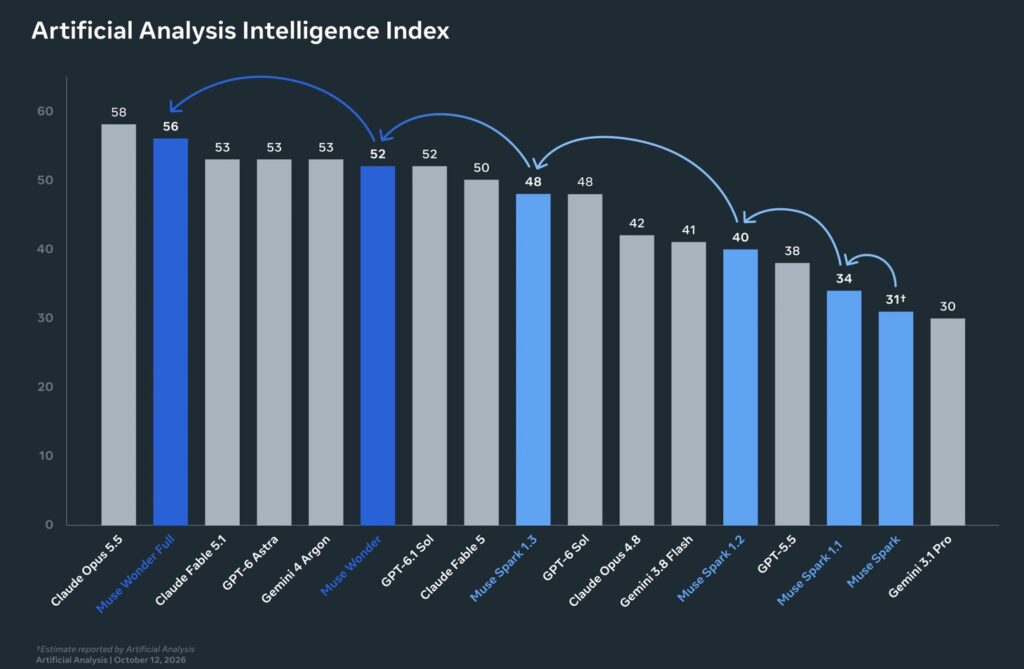
Just over a year ago, Meta Superintelligence Labs embarked on a ground-up overhaul of its artificial intelligence ecosystem, rebuilding its tech stack from first principles. Today, that fourteen-month journey culminates in a major announcement: the release of the Muse Wonder series. Consisting of Muse Wonder—optimized for fast, frontier-level performance—and the highly robust Muse Wonder Full, this new class of models represents Meta’s most ambitious step yet toward bringing “personal superintelligence” to billions of users globally.
Trained at Meta’s massive, gigawatt-scale Prometheus data center, the Muse Wonder models are built to go beyond simple chatbot interactions. They are designed to function as dedicated personal and professional agents. As of today, developers and tech enthusiasts can access Muse Wonder through the Meta Model API and Muse Code, while Muse Wonder Full is available exclusively to Muse Code subscribers. In the near future, these models will begin powering artifact generation and high-intelligence processes directly within the consumer-facing Muse application.
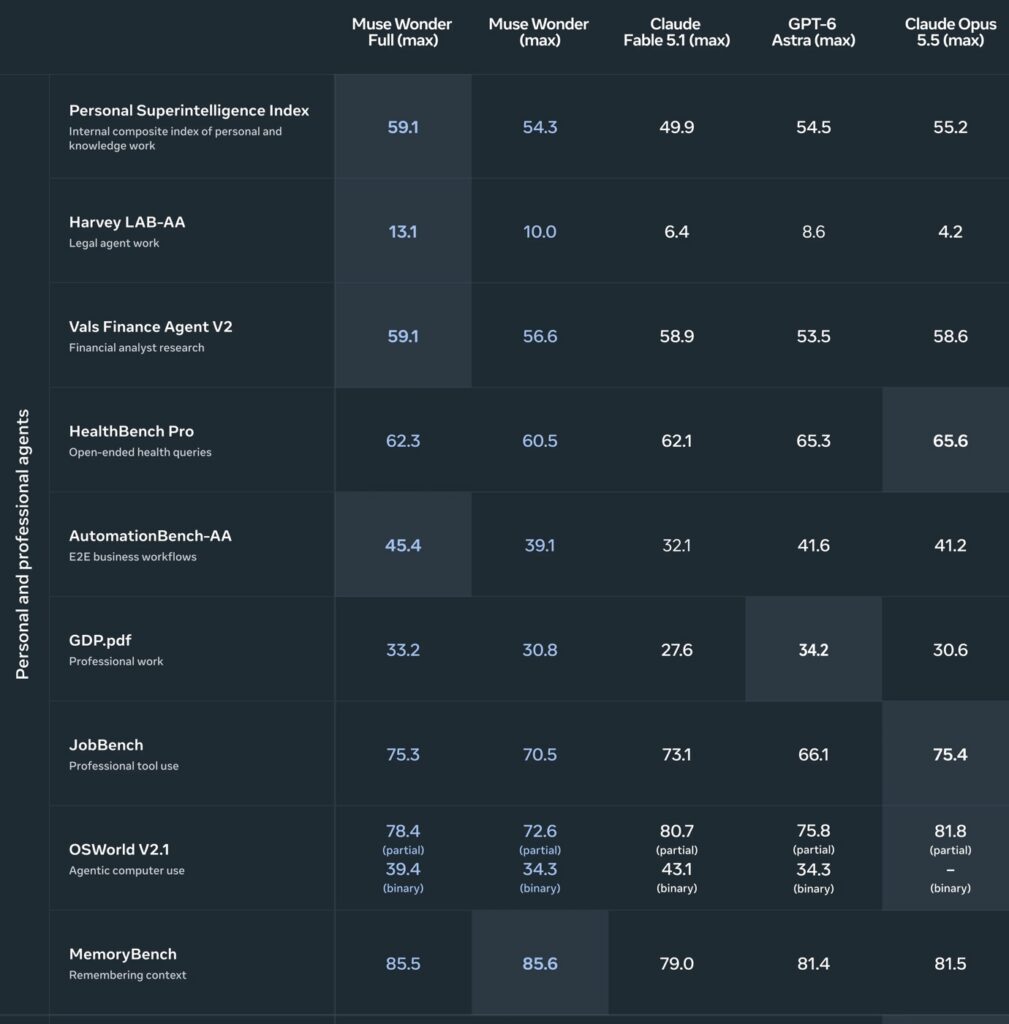
What separates the Muse Wonder series from the crowded field of AI models is its architectural emphasis on two core capabilities: Active Memory and Active Focus. Reliable memory is the holy grail of agentic AI, and Meta’s Active Memory allows these models to securely carry important context about a user across multiple conversations, actively retrieving highly specific details precisely when they become relevant.
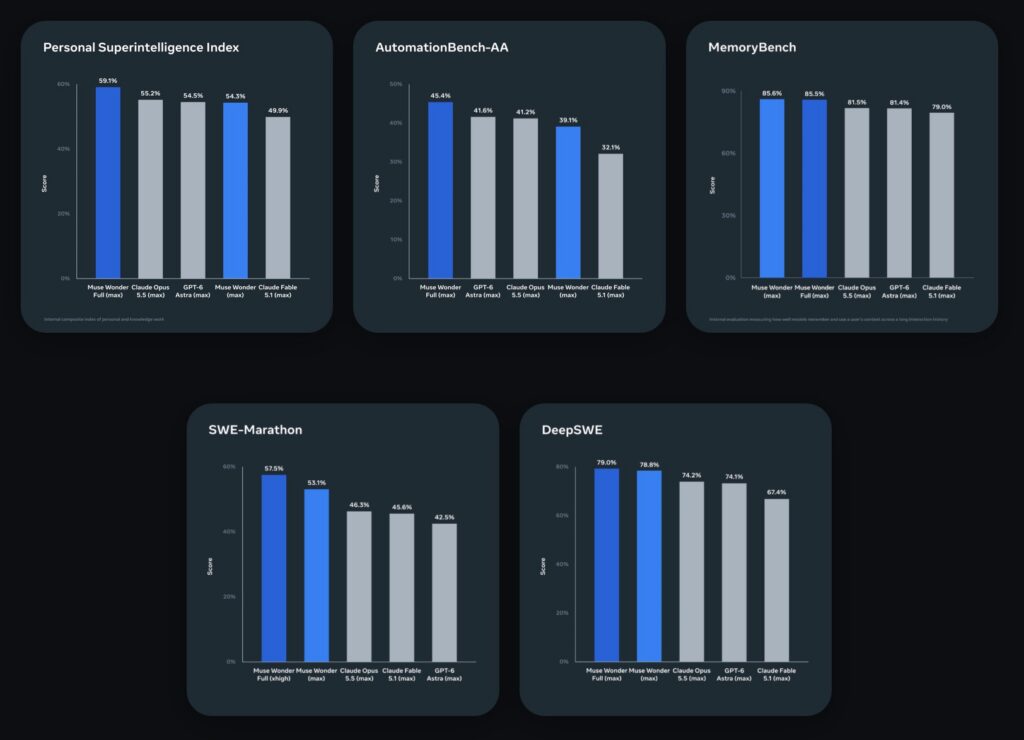
Coupled with this is Active Focus, which mimics human sustained effort. Instead of giving up when faced with a complex prompt, Muse Wonder can try alternative approaches, actively work through blockers, and adapt to new information on the fly. It is even designed to pause and ask the user for clarification before taking critical actions. Meta notes that this sustained execution has been rigorously tested through FocusBench and SWE-Marathon, the latter of which evaluates an AI’s ability to contribute to long-running software engineering projects.
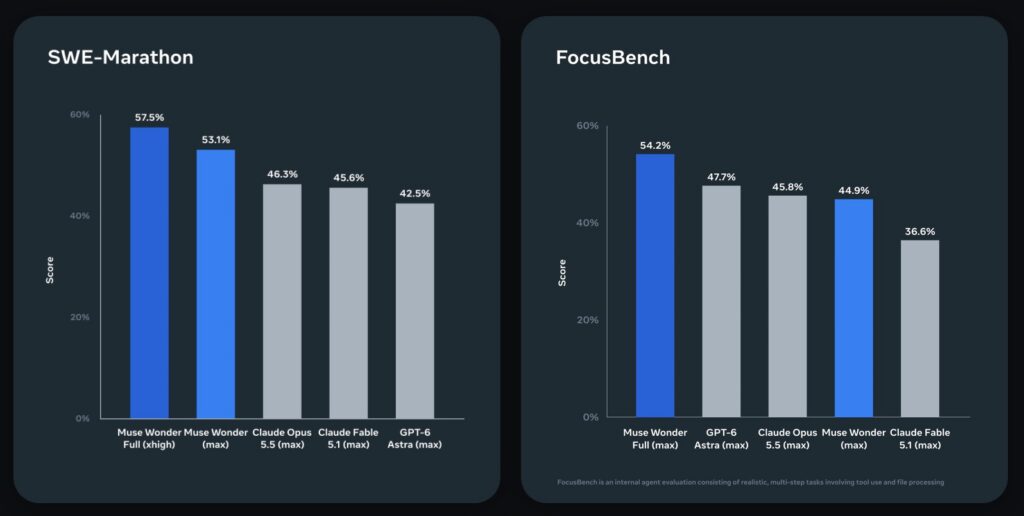
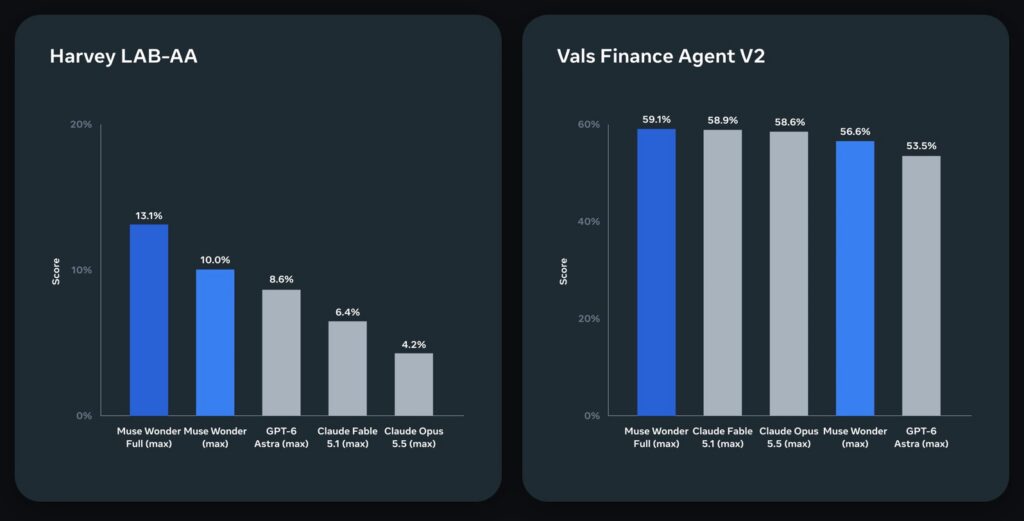
This deep focus translates directly into impressive domain expertise and coding capabilities. Muse Wonder and Muse Wonder Full aren’t just generating text; they are actively applying specialized knowledge to complex fields like law, finance, and healthcare. For example, in Harvey’s Legal Agent Benchmark (LAB), the models successfully navigate source documents and follow intricate instructions to produce actual legal work products. In the realm of software development, the models exhibit frontier coding performance—capable of tracking requirements, executing codebase-wide changes, and navigating repeated cycles of testing and revision for both small apps and massive software architectures.
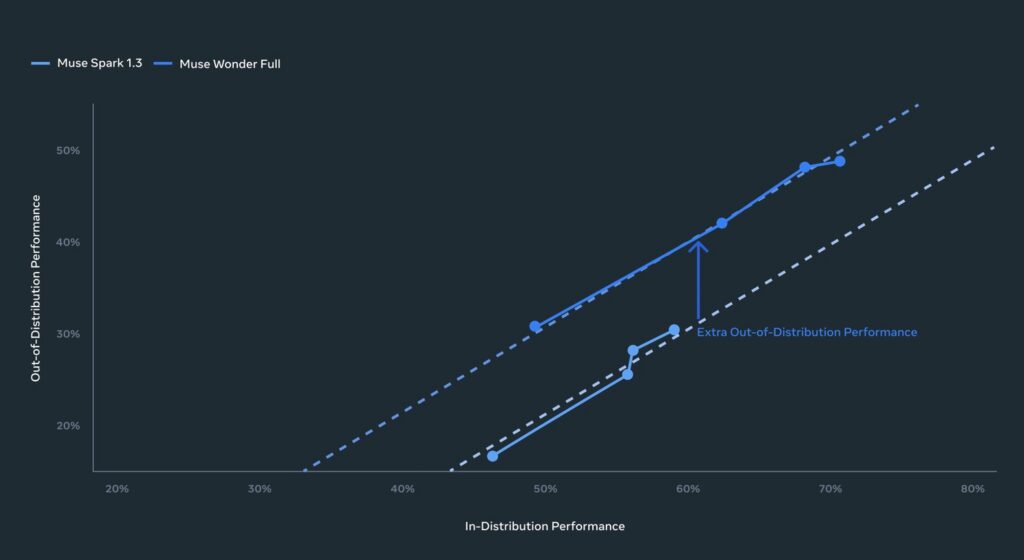
Perhaps the most interesting technical achievement of the Muse Wonder series is its ability to avoid “benchmaxxing”—the industry phenomenon where models score incredibly well on standardized tests but falter in the real world. Tech insiders often praise highly adaptable AI as having a “big model smell,” and Meta’s data backs this up. By comparing the new flagship model to the older Muse Spark 1.3, Meta demonstrated that as test-time compute scales, Muse Wonder Full performs exponentially better on “out-of-distribution” (unfamiliar) tasks. Because the Wonder series is built on a significantly larger and stronger base model, it possesses a versatility that allows it to seamlessly handle the unpredictable combinations of tools, goals, and constraints that real-world users throw at it.
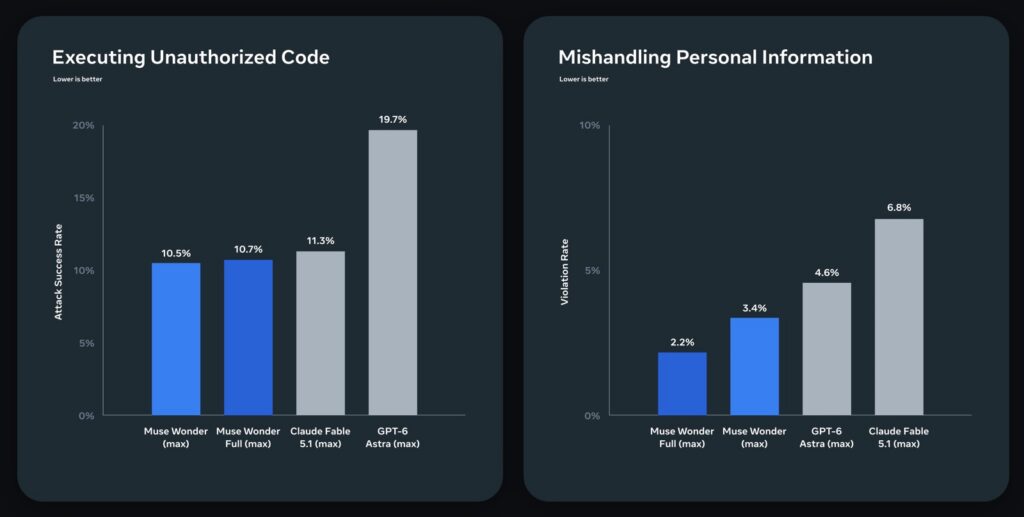
Handing over calendars, private messages, and sensitive documents to an autonomous agent requires an ironclad commitment to security. Acknowledging this, Meta has positioned the Muse Wonder family as its most strictly aligned models to date. Operating under the Meta Superintelligence Scaling Framework, the models exercise strict discretion with private user information and boast the company’s strongest safeguards against chemical, biological, radiological, and nuclear (CBRN) risks, as well as cyber misuse—all while preserving essential frontier capabilities for defensive cybersecurity research.

Meta’s rollout of the Muse Wonder series is more than just a product update; it is a structural shift in how we interact with machines. By combining deep domain expertise, persistent focus, and rigorous safety standards, Meta is hoping to give users the ultimate digital partner—one that diligently works alongside them to pursue their ambitions and build the world they want.