
As the internet’s library turns 25, it secures major deals with Meta, Microsoft, and others to fund its future while protecting its human-curated legacy.
- Monetizing the Boom: To offset the massive strain of AI bot traffic, Wikipedia has signed enterprise deals with Amazon, Meta, Microsoft, Perplexity, and Mistral AI, requiring them to pay for high-speed data access.
- Protecting the Donors: Founder Jimmy Wales and leadership argue that the nonprofit’s 8 million individual donors should not be subsidizing the infrastructure costs of trillion-dollar tech giants.
- Human vs. Machine: While Wikipedia faces political criticism and rivalries from Elon Musk’s “Grokipedia,” Wales insists that human-curated data remains the gold standard for training reliable, non-toxic AI models.
Wikipedia, the internet’s most prominent bastion of free knowledge, marked its 25th anniversary this week not just with celebration, but with a strategic pivot. On Thursday, the Wikimedia Foundation unveiled a series of significant business agreements with a slew of artificial intelligence heavyweights, including Amazon, Meta Platforms, Microsoft, Perplexity, and France’s Mistral AI.
These deals represent a shift in the landscape of the “free internet.” While the crowdsourced encyclopedia remains free for individual users, the organization is drawing a line in the sand regarding the tech giants that scrape its content to train their Large Language Models (LLMs).
The High Cost of “Free” Knowledge
For a quarter of a century, Wikipedia has operated on a vision of an open online space. However, that vision is increasingly clouded by the aggressive data collection methods of generative AI developers. The sheer volume of bots—often disguised to evade detection—has been heavily taxing Wikipedia’s servers.
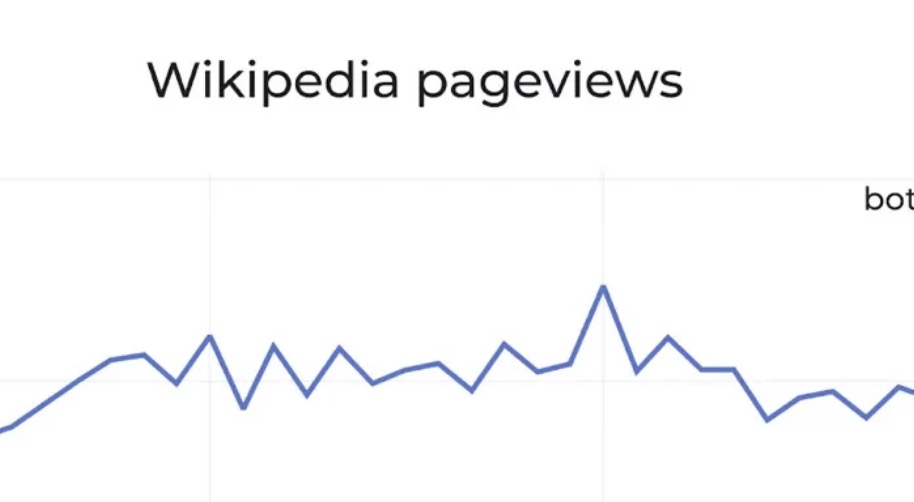
According to the Wikimedia Foundation, while human traffic to the site fell by 8% last year, bot traffic surged. This raises a fundamental economic question: who pays for the infrastructure required to feed the AI boom?
“Our infrastructure is not free, right?” said Wikimedia Foundation CEO Maryana Iskander in an interview from Johannesburg. Iskander, who will step down on January 20 to be replaced by Bernadette Meehan, emphasized that maintaining the servers costs significant money.
Currently, the bulk of Wikipedia’s funding comes from 8 million individual donors. Founder Jimmy Wales argues that this model cannot sustain the parasitic relationship established by Big Tech.
“They’re not donating in order to subsidize these huge AI companies,” Wales explained. “They’re saying, ‘You know what, actually you can’t just smash our website. You have to sort of come in the right way.’”
Under the new agreements, these AI companies will pay to access Wikipedia content via an enterprise platform “at a volume and speed specifically designed for their needs.”
Better Data, “Less Angry” AI
Despite the financial disputes, Jimmy Wales has taken a pragmatic, even welcoming, stance toward artificial intelligence—provided the terms are fair. He views Wikipedia as a vital stabilizing force for AI development.
“I’m very happy personally that AI models are training on Wikipedia data because it’s human curated,” Wales told The Associated Press. He drew a sharp contrast between Wikipedia’s editorial standards and other data sources, specifically taking a jab at Elon Musk’s platform, X (formerly Twitter).
“I wouldn’t really want to use an AI that’s trained only on X, you know, like a very angry AI,” Wales noted.
The logic is clear: If AI models want to be accurate and neutral, they need high-quality data. Wales insists that tech companies want to work with Wikipedia rather than be blocked, but they “should probably chip in and pay for [their] fair share of the cost.”

Integrating AI into the Wiki Experience
The relationship between Wikipedia and AI is not purely financial; it is also functional. The Wikimedia Foundation has outlined a strategy to integrate AI tools to assist—not replace—its 250,000 volunteer editors.
Wales acknowledged that while current AI is not capable of writing high-quality Wikipedia entries from scratch (“It often is quite rambling and sort of talks nonsense”), it can handle tedious maintenance tasks. Future tools might scan text to update dead links or suggest sources.
Furthermore, the user experience may soon evolve from keyword searching to a chatbot-style interface. “You can imagine a world where you can ask the Wikipedia search box a question and it will quote to you from Wikipedia,” Wales said, envisioning a system that cites specific paragraphs and articles to answer user queries directly.
Political Crossfire and “Grokipedia”
As Wikipedia enters its next quarter-century, it faces challenges beyond server costs. The platform has increasingly come under fire from political conservatives in the U.S., including Republican lawmakers investigating alleged “manipulation efforts” and bias within the editing process. Critics have dubbed the site “Wokepedia.”
Leading this charge is billionaire Elon Musk, who has urged users to stop donating to Wikipedia and launched a rival AI-powered feature called Grokipedia.
Wales, however, dismissed Grokipedia as a “real threat.” He pointed out that because Grokipedia relies on LLMs, it essentially regurgitates Wikipedia content—often with hallucinations or errors attached. “The more obscure topic you look into, the worse it is,” Wales observed.