Bridging the gap between high-fidelity 3D models and retro-style volumetric rendering with semantic precision.
- A Novel Framework: Voxify3D introduces a two-stage pipeline that seamlessly converts standard 3D meshes into stylized voxel art, overcoming the traditional trade-offs between geometric abstraction and aesthetic appeal.
- Tech Synergy: The system combines orthographic pixel art supervision, CLIP-based semantic alignment, and palette-constrained Gumbel-Softmax quantization to ensure pixel-perfect coherence and semantic preservation.
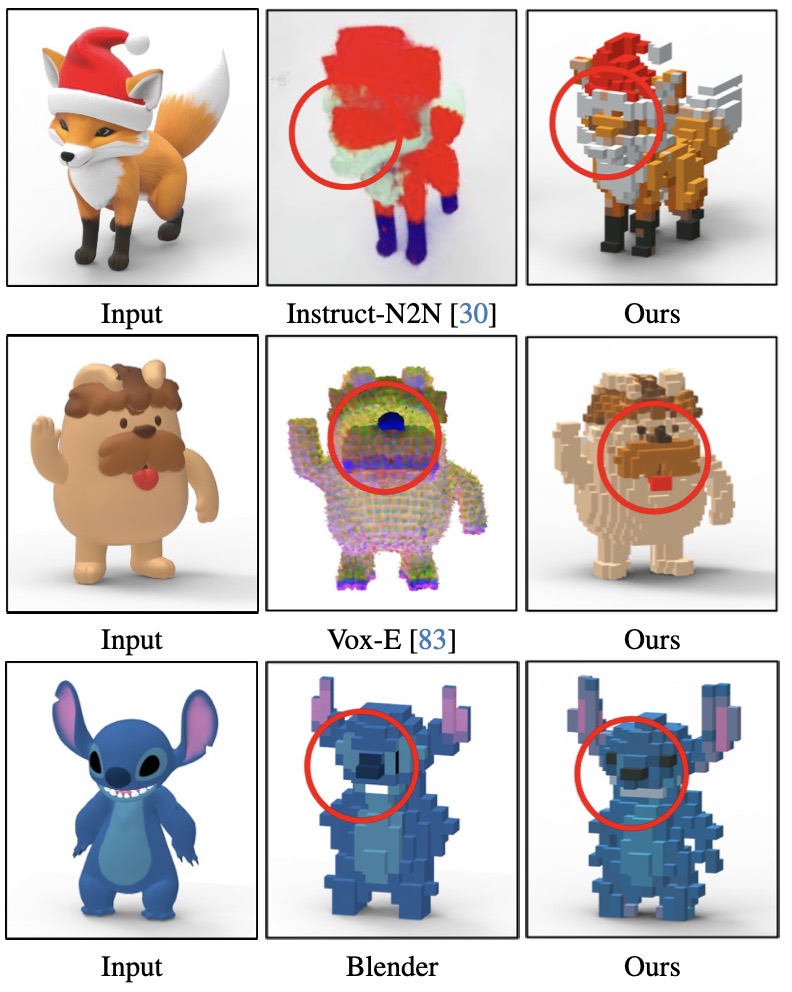
- Verified Excellence: Outperforming existing baselines with a 77.90% user preference rate, Voxify3D not only dominates in digital rendering but also opens doors for physical fabrication, such as LEGO-style assemblies.
Voxel art—a distinctive stylization that serves as the 3D cousin to 2D pixel art—has cemented its place as a cornerstone of modern gaming and digital media. From indie darlings to blockbuster sandboxes, the charm of the “volumetric pixel” is undeniable. However, creating these assets poses a significant technical hurdle. While artists crave the retro aesthetic, automated generation from existing 3D meshes remains notoriously challenging.
The difficulty lies in a conflict of requirements: how does one abstract geometry into blocks without losing the object’s identity? How does one maintain a limited, coherent color palette while respecting the original texture? Existing methods have historically struggled here, often over-simplifying the geometry or failing to capture the crisp, palette-constrained aesthetics that define the genre.
Enter Voxify3D, a groundbreaking differentiable framework designed to solve these exact problems. By synergistically integrating 3D mesh optimization with 2D pixel art supervision, Voxify3D offers a new standard for automated voxelization.
The Voxify3D Engine: A Two-Stage Symphony
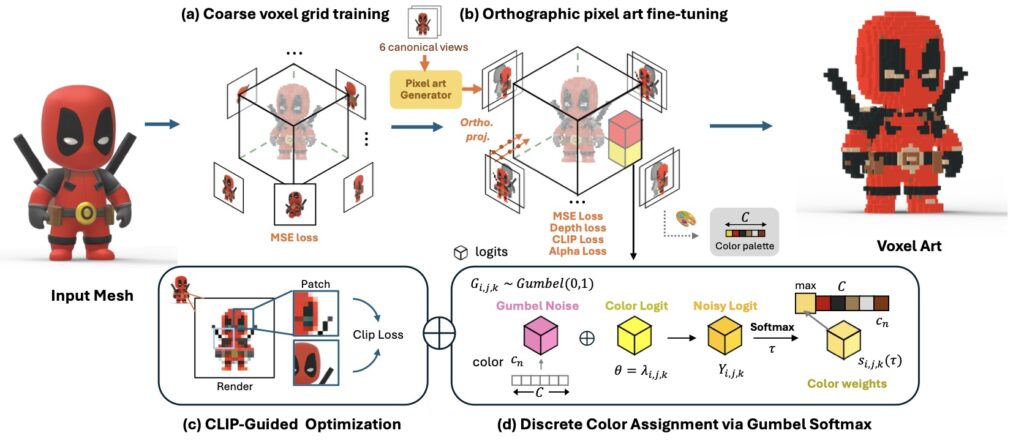
The core innovation of Voxify3D is its ability to bridge the gap between continuous 3D shapes and discrete colored blocks. The framework operates through a sophisticated two-stage pipeline that moves from general shape approximation to precise stylistic refinement.
Capturing the Coarse Geometry
The process begins with a standard 3D mesh. The system renders multi-view images to optimize a voxel-based radiance field (specifically using DVGO). By utilizing Mean Squared Error (MSE) loss, the system learns the coarse geometry and appearance of the object. This establishes the “canvas” upon which the art will be generated.
The Art of Refinement
The magic happens in the second stage, where the coarse voxel grid is fine-tuned into a stylized masterpiece. This is achieved through three specific technological components working in unison:
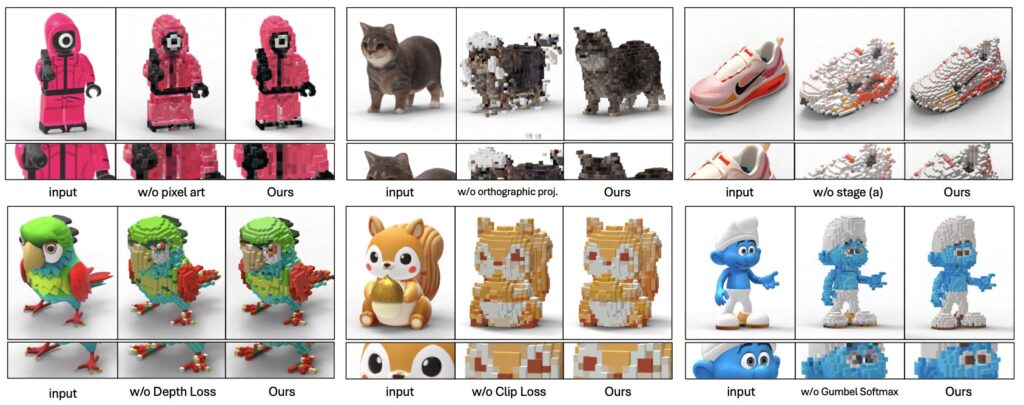
- Orthographic Pixel Art Supervision: To achieve that “flat” retro look, the system refines the grid using six orthographic views. This eliminates perspective distortion, ensuring precise alignment between the 3D voxels and the 2D pixel aesthetic.
- Patch-Based CLIP Alignment: One of the biggest risks in lowering resolution is losing the “meaning” of the image. By using a CLIP loss computed over rendered patches, Voxify3D ensures that a voxelized dog still looks like a dog. This preserves semantics even across extreme discretization levels.
- Differentiable Color Optimization: Perhaps the most technical innovation is the use of palette-constrained Gumbel-Softmax quantization. This allows the system to optimize colors within a discrete space (a specific color palette) while remaining differentiable. It means the software can mathematically “learn” which specific color from a limited set best fits a specific voxel.
Performance and Controllability
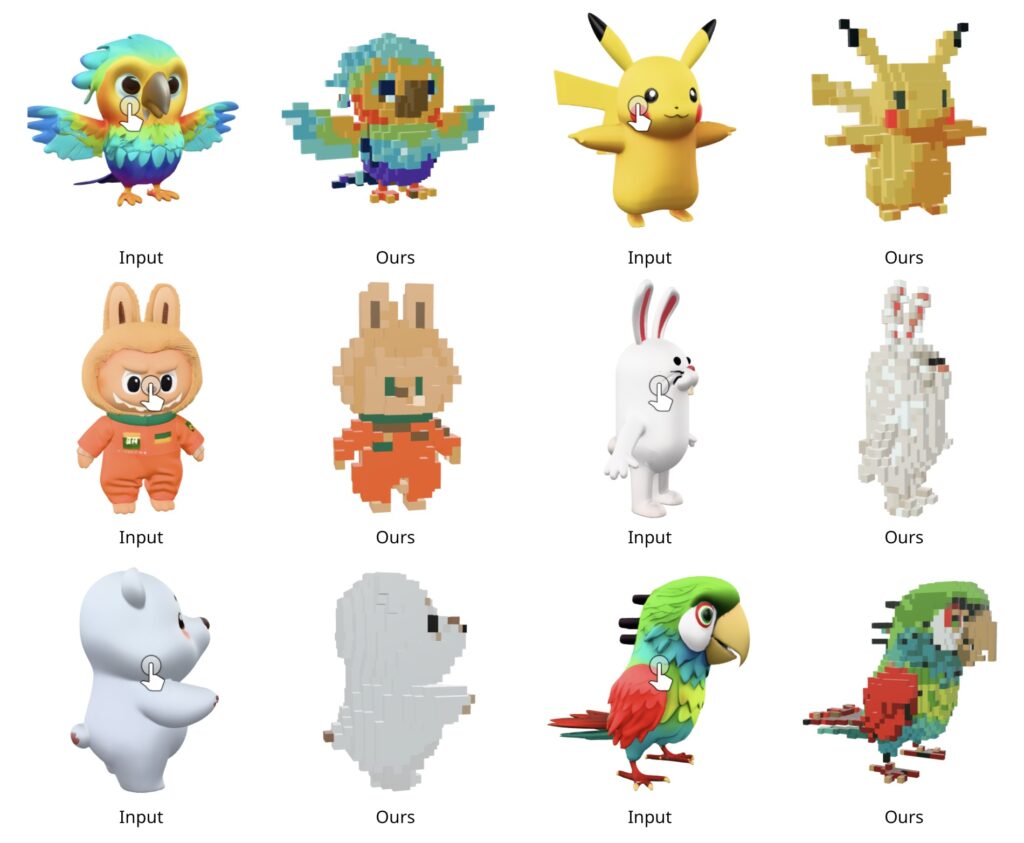
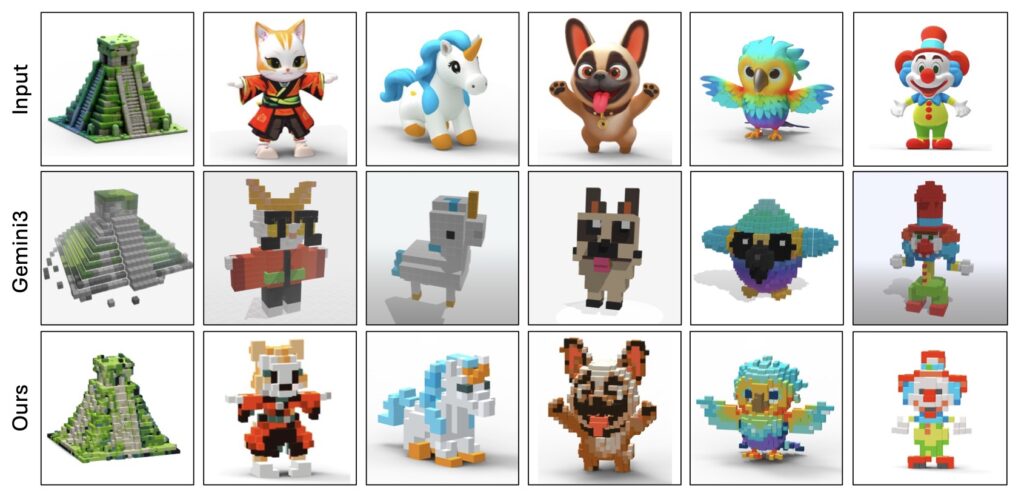
The results speak for themselves. In extensive experiments, Voxify3D demonstrated superior performance, achieving a 37.12 CLIP-IQA score. More telling, however, is the human element: in user studies, the output of Voxify3D was preferred 77.90% of the time over existing baselines.
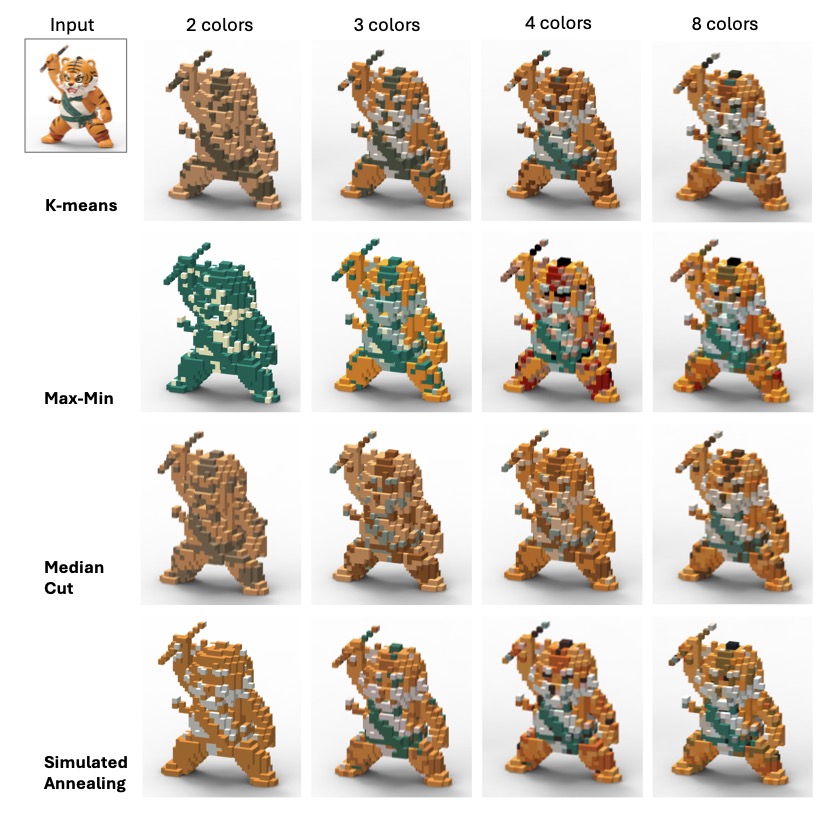
The system is not just powerful; it is flexible. It allows for controllable abstraction, enabling users to dictate the number of colors (e.g., 2 to 8 colors) and resolution scale (20× to 50×). Whether the goal is a minimalist icon or a detailed character model, the framework maintains structural consistency and visual appeal.
Beyond the Screen: Physical Fabrication
While Voxify3D is a digital tool, its implications extend into the physical world. Because the output is inherently volumetric and block-based, it is perfectly suited for fabrication. The researchers illustrated this potential by rendering their voxel outputs as LEGO-style assemblies.
This demonstrates a pipeline where a digital artist could take a high-definition character mesh, run it through Voxify3D to create a structurally sound block model, and then build it in the real world using plastic bricks. Future iterations of the work aim to adopt assembly-aware strategies to improve physical realizability, ensuring that the virtual blocks adhere to brick connectivity principles.
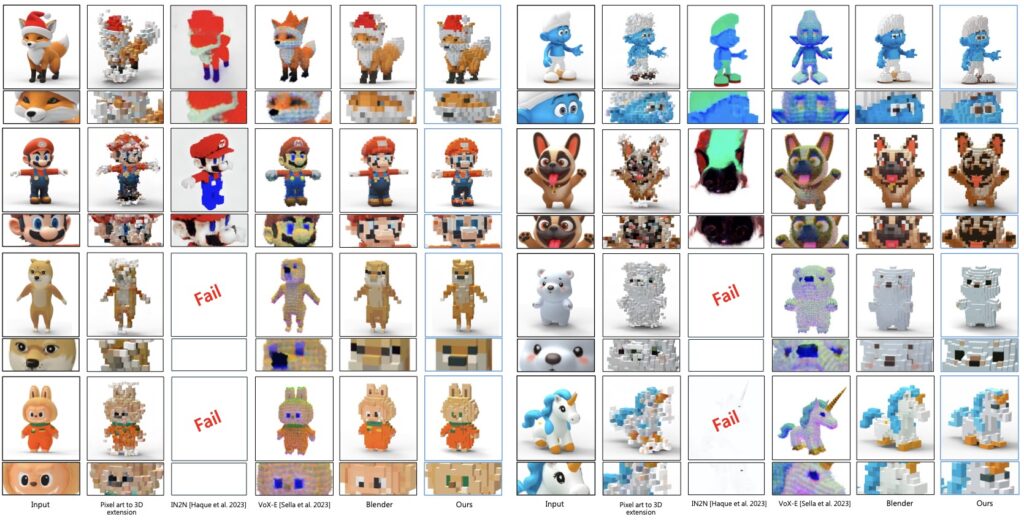
Despite its success, Voxify3D is not without limitations. The system currently struggles with highly intricate shapes. When resolution is low, thin structures or fine facial details may be lost in the abstraction process.
Looking forward, the research team aims to integrate geometric priors and advanced training strategies to enhance detail preservation. By combining better scalability with assembly-aware fabrication logic, Voxify3D is poised to become the definitive tool for bridging the worlds of high-end 3D graphics, retro pixel art, and physical creation.