
From Mac Minis to Microchips: Why Ultra-Lightweight Go Architectures are the Future of Personal AI
- Extreme Efficiency: PicoClaw delivers the core functionality of heavy-duty assistants using only 1% of the code and memory typically required.
- Hardware Democratization: The system runs on $10 RISC-V hardware with less than 10MB of RAM, making AI agents accessible on almost any Linux-based device.
- Autonomous Engineering: Developed in just one day, 95% of the core was built through an AI-driven “self-bootstrapping” process in the Go programming language.
For years, the conventional wisdom in the AI industry has been “bigger is better.” We’ve been told that to run a capable personal assistant, you need a dedicated Mac Mini, a beefy GPU, or a constant tether to a massive cloud server. PicoClaw has just shattered that narrative. Inspired by the nanobot philosophy and born from the lineage of OpenClaw, PicoClaw is an ultra-lightweight AI agent refactored from the ground up to prove that intelligence doesn’t require a massive footprint.
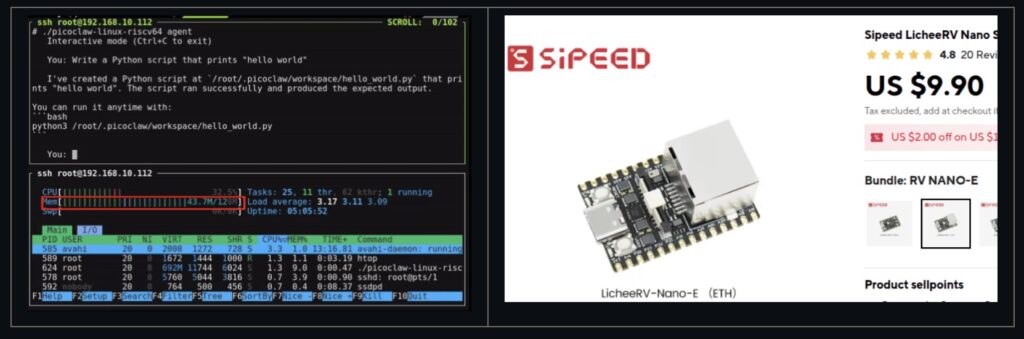
The most striking aspect of PicoClaw isn’t just its size, but its origin story. In a feat of “recursive engineering,” the AI agent itself drove the entire architectural migration from its predecessors into a native Go implementation. This self-bootstrapping process allowed the system to optimize its own code, resulting in a core that is 95% agent-generated. By utilizing human-in-the-loop refinement for the final polish, the developers managed to replicate the core features of much larger systems in a single day of development.
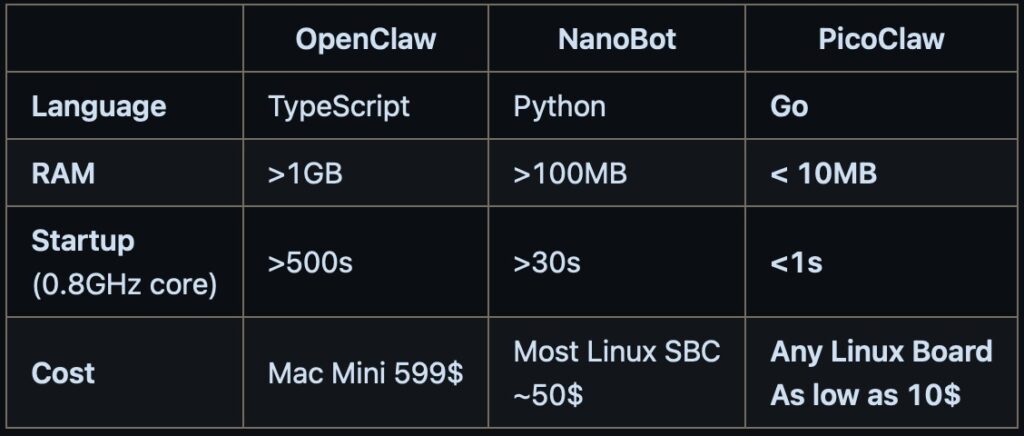
The technical specifications of PicoClaw read like a manifesto for the minimalist coder. While traditional “Clawdbot” style setups might demand gigabytes of overhead, PicoClaw operates within a <10MB memory footprint. This 99% reduction in memory usage isn’t just a vanity metric; it translates directly to hardware freedom. It means you can ditch the $500 desktop setup in favor of $10 RISC-V or ARM hardware. If a device runs Linux, it can now serve as a fully functional AI agent.
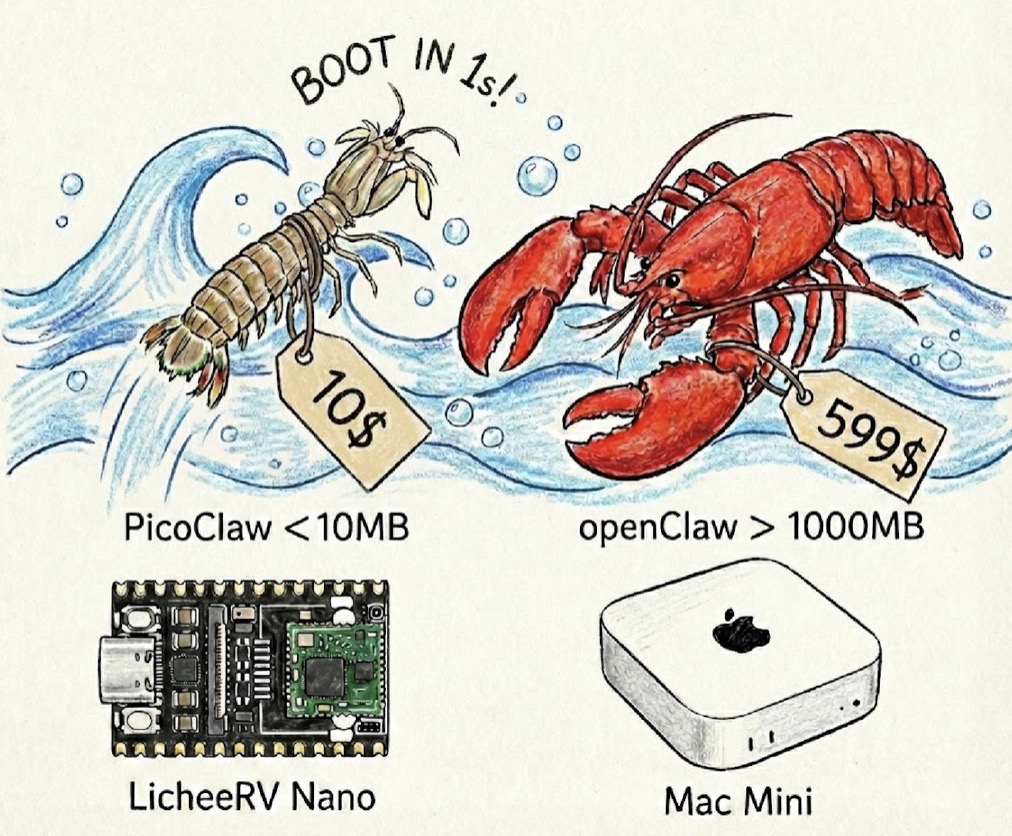
Performance-wise, the transition to a single, self-contained Go binary has yielded “lightning in a bottle.” PicoClaw boasts a 400X faster startup time compared to its heavier counterparts. Even on a modest 0.6GHz single-core processor, the system boots in under one second. This level of portability—spanning RISC-V, ARM, and x86 architectures—ensures that “One-click to Go” is a reality for hobbyists and enterprise developers alike.
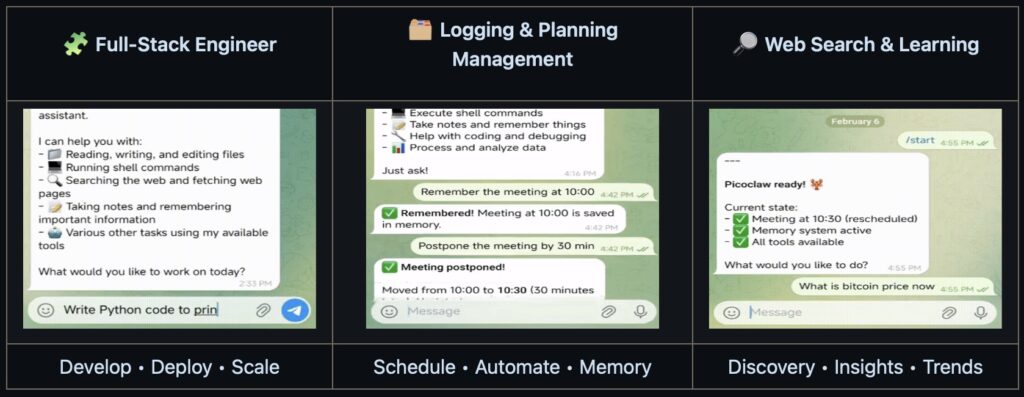
Ultimately, PicoClaw represents a shift in the AI landscape from “quantity of compute” to “quality of architecture.” By stripping away the bloat and focusing on a Go-native, hyper-optimized core, PicoClaw has turned the dream of ubiquitous, low-cost AI agents into a $10 reality. As the project slogan suggests—皮皮虾,我们走! (Mantis Shrimp, let’s go!)—the era of heavy, expensive AI is behind us; the era of the nimble, ultra-efficient agent has arrived.