
From exploding pressure cookers to candy forests, a wave of low-quality, algorithmic content is generating billions of views—and drowning out human creativity.
- Algorithmic Saturation: Research indicates that more than 20% of videos recommended to new YouTube users are “AI slop,” with one-third of feeds comprised of low-quality “brainrot” designed solely to monetize attention.
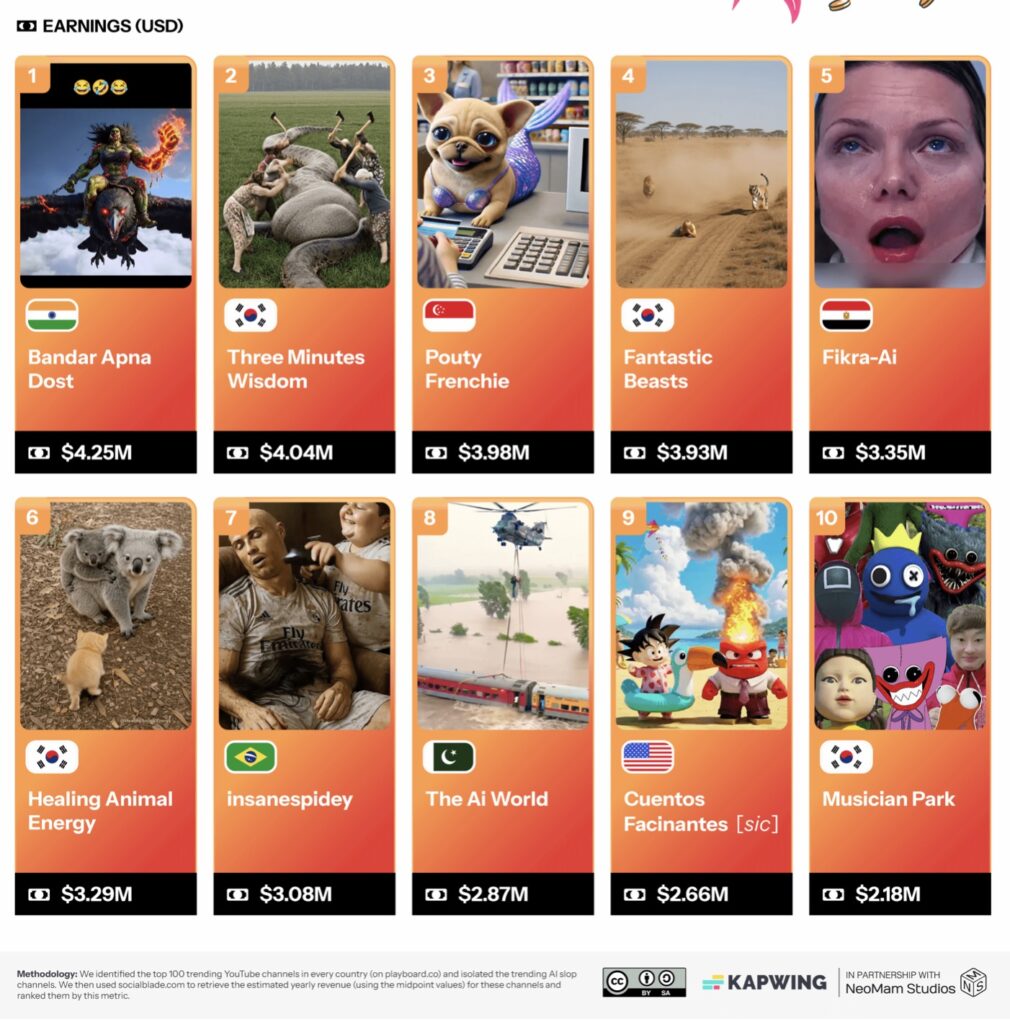
- A Lucrative Industry: Despite being low-quality, these channels generate an estimated $117 million annually, with top channels in India and the US earning millions individually through billions of views.
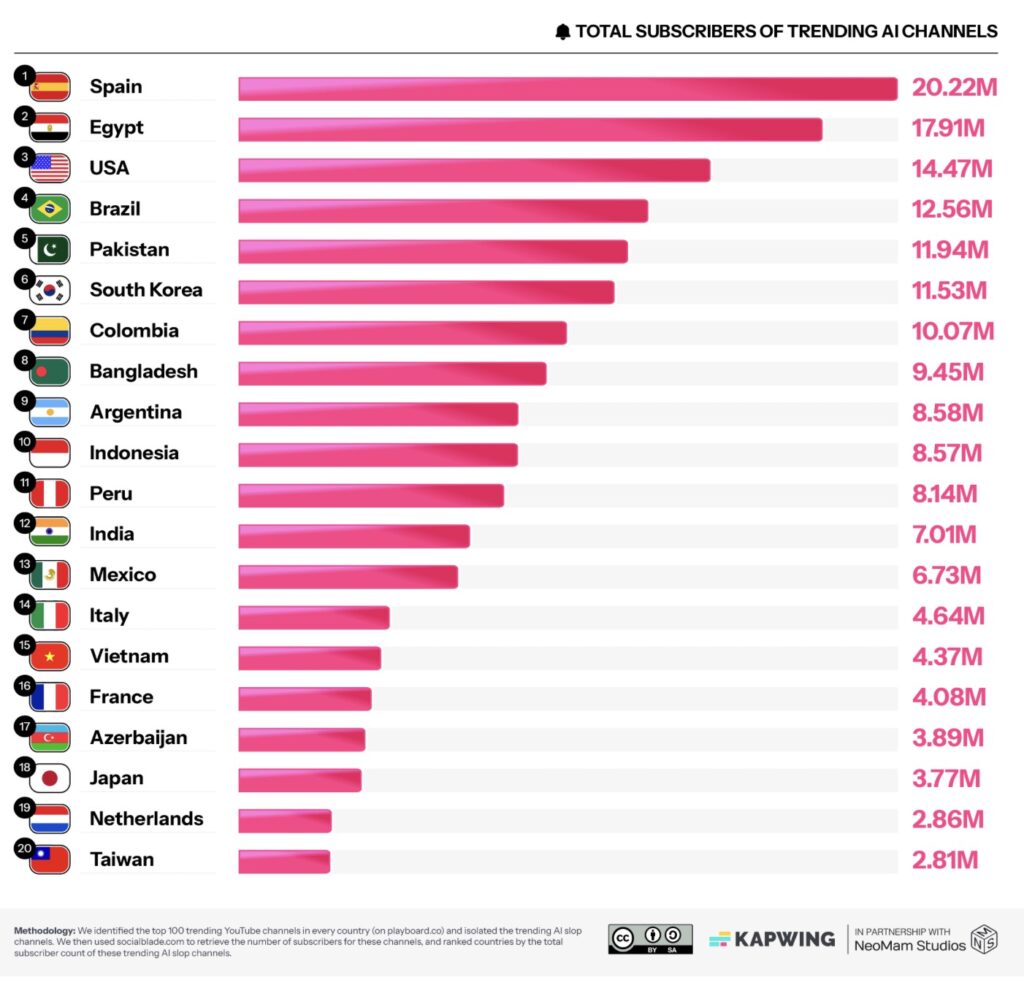
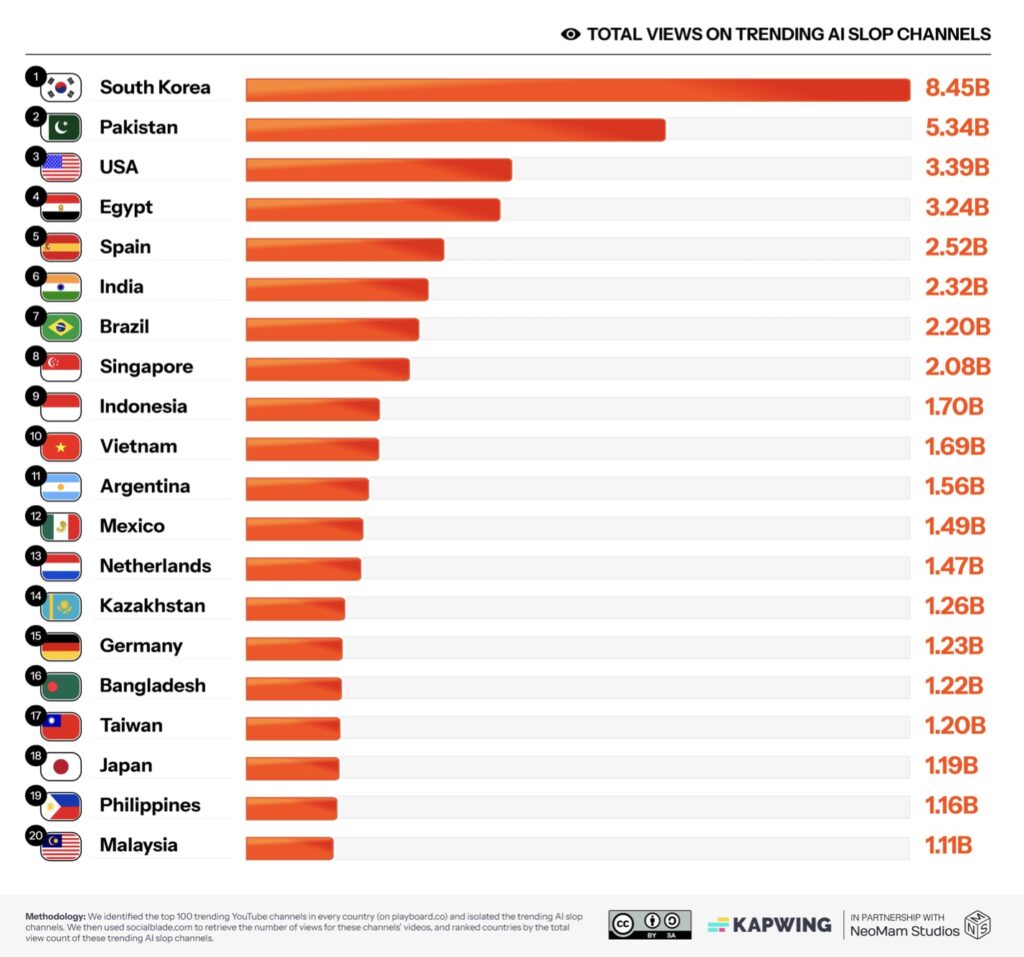
- Global Reach: The phenomenon is international, with Spain leading in subscribers (20 million) and South Korea leading in views (8.45 billion), creating a semi-structured industry that prioritizes quantity over human creativity.
If you create a brand new YouTube account today and scroll through your feed, you won’t just see viral dances or news clips. You will likely encounter a surreal stream of digital refuse: anthropomorphic monkeys fighting demons, French bulldogs eating crystal sushi, and Infinite loops of exploding pressure cookers. This is the era of “AI slop”—and it is taking over the world’s biggest video platform.
According to a comprehensive study by video-editing company Kapwing, low-quality, AI-generated content is now saturating social media at an alarming rate. By surveying 15,000 of the world’s most popular YouTube channels, researchers found that the platform is being flooded by a rapidly expanding industry that generates approximately $117 million (£90m) in revenue every year.
The “Brainrot” Economy
The scale of this operation is staggering. The study identified 278 top-tier channels that contain nothing but AI slop. Together, these channels have amassed over 63 billion views and 221 million subscribers.
When researchers simulated the experience of a new user by creating a fresh account, the results were stark. Of the first 500 videos recommended, 104 were classified as AI slop. Even more concerning, one-third of the feed was categorized as “brainrot”—a broader category of low-effort, addictive content designed to numb the viewer and monetize their attention span.
This isn’t accidental. It is a semi-structured, growing industry. “Sloppers,” as they are sometimes called, utilize generative AI tools to churn out vast quantities of content. As journalist Max Read notes, these creators congregate on Telegram and Discord, trading tips on how to game algorithms. For many in middle-income countries like India, Nigeria, Brazil, and Ukraine, this is a viable career; the ad revenue from YouTube significantly outpaces local median wages.
The Stars of the Slop
The content itself ranges from the bizarre to the macabre, yet it commands audiences larger than major television networks. The study highlights several global heavyweights in the slop industry:
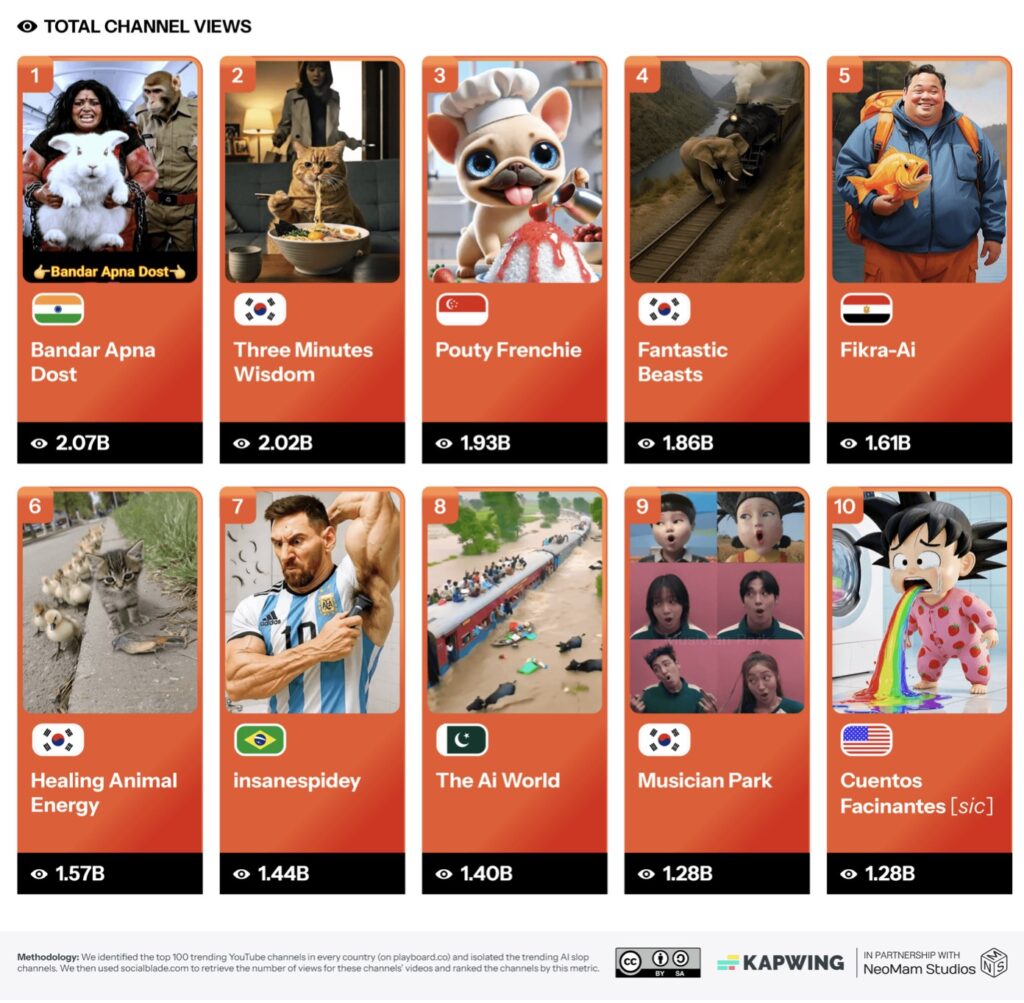
- Bandar Apna Dost (India): The most-viewed channel in the study features a realistic CGI monkey and a Hulk-like character traveling on a helicopter made of tomatoes. With 2.4 billion views, it has an estimated annual revenue of up to $4.25 million.
- Cuentos Facinantes (USA): This Spanish-language channel targets children with low-quality cartoons and holds the title for the most subscribers in the study at 5.95 million.
- Pouty Frenchie (Singapore): Targeting children with videos of a bulldog driving to candy forests set to the sound of laughing toddlers, this channel generates nearly $4 million a year from 2 billion views.
- The AI World (Pakistan): Perhaps the most cynical entry, this channel uses AI to generate shorts of catastrophic flooding, titling them “Poor Family” or “Flood Kitchen,” often set to relaxing sleep music.

A Global Phenomenon
While the content feels detached from reality, its consumption is geolocated and massive. Spain has emerged as a hub for subscribers, with 20.22 million people—nearly half the country’s population—following trending AI channels. South Korea, however, leads in engagement, with trending slop channels amassing a colossally high 8.45 billion views.
The rise of this content marks a shift in how media is consumed. It is decontextualized, international, and largely language-agnostic. A video of a pressure cooker exploding requires no translation; it triggers a primal, algorithmic “click” that transcends borders.
The Death of Context and the Rise of Noise
Critics argue that this flood of synthetic media is contributing to “information exhaustion.” Researcher Eryk Salvaggio suggests that this content acts as noise, drowning out legitimate signals and increasing human dependency on algorithms to sort the world. Furthermore, the “illusory truth effect” means that constant exposure to AI-generated fakes—even obvious ones—can warp a viewer’s perception of reality.
Despite these concerns, the platforms remain largely permissive. A YouTube spokesperson stated that generative AI is merely a “tool” and that the company focuses on “connecting users with high-quality content,” removing only what violates specific community guidelines.
For the human creators trying to compete with a machine that can produce ten videos in the time it takes to write a single script, the playing field looks increasingly uneven. In the world of AI slop, human creativity is secondary to the sheer volume required to feed the algorithm.