
Traffic has plummeted to 2008 levels, yet revenue has doubled. Here is the fascinating story of a tech giant becoming a “canary in the circular coal mine.”
- The Great Collapse: Since the launch of ChatGPT, monthly question volume on Stack Overflow has crashed from a peak of ~300,000 to roughly 6,866—levels not seen since its launch in 2008.
- The Financial Rebound: despite the death of the public forum, annual revenue has doubled to $115 million thanks to aggressive monetization of its back-catalog.
- The New Business Model: The company has pivoted from an ad-supported community to an enterprise data provider, selling its human-verified answers to the very AI labs that destroyed its traffic.
In July 2023, Elon Musk looked at the trajectory of the internet’s most famous coding forum and diagnosed it with “death by LLM.” He wasn’t exaggerating.
For over a decade, Stack Overflow was the backbone of the internet for software developers. During the pandemic, it reached the peak of its powers, serving as the go-to repository for coders seeking “evergreen” technical solutions. But the arrival of generative AI has fundamentally altered the landscape. With the rise of powerful coding assistants like ChatGPT, Cursor, Claude, Google’s Gemini, and Microsoft’s Copilot, the need to ask a human on a public forum has evaporated.
However, a closer look at Stack Overflow reveals a strange paradox: The forum is dead, but the company is alive—and richer than ever.
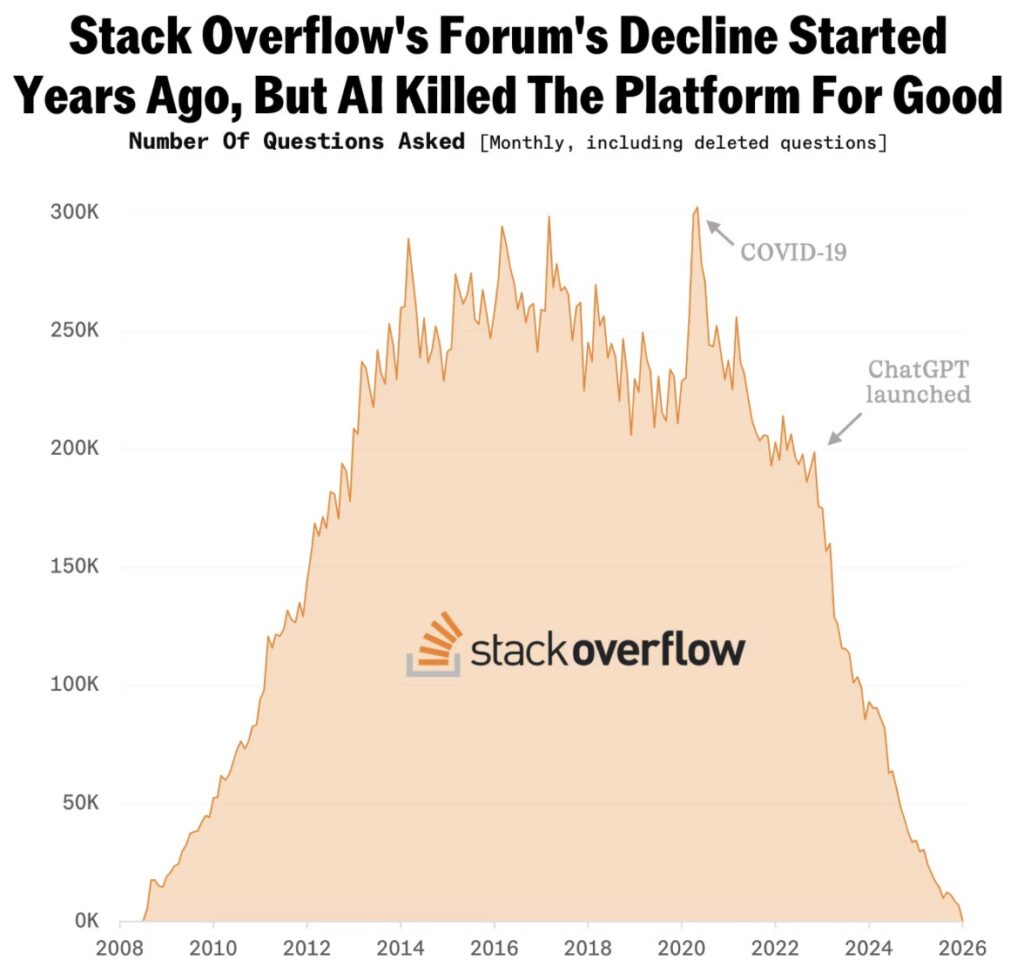
The “Death by LLM” Reality
The statistics regarding the platform’s public engagement are stark. The site has seen the number of monthly questions collapse from a high of 300,000 to approximately zero in relative terms. Last month, Stack Overflow recorded just 6,866 questions. This volume is roughly equal to the traffic the site experienced when it first launched back in 2008.
As queries move into private chat windows with Large Language Models (LLMs), the public square has emptied out. But while Stack Overflow the Q&A forum looks dead, Stack Overflow the company has pulled off a high-wire survival act.
The Pivot: Monetizing the Archives
Unlike education giant Chegg and other knowledge hubs that fell victim to generative AI without a backup plan, Stack Overflow realized it was sitting on a goldmine: Training Data.
The company has successfully doubled its annual revenue to $115 million over this span. While traffic fell off a cliff, the company managed to slim its net losses significantly—from $84 million in FY2023 to $22 million in the last fiscal year. This was achieved through a combination of desperate cost-cutting measures, including mass layoffs, and two major revenue streams that embrace the AI revolution:
- Stack Internal: This is the company’s new flagship enterprise product. It is a generative AI tool powered by the millions of high-quality Q&A pairs accumulated on the site over the years. Currently, 25,000 companies globally use this private, trusted instance of Stack Overflow to solve internal coding problems.
- Data Licensing: Following a model similar to Reddit (which generated over $200 million licensing user content in 2024), Stack Overflow is selling access to its back-catalog of human answers to AI labs. These labs need high-quality, human-verified logic to train the next generation of models.
Trust as the New Product
The irony is palpable. The AI tools that destroyed Stack Overflow’s traffic are now its primary customers. The company has shifted from an ad-revenue model dependent on eyeballs to a data-revenue model dependent on “trust.”
As CEO Prashanth Chandrasekar noted last December, the company’s new value proposition is the immense digital warehouse of human expertise it built over the last 15 years. LLMs are hungry for data on how to solve coding problems, but they cannot verify truth on their own. They need the historical data of humans correcting other humans.
The Canary in the Circular Coal Mine
Stack Overflow has become a fascinating case study in the modern tech ecosystem. It represents a “circular coal mine”:
- The platform creates data.
- AI models eat the data to become smart.
- Users stop using the platform because the AI is smart.
- The platform sells the old data to the AI to survive.
A looming question remains. As the CEO pointed out, the warehouse is “increasingly aging.” If no one is asking new questions on the forum, where will the training data for the next generation of programming challenges come from? For now, the company is kicking, raking in millions, and surviving the AI apocalypse by selling the very thing that made it famous.