
As the retail giant secures new tools for forecasting and automated markdowns, lawmakers and consumer advocates worry about a stealthy shift toward dynamic pricing.
- A Technological Leap in Retail: Walmart has secured two new AI-driven patents in 2026 focusing on automated e-commerce markdowns and machine learning-based demand forecasting, aiming to optimize inventory across its massive retail empire.
- Fears of Surge Pricing: While Walmart insists these systems are strictly for inventory management and markdowns, the tools’ ability to analyze individual shopper data has fueled fears among consumers and lawmakers about the potential for dynamic or personalized “surge” pricing.
- Physical Stores Meet Digital Tags: The debate is amplified by Walmart’s ongoing rollout of electronic shelf labels across all 4,600 of its US locations, a move that promises efficiency but has prompted legislative pushback and union concerns over job automation and rapid price fluctuations.
The modern grocery run is quietly becoming a high-tech data exchange, and the world’s largest retailer is at the center of the transformation. Walmart is actively developing algorithmic tools to shape how it sets and adjusts prices, a move that is intensifying scrutiny from US lawmakers already wary of data-driven pricing in the retail sector. So far in 2026, Walmart has added to its robust portfolio of nearly 50 US patents by securing two specific patents covering automated markdowns and machine learning-based demand forecasting.
Walmart is adamant that these new systems are not designed for surge pricing or individualized cost adjustments. However, their capabilities arrive at a highly sensitive moment. Across the country, lawmakers are moving aggressively to restrict the very practices consumer advocates fear these algorithms could eventually enable.
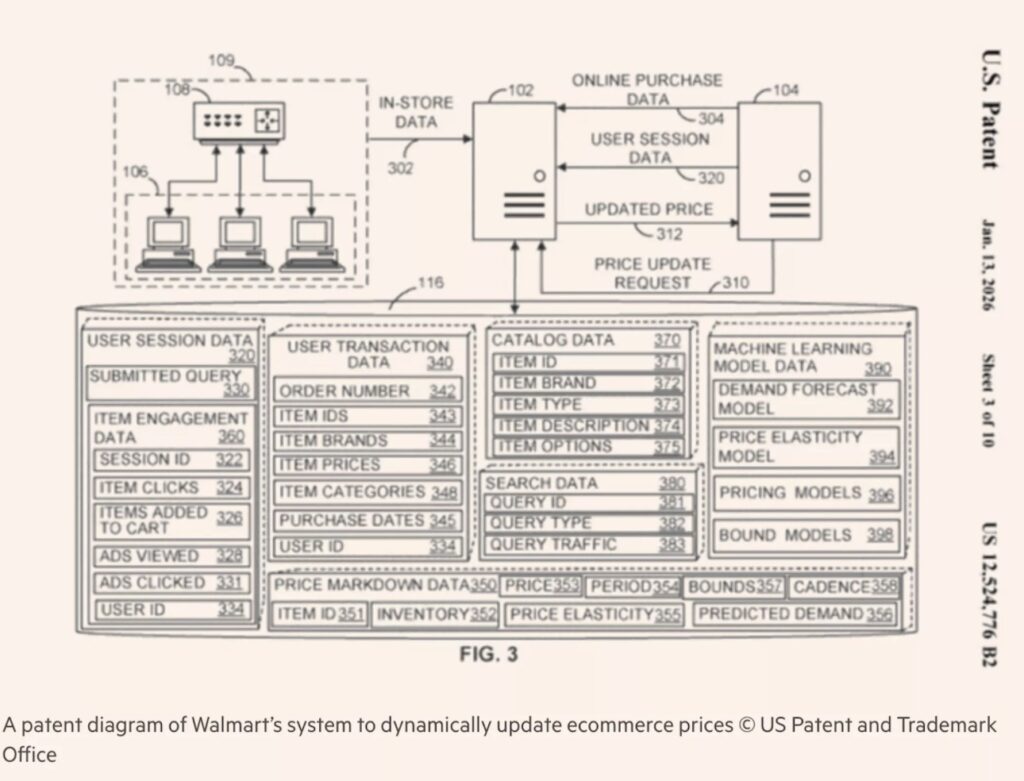
The Mechanics of Walmart’s New Patents
The first of the two patents, issued in January 2026, describes an “end-to-end price markdown system” specifically tailored for Walmart’s sprawling e-commerce platforms, which generated over $150 billion in sales last year. According to the filing, this system dynamically and automatically updates item prices to execute markdowns based on a wealth of data, including predicted demand and consumer price sensitivity. Walmart clarified to the Financial Times that this tool is meant to fine-tune discounts across massive transaction volumes, completely unrelated to real-time dynamic pricing of base costs.
The second patent, granted just last week, outlines a “demand forecasting and price recommendation” engine. Powered by machine learning, this system is designed to suggest prices that will quickly move inventory within specific time frames, whether that is a week, a month, or a quarter. What has raised eyebrows is the breadth of data this engine can ingest: purchase history, past prices, payment methods, and uniquely identifiable customer information, including passport or driver’s license numbers. Designed to work across diverse categories—from vegetables and spices to outdoor equipment and clothing—Walmart insists this tool is meant to support merchant decision-making, not automatically execute price changes.
“We don’t participate in surge pricing,” a Walmart spokesperson stated, reiterating that the company views these tools strictly as mechanisms to manage markdowns and inventory more efficiently.
A Clash with the “Everyday Low Price” Legacy
The debate over these patents is particularly sharp given Walmart’s long-standing retail philosophy. Founder Sam Walton built the empire on the promise of “everyday low prices,” focusing on keeping costs consistently below rivals rather than leaning on the unpredictable, short-term promotions common in the industry. Historically, this strategy has worked; research by Morgan Stanley notes that Walmart’s grocery prices have reliably sat 10 to 25% lower than those of conventional supermarkets.
Yet, as algorithmic pricing becomes a political target, Walmart finds its technological advancements under a microscope. Lawmakers in Maryland, Pennsylvania, and Minnesota have recently introduced measures aimed at banning or severely limiting dynamic pricing in supermarkets. In Maryland, Governor Wes Moore proposed the Protection from Predatory Pricing Act, a sweeping measure that would prohibit dynamic pricing and ban the use of surveillance data to inform individualized food prices. Consumer advocates and unions warn that, regardless of current intent, retailers could eventually pivot to adjusting prices at the individual shopper level.
Electronic Labels: The Digital Storefront
The digital transformation is not limited to Walmart’s e-commerce operations. At the physical store level, the retailer is in the process of rolling out electronic shelf labels (ESLs) across all 4,600 of its US stores within the next year. Having already installed these digital tags in roughly half of its locations, Walmart champions the system as a way to replace thousands of wasteful paper labels and dramatically reduce human pricing errors.
However, because electronic labels allow prices to be updated remotely and instantaneously, they have become a flashpoint. Two Democratic US senators have introduced legislation to bar ESLs in large grocery stores entirely. This proposal is heavily backed by the United Food and Commercial Workers International Union, whose members face the very real threat of having pricing and labeling tasks automated away.
Critics argue that these digital tags could easily be used to mislead shoppers by fluctuating prices too frequently or in ways that are nearly impossible for a consumer to track. The Retail Industry Leaders Association has summarized the debate by noting that while these fears are widespread, they remain largely hypothetical, pointing out a lack of concrete evidence that major retailers are using the technology for aggressive dynamic pricing today.
Walmart, for its part, has pushed back hard against claims that its shelf-label rollout is a Trojan horse for algorithmic price discrimination. In a statement released this month, the company assured the public that electronic labels simply make it easier to keep shelf tags accurate, emphasizing that in-store prices remain “consistent regardless of demand, time of day or who is shopping.”
Whether these AI patents and digital tags represent a natural evolution of retail efficiency or the first steps toward a fundamentally different pricing model remains to be seen. For now, the algorithm is waiting in aisle five.