Google’s major upgrade to its specialized reasoning mode bridges the gap between abstract theory and physical creation for AI Ultra subscribers.
- A Leap in Logic: The upgraded Gemini 3 Deep Think achieves gold-medal standards in international math and physics benchmarks, setting a new bar for AI reasoning.
- Code to Construct: New capabilities allow users to transform 2D sketches into 3D-printable files, streamlining the path from initial concept to physical prototype.
Specialized Access: The update is rolling out now to Google AI Ultra subscribers and, for the first time, is available to select researchers and enterprises via the Gemini API.
In a move that signals a shift from conversational AI to practical industrial utility, Google has officially released a significant upgrade to Gemini 3 Deep Think. This specialized reasoning mode is no longer just about answering questions; it is being positioned as a foundational tool for the next generation of scientific discovery and mechanical engineering. By blending deep scientific knowledge with everyday utility, the update seeks to solve “messy” real-world problems that lack clear guardrails or single, easy solutions.
The most striking feature of the new Deep Think is its ability to bridge the digital and physical worlds. In what feels like a page out of science fiction, engineers can now turn a simple hand-drawn sketch into a 3D-printable reality. Deep Think analyzes the nuances of a drawing, builds the complex underlying geometry, and generates the necessary files to create a physical object. This evolution moves the model beyond abstract theory, allowing researchers to model physical systems through code and interpret complex data sets with unprecedented speed.
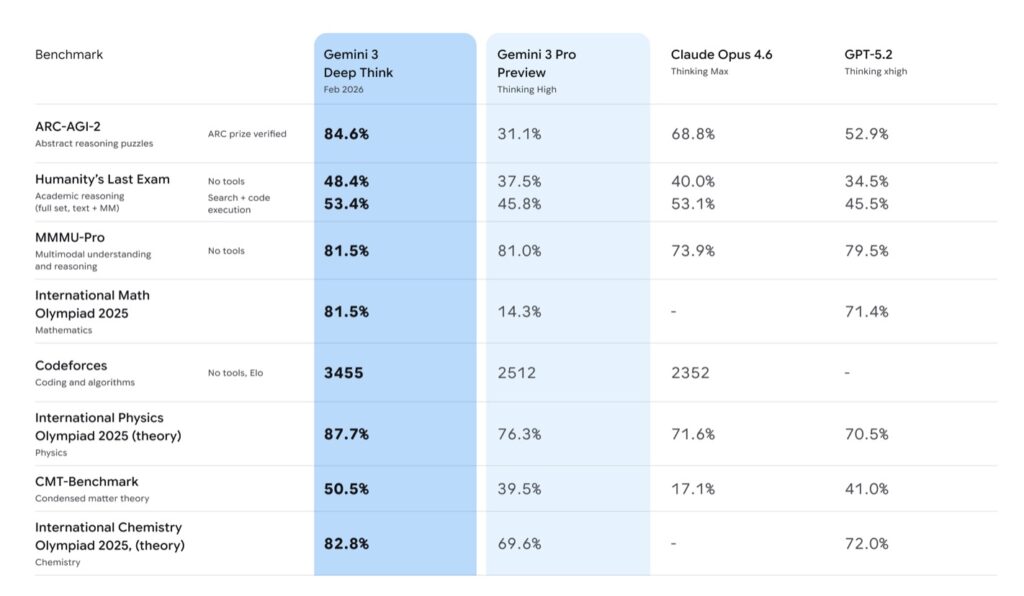
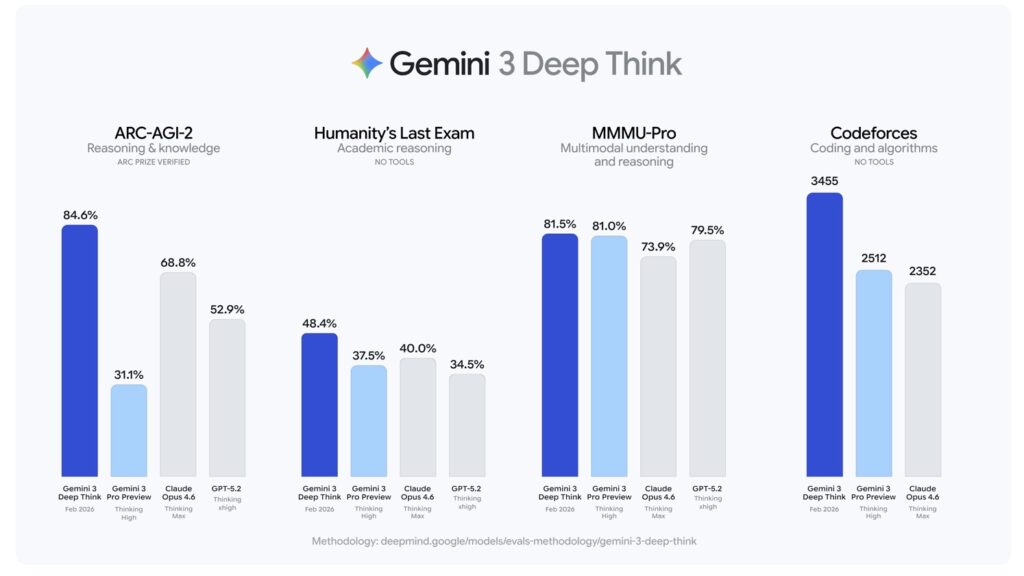
The technical milestones backing this release are equally formidable. According to internal reports, the updated mode has reached “gold-medal level” performance on the 2025 International Math Olympiad and the written sections of the International Physics and Chemistry Olympiads. Perhaps most impressively, it set a new standard on Humanity’s Last Exam, a benchmark specifically designed to push frontier models to their absolute limits, scoring a 48.4% without the assistance of external tools.

For the competitive programming community, the results are even more jarring. Deep Think has attained an Elo rating of 3455 on Codeforces, placing its coding proficiency in the highest echelons of human capability. It also achieved a verified 84.6% on the ARC-AGI-2 benchmark, a metric often cited by the ARC Prize Foundation as a primary indicator of progress toward artificial general intelligence.
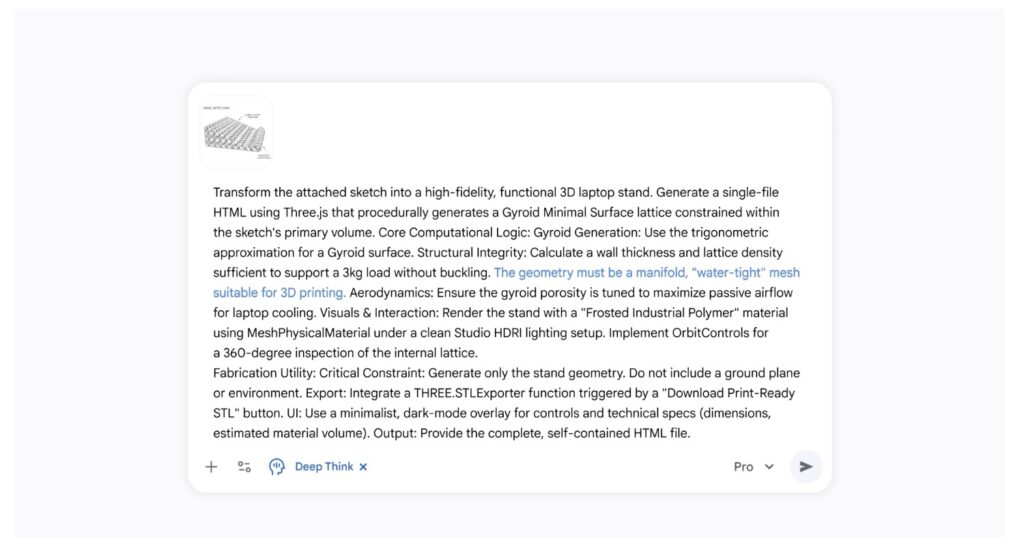
The rollout of these features is already underway. Starting today, Google AI Ultra subscribers can access the updated “Deep Think” option directly from the tools menu in the Gemini app. Recognizing the demand for these tools in specialized environments, Google is also opening an Early Access Program for the Gemini API, allowing select enterprises and researchers to integrate this reasoning power into their own proprietary workflows.
As AI continues to transition from a digital assistant to a laboratory collaborator, Gemini 3 Deep Think stands as a testament to the power of specialized reasoning. By tackling advanced theoretical physics and real-world engineering with equal poise, Google is making it clear: the future of AI isn’t just about thinking—it’s about building.