Leveraging the unified memory of NVIDIA DGX Spark, deep tech startup CYRAN AI cuts massive satellite imagery decode times by more than half, enabling real-time geospatial intelligence in air-gapped environments and paving the way for on-orbit inference.
- The Bottleneck Broken: CYRAN AI reduced the decode time of massive 26 GB satellite scenes from over five minutes to just over two minutes on local, edge-ready hardware.
- The Power of Unified Memory: Utilizing NVIDIA DGX Spark and its newly developed PixelFlux library, CYRAN eliminated data transfer overhead by combining GPU and CPU memory pools.
- From Air-Gapped to Orbit: This breakthrough enables interactive, real-time analysis for defense, Industry 4.0, and eventually space-based payloads, operating entirely without cloud infrastructure.
Humanity is currently observing the Earth at an unprecedented scale. Satellites, drones, and ground sensors are capturing our world in staggering detail, generating a tidal wave of geospatial data. However, for the intelligence analysts, defense operatives, and Industry 4.0 engineers operating at the tactical edge, capturing the data is only half the battle. The real challenge lies in processing it. For years, the bottleneck in delivering real-time intelligence hasn’t been the artificial intelligence models analyzing the imagery, but the seemingly mundane task of decoding it. JPEG 2000 is the gold standard compression format across Earth observation, utilized by major entities like Maxar, USGS, and Sentinel-2. Yet, with single scenes routinely exceeding ten gigabytes uncompressed, standard CPU pipelines choke. When analysts are operating in forward operations centers or secure, air-gapped environments without cloud access, a five-minute wait to decode a single image is not a minor inconvenience—it is a workflow-breaking pipeline stopper.
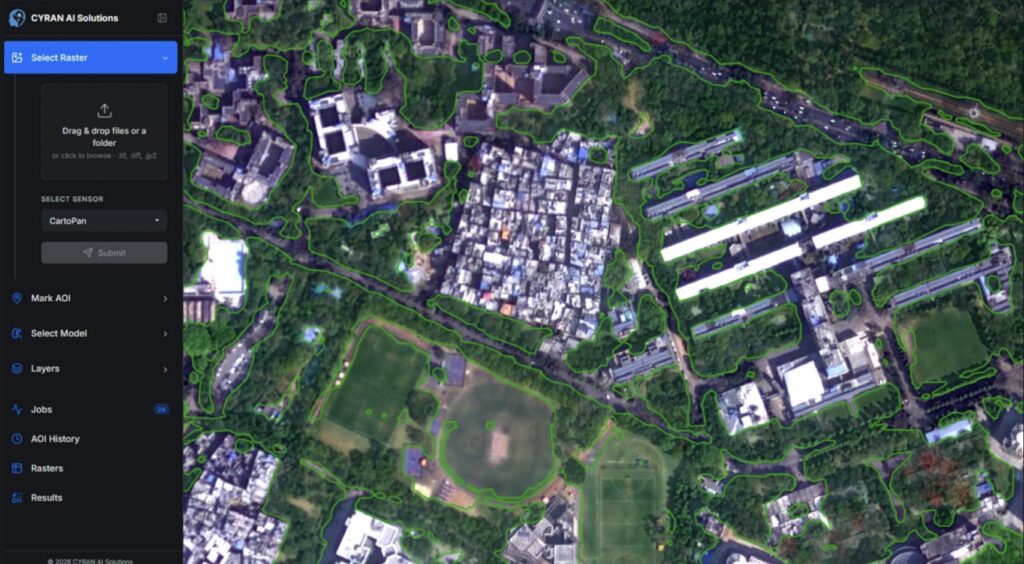
CYRAN AI Solutions, an AI-native deep tech startup spun out of IIT Delhi’s NVM and Neuromorphic Hardware Research Group, recognized this hidden wall. As a member of the NVIDIA Inception program, CYRAN builds sophisticated sensor fusion platforms designed to deliver real-time intelligence from orbit, air, and ground. Their flagship SpatialFuse platform was built for analysts who rely on rapid insights, but it was being constrained by these exorbitant decode times. For example, decoding a 26 GB satellite scene took more than five minutes on a conventional pipeline. In fields ranging from digital pathology to sovereign intelligence—any domain where data volumes have wildly outpaced legacy tooling—CYRAN knew that relying on a cloud round-trip was often impossible. They needed a local, hardware-based solution capable of keeping pace with modern sensors.
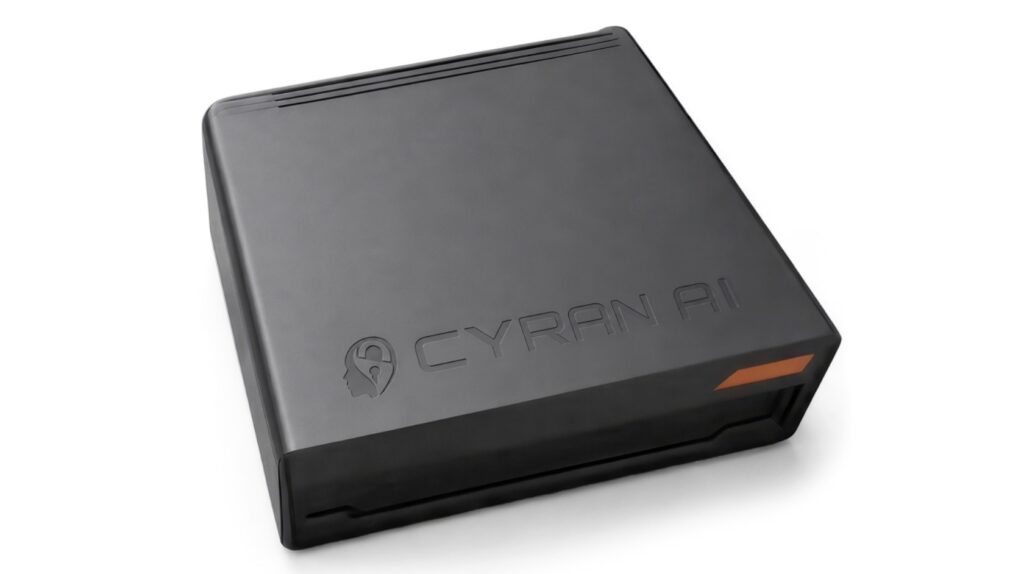
The solution arrived in the architecture of NVIDIA DGX Spark combined with CYRAN’s proprietary PixelFlux library. Built on the GB10 platform, DGX Spark features an NVIDIA Blackwell GPU and an NVIDIA Grace CPU that share a unified LPDDR5X memory pool. This architecture fundamentally changes how data is handled. In traditional discrete GPU setups—even high-end workstations like the NVIDIA RTX A6000 Ada—massive decoded image buffers must be laboriously copied back to the host memory over PCIe after processing. DGX Spark eliminates this transfer step entirely. Leveraging NVIDIA nvJPEG2000, CYRAN’s PixelFlux library replaces the CPU-based decode path, offloading the heavy lifting to the GPU. Because the CPU and GPU share the same memory pool, the decoded data is instantly available for use. For machine learning training workflows, PixelFlux seamlessly integrates with NVIDIA DALI, ensuring the GPU remains constantly fed from local storage without CPU preprocessing dragging down the system.
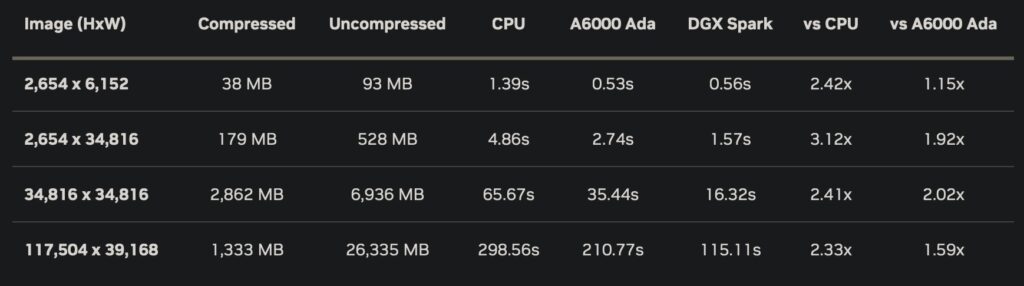
The performance leaps achieved by this unified approach are unambiguous. That 26 GB satellite scene that previously languished for over five minutes now completes in just over two minutes on a system compact enough to deploy in a forward operations center. As image sizes scale, so does the architectural advantage. While DGX Spark wins by 1.15x on the smallest test scenes compared to the RTX A6000 Ada, the advantage grows to over 2x for images a half-gigabyte and larger. The larger the image, the more time conventional workstations waste on data transfer—a hurdle unified memory simply erases. This raw throughput translates into transformational business impacts. Development and debugging cycles that once required massive multi-GPU servers or cloud access can now be executed natively on a desk. Machine learning engineers and analysts can finally engage in genuinely interactive, large-scene exploration locally—a strict operational requirement for secure defense and intelligence sectors.
Yet, terrestrial edge computing is merely the proving ground. Because the underlying nvJPEG2000 library is highly portable across Blackwell-based deployments, pipelines validated locally can scale directly to massive data centers and cloud environments without rework. CYRAN’s vision, championed by founder Prof. Manan Suri, extends far beyond the Earth’s surface. The company is actively exploring how to port these edge AI capabilities directly to advanced space payloads for on-orbit inference. As the number of space-based sensors expands, the compute and power constraints in orbit become exponentially more severe than on the ground. The exact principles that make NVIDIA DGX Spark so effective at the edge—fast local processing, highly efficient memory utilization, and a footprint built for constrained environments—apply perfectly to space. What began as a mission to solve a five-minute decoding delay has ultimately proven that the entire spectrum of geospatial intelligence, from sensor to insight, can now run anywhere.