

Faster, smarter, and fiercely autonomous—the latest model shifts AI from a reactive chatbot to a relentless problem-solver capable of managing complex, multi-step workflows from start to finish.
- A Leap in Autonomy and Action: GPT-5.5 transitions AI from generating text to actively using tools, checking its own work, and completing complex, multi-step tasks independently.
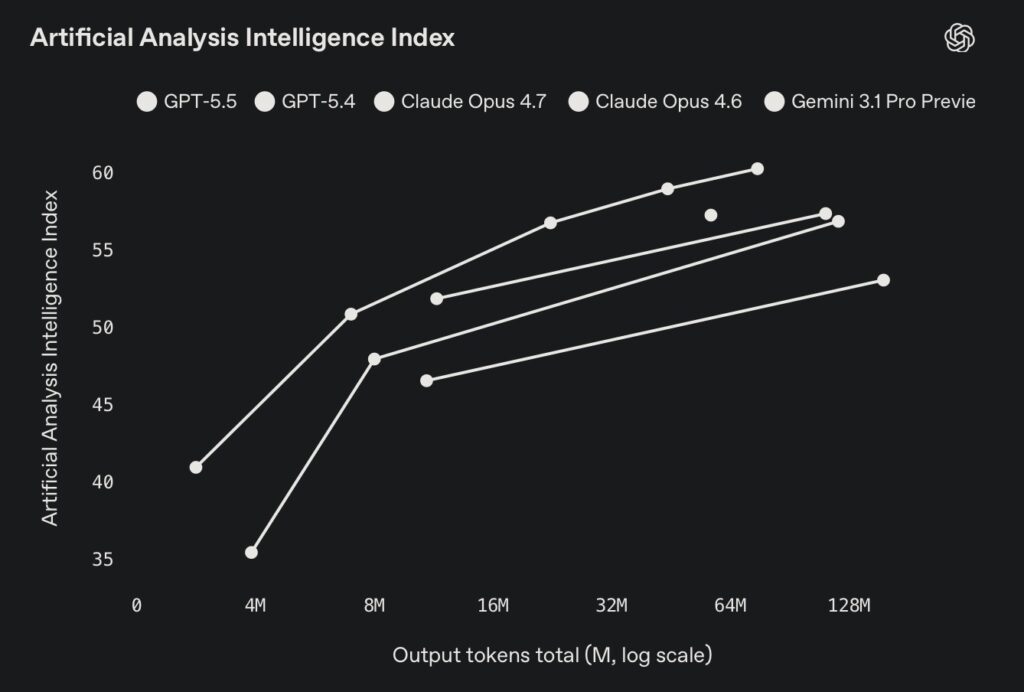
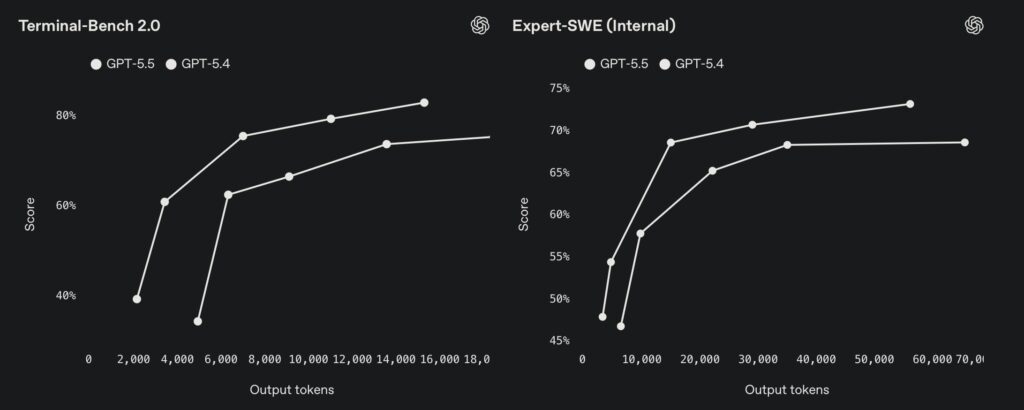
- Uncompromising Efficiency: Despite significant intelligence gains, it matches the per-token speed of GPT-5.4 while using far fewer tokens to achieve higher-quality results.
- Transforming Every Industry: From outperforming competing models in complex software engineering to discovering novel mathematical proofs and automating heavy knowledge work, GPT-5.5 acts as a true digital partner.
The way we interact with computers is undergoing a fundamental shift. For years, artificial intelligence has acted as an eager but dependent assistant, requiring meticulous step-by-step guidance to produce useful results. With the introduction of GPT-5.5, available now in ChatGPT and Codex, the paradigm has changed. We are entering the era of agentic AI. Instead of carefully managing every step of a process, users can now hand over a messy, ambiguous goal and trust the system to plan, navigate obstacles, and drive the task to completion.
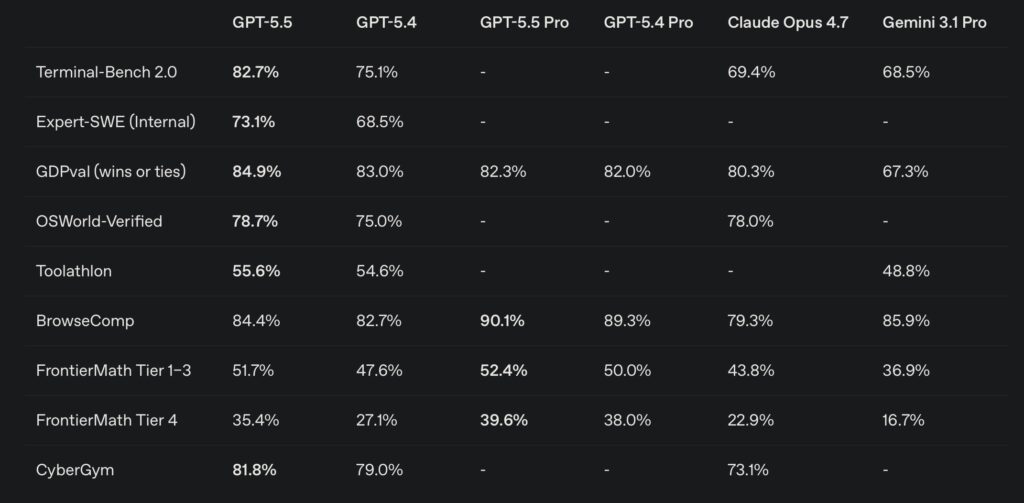
What makes GPT-5.5 truly remarkable is that it delivers a massive leap in intelligence without the traditional trade-off of speed. Historically, larger and more capable models have been slower and more resource-intensive. However, GPT-5.5 matches the per-token latency of its predecessor, GPT-5.4, in real-world applications. Not only is it fast, but it is also exceptionally efficient, requiring significantly fewer tokens to complete identical tasks. On the Artificial Analysis Coding Index, GPT-5.5 provides state-of-the-art intelligence at half the cost of competitive frontier models. This makes the newly introduced GPT-5.5 Pro a highly practical option for demanding, resource-heavy workflows.
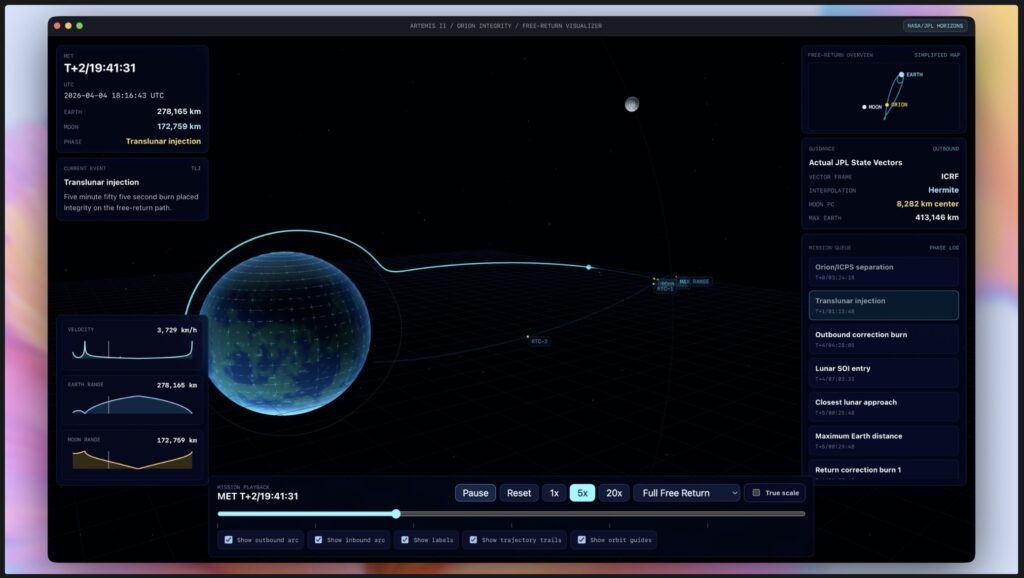
Nowhere are these gains more evident than in software engineering. GPT-5.5 is engineered to hold context across massive codebases, reason through ambiguous failures, and confidently execute system-wide refactors. Its benchmark performances speak volumes: it achieved a staggering 82.7% accuracy on Terminal-Bench 2.0 (testing complex command-line tool coordination) and 58.6% on SWE-Bench Pro (evaluating real-world GitHub issue resolution), solving more tasks end-to-end in a single pass than any previous model. Senior engineers report that it noticeably outperforms both GPT-5.4 and Claude Opus 4.7 in autonomy, often catching issues and predicting testing needs without explicit prompting. The impact is so profound that one early-access engineer at NVIDIA remarked, “Losing access to GPT-5.5 feels like I’ve had a limb amputated.”
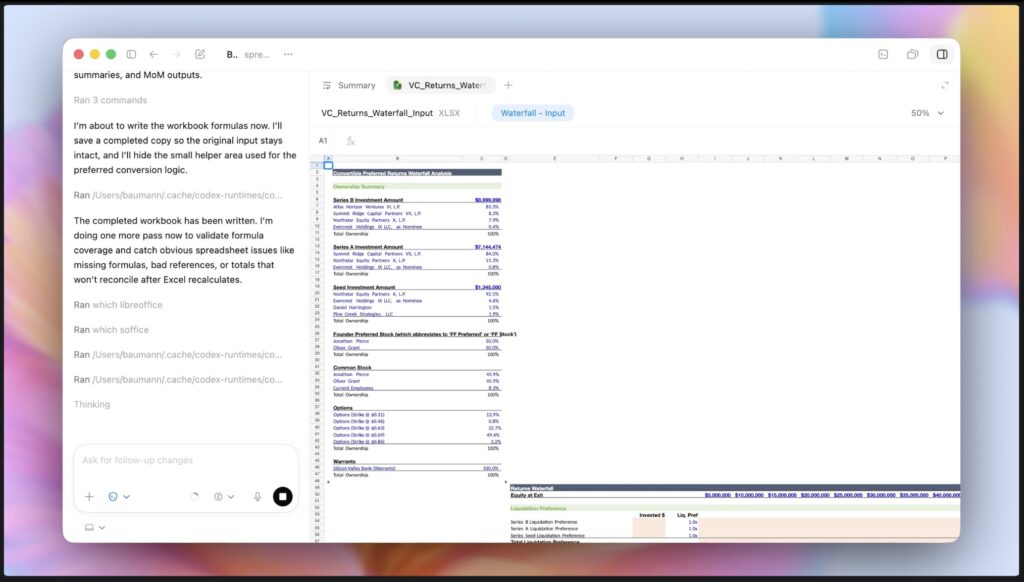
Yet, the model’s prowess extends far beyond the realm of code. GPT-5.5 is poised to revolutionize everyday knowledge work by naturally moving through the full loop of professional tasks: researching, synthesizing data, formatting documents, and building complex spreadsheets. At OpenAI, over 85% of the company already relies on the model weekly. The Finance team utilized it to review over 71,000 pages of tax forms, accelerating a massive project by two weeks. The Communications team built an automated Slack agent for risk-scoring speaking requests, and Go-to-Market employees are saving up to 10 hours a week on automated reporting. Scoring 84.9% on GDPval and 78.7% on OSWorld-Verified, the model proves it can autonomously operate real computer environments and produce well-specified work across dozens of occupations.
Perhaps the most thrilling frontier for GPT-5.5 is scientific research. True scientific progress requires an iterative loop of exploring ideas, testing assumptions, and interpreting data. On GeneBench, a rigorous evaluation for multi-stage genetics data analysis, the model excelled at navigating ambiguous data and implementing modern statistical methods. Even more astonishingly, an internal version of GPT-5.5 contributed to discovering a new proof regarding Ramsey numbers in combinatorics—a notoriously difficult field of mathematics. It didn’t just provide code; it generated a surprising, useful mathematical argument that was later verified by researchers. Early testers have praised the model not as a simple search engine, but as an iterative “research partner” that critiques manuscripts, stress-tests theories, and persists through long-term projects.
Recognizing the immense power of agentic AI, this release is backed by the strongest set of safeguards to date. Before rollout, the model was evaluated by nearly 200 trusted external partners and rigorously tested against advanced cybersecurity and biology threats. Today, GPT-5.5 and GPT-5.5 Pro are rolling out to Plus, Pro, Business, and Enterprise users across ChatGPT and Codex, with API access arriving very soon. We are no longer just chatting with machines; we are working alongside them, opening up a new frontier of human-computer collaboration.