

How Google’s new Quantization-Aware Training brings frontier AI to your everyday laptop and smartphone, cutting memory usage by 4x without sacrificing intelligence.
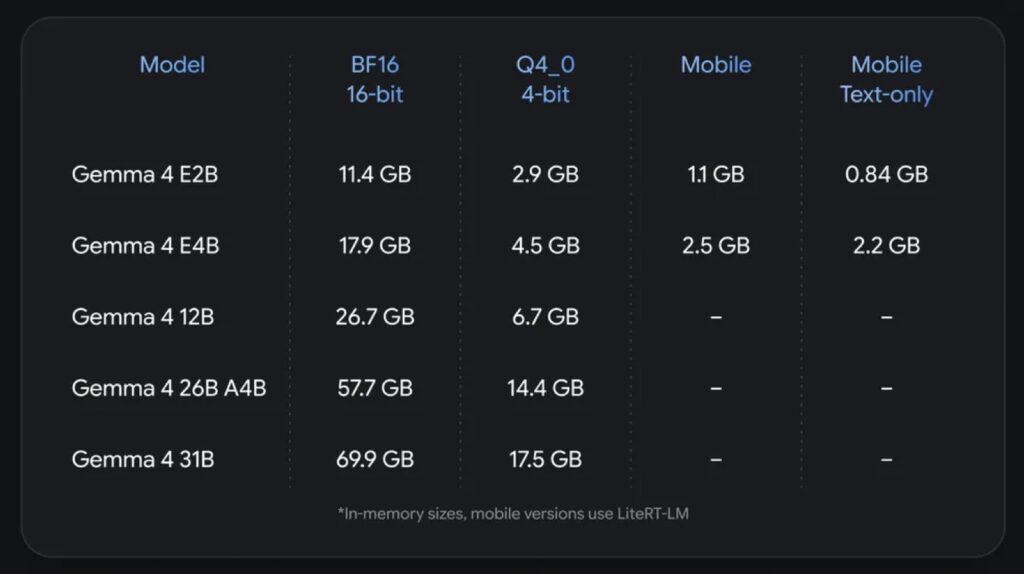
- Unprecedented Compression: New Quantization-Aware Training (QAT) checkpoints reduce memory requirements by approximately 4x, shrinking the Gemma 4 E2B model’s footprint to just 1 GB.
- Zero Compromise on Quality: By integrating quantization directly into the training simulation, QAT effectively eliminates the performance degradation typically caused by standard Post-Training Quantization (PTQ).
- Ecosystem & Hardware Ready: Featuring a novel mobile-specialized schema and day-one support across platforms like Hugging Face, Ollama, and vLLM, these models are ready to run locally on anything from flagship phones to desktop GPUs.
The artificial intelligence landscape is undergoing a massive paradigm shift. While cloud-based gigantomodels dominate the headlines, the true frontier of consumer AI lies in edge computing—putting powerful, private, and lightning-fast intelligence directly onto the devices we use every day. Two months after the initial release of the Gemma 4 family, the push to expand its capabilities and accessibility has culminated in a massive breakthrough for local AI. Following the introduction of Multi-Token Prediction (MTP) to accelerate inference and the recent launch of a unified 12B model to bridge the gap between the edge-friendly E4B and the heavy-duty 26B Mixture-of-Experts (MoE) models, the ecosystem is taking its biggest leap yet.
Today marks the release of new checkpoints optimized with Quantization-Aware Training (QAT). Designed specifically to democratize high-level AI, these checkpoints allow Gemma 4 to run seamlessly on everyday edge devices and consumer GPUs, permanently changing how we approach local inference.
Rethinking Compression: QAT vs. PTQ
Quantization is the undisputed key to running large language models on consumer hardware. By shrinking the precision of the model’s weights, you drastically reduce the VRAM required to load it while simultaneously accelerating decode speeds. However, standard Post-Training Quantization (PTQ)—which acts as a blunt compression tool applied after a model has already finished learning—often leads to noticeable performance degradation and “brain fog” for the AI.
Instead of simply squishing the model after the fact, QAT integrates the quantization process directly into the training loop. By simulating low-precision operations while the model is still learning, Gemma 4 is taught how to preserve its intelligence even when compressed. The result is staggering: a ~4x reduction in memory usage that yields significantly higher overall quality compared to standard PTQ baselines, delivering loss-less quantization that maintains the accuracy you expect from the Gemma 4 family.
Saving on VRAM: Optimizing for Mobile Under the Hood
To maximize performance across the board, the standard QAT recipe was applied to the highly popular Q4_0 format for all models. But for edge models specifically (E2B and E4B), standard compression formats are notoriously difficult for mobile processors to execute efficiently. To ensure smooth performance on mobile, a custom, mobile-specialized quantization schema was engineered from the ground up for edge hardware:
- Static Activations: Standard models waste precious processing power calculating how to scale data on the fly. By pre-calculating these settings during training, the workload on mobile chips is vastly reduced, resulting in much faster response times.Google Blog
- Channel-Wise Quantization: The compressed data is fundamentally structured to fit the physical design of mobile accelerators, allowing your phone to run calculations natively without resorting to slow software workarounds.Google Blog
- Targeted 2-Bit Quantization: The specific parts of the model responsible for generating tokens are heavily compressed down to 2-bit, while the core reasoning layers are kept at higher precision. This drastically saves storage space without making the model less capable.Google Blog
- Embedding and KV Cache Optimization: Compression is heavily focused on the model’s vocabulary list and short-term memory. This drops the active memory footprint, allowing you to maintain long, infinite-scroll chats without running out of RAM.Google Blog
Modularity plays a massive role in optimization. Because the built-in audio and vision encoders are unnecessary for many text-based use cases, developers can strip down the footprint even further by deploying only the specific modalities they need. For instance, the Gemma 4 E2B text-only model—stripped of its Per-Layer Embeddings—requires less than 1 GB of memory to operate.
The Gemma 4 QAT release is not just a technical update; it is a fundamental shift in where and how we deploy artificial intelligence. By shrinking the hardware barrier to entry, powerful, private reasoning is no longer confined to the cloud—it is officially in the palm of your hand.