Redefining open-source software engineering with state-of-the-art efficiency, autonomous agents, and end-to-end automation.
- A New Era of Open Models: Launching the Devstral 2 family, featuring a powerful 123B parameter model and a compact 24B model, both capable of state-of-the-art performance with significantly reduced hardware requirements.
- The Mistral Vibe Advantage: Introducing a native, open-source CLI that acts as an autonomous software engineering agent, allowing developers to execute complex codebase changes using natural language.
- Production-Grade & Cost-Efficient: Achieving top-tier results on SWE-bench Verified while being up to 7x more cost-efficient than competitors, with free API access currently available.
The landscape of AI-assisted software development is shifting rapidly, moving from simple code completion to autonomous agents capable of maintaining entire systems. Today marks a significant milestone in that evolution with the release of the Devstral 2 coding model family and Mistral Vibe, a native Command Line Interface (CLI) designed for end-to-end code automation. By prioritizing efficiency, open-source accessibility, and agentic capabilities, Devstral is lowering the barrier to entry for distributed intelligence.
The Devstral 2 Family: Efficiency Meets Power
The new lineup consists of two distinct models designed to cover every use case, from enterprise-grade orchestration to local deployment on consumer hardware.
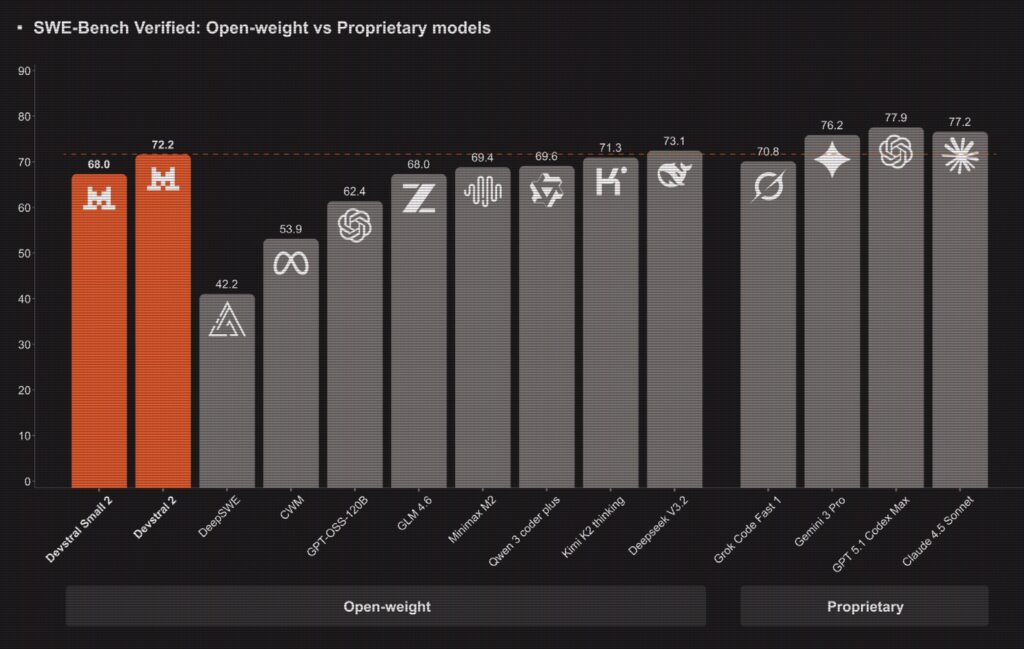
Devstral 2 (123B) is the flagship dense transformer. Released under a modified MIT license, it supports a massive 256K context window and sets a new standard for open-weight models. It achieves a remarkable 72.2% on SWE-bench Verified, effectively matching the tool-calling success rates of the best closed-source models. Despite its power, it remains highly efficient, designed to run optimally on data center hardware like NVIDIA H100s.
Devstral Small 2 (24B), released under the permissive Apache 2.0 license, brings the same 256K context window to a much smaller footprint. Scoring 68.0% on SWE-bench Verified, it punches well above its weight class. It is capable of running locally on consumer-grade GPUs—and even CPU-only configurations—ensuring fully private, on-device runtimes. Furthermore, Devstral Small 2 supports image inputs, making it an ideal engine for multimodal agents.
Shattering the Size-Performance Paradigm
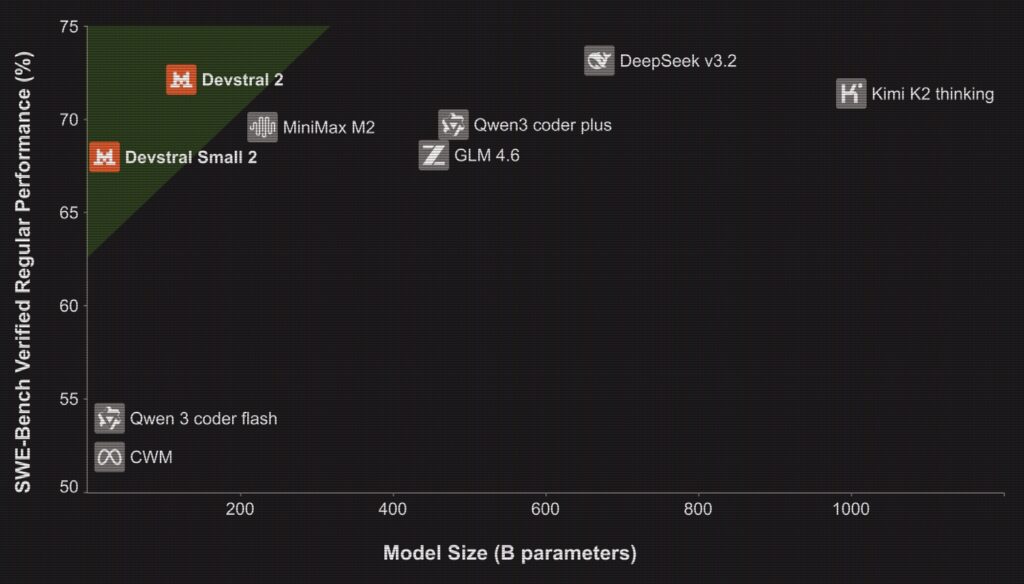
What makes the Devstral family truly revolutionary is its efficiency relative to competitors. Devstral 2 (123B) and Devstral Small 2 (24B) are roughly 5x and 28x smaller than DeepSeek V3.2, and 8x and 41x smaller than Kimi K2, respectively.
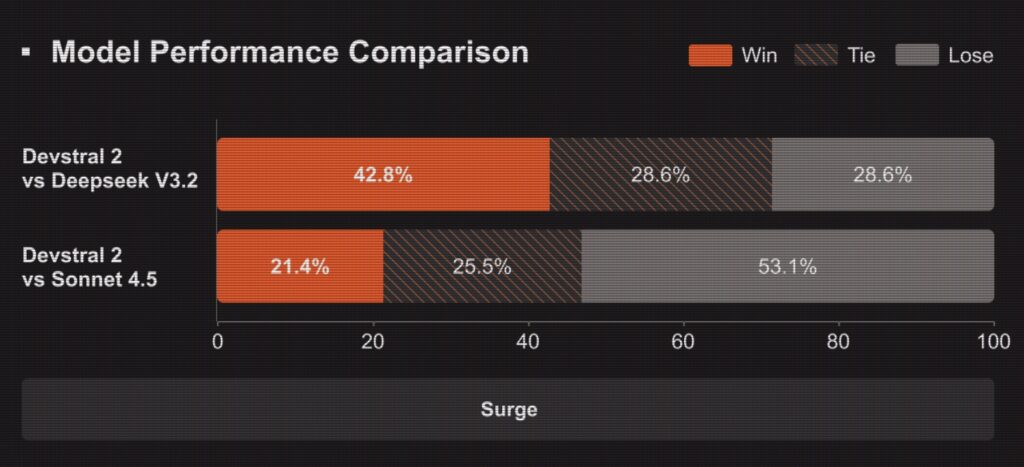
This drastic reduction in size does not come at the cost of capability. In human evaluations scaffolded through Cline, Devstral 2 demonstrated a 42.8% win rate against DeepSeek V3.2. While closed-source models like Claude Sonnet 4.5 still hold a lead in raw performance, Devstral 2 offers a compelling alternative that is up to 7x more cost-efficient for real-world tasks.
Industry partners have already noted the impact. “Devstral 2 is at the frontier of open-source coding models,” states the team at Cline. “It delivers a tool-calling success rate on par with the best closed models; it’s a remarkably smooth driver.”
Mistral Vibe: The Agent in Your Terminal
To fully leverage these models, we are introducing Mistral Vibe, an open-source CLI tool (Apache 2.0) that brings the AI agent directly into your workflow.
Vibe is not just a chat interface; it is an autonomous operator. Using natural language, developers can instruct Vibe to explore, modify, and execute changes across a codebase. Features include:
- Project-Aware Context: Vibe automatically scans file structures and Git status to understand the full scope of a project, not just a single file.
- Smart References & Orchestration: Developers can reference specific files with
@autocomplete, execute shell commands with!, and rely on Vibe for multi-file architecture reasoning. This capability can potentially halve Pull Request cycle times. - Integration: Vibe is available as a standalone tool (install via
uv tool install mistral-vibe) or as an extension within the Zed IDE via the Agent Communication Protocol.