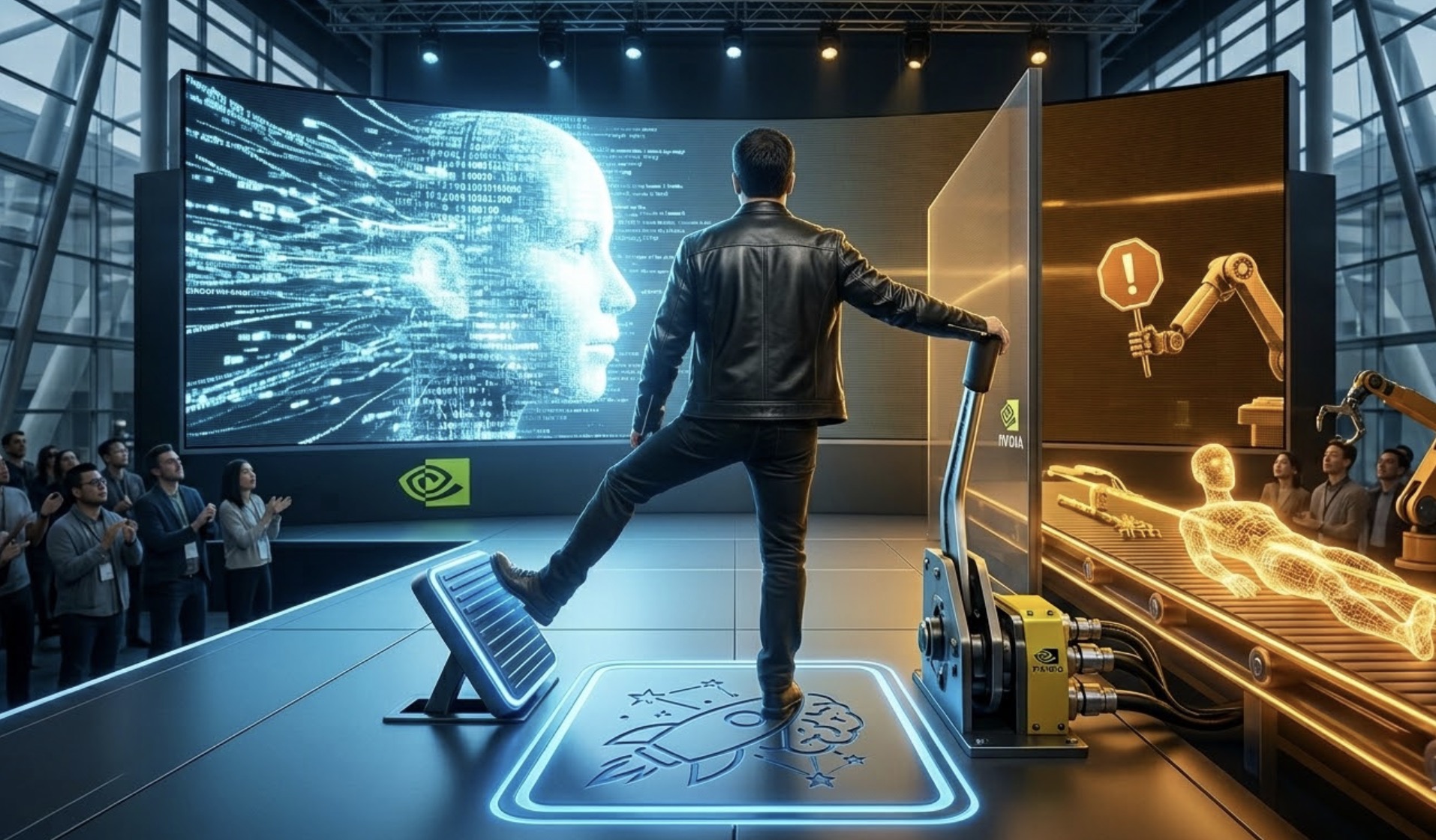
During a recent podcast appearance, the tech titan ignited the industry by claiming Artificial General Intelligence has arrived, highlighting a complicated, multi-billion-dollar debate over what AGI actually means.
- A Bold Declaration: On a recent podcast, Nvidia CEO Jensen Huang stated he believes Artificial General Intelligence (AGI) has already been achieved, a claim that immediately sent shockwaves through the tech community.
- The Multi-Billion Dollar Buzzword: AGI remains a vaguely defined and highly contentious term, driving massive corporate contracts and prompting industry leaders to constantly rebrand the concept to manage public hype.
- The Reality Check: While praising the viral success of AI agent platforms like OpenClaw for creating digital influencers and novel apps, Huang ultimately admitted these tools are still entirely incapable of building or running a complex enterprise like Nvidia.
On a recent Monday episode of the Lex Fridman podcast, Nvidia CEO Jensen Huang dropped a conversational bombshell that strikes at the very heart of the modern technological revolution: “I think we’ve achieved AGI.” In an industry fueled by both rapid innovation and boundless hype, Huang’s statement immediately became a hot-button issue, forcing developers, investors, and the general public to confront a question that has loomed over Silicon Valley for years: Is the future already here, or are we simply redefining it to fit our current capabilities?
To understand the weight of Huang’s words, one must look at the broader landscape of Artificial General Intelligence. AGI is a vaguely defined benchmark typically denoting an AI system that equals or surpasses human intelligence across a wide range of cognitive tasks. In recent years, the term has incited relentless debate. Tech CEOs and workers are caught in a tug-of-war, recognizing the immense marketing power of AGI while simultaneously trying to distance themselves from its over-hyped, science-fiction connotations. Consequently, many tech leaders have attempted to coin their own, purportedly clearer terminology, though these new phrases almost always serve as semantic stand-ins for AGI. More crucially, the definition of AGI is not just an academic debate; it is the subject of key clauses in big-ticket contracts between juggernauts like OpenAI and Microsoft. Depending on when and how AGI is officially declared “achieved,” billions of dollars and the very control of foundational models could shift overnight.
It was within this high-stakes context that podcast host Lex Fridman pressed the Nvidia chief executive. Fridman offered his own practical, high-bar definition of AGI: an AI system capable of “essentially doing your job”—specifically, starting, growing, and successfully running a tech company worth more than $1 billion. When asked whether such a reality was five, ten, fifteen, or twenty years away, Huang did not hesitate. “I think it’s now,” he responded. “I think we’ve achieved AGI.” As Fridman aptly noted, such a statement was bound to get a lot of people incredibly excited.

To back up his claim, Huang pointed to the current landscape of AI capabilities, specifically highlighting OpenClaw, the open-source AI agent platform, and its recent viral success. He noted that developers and everyday users are currently deploying individual AI agents to execute a wide array of creative and functional tasks. According to Huang, it wouldn’t be surprising to see these agents spark a new social phenomenon, whether it be generating a wildly popular digital influencer or coding a simple, Tamagotchi-style social application that becomes an out-of-the-blue, instant success. In this light, AI is already performing tasks that, until very recently, required a dedicated team of human creatives and programmers.
The reality of AGI is rarely as simple as a viral success story, and Huang quickly seemed to walk back the absolute nature of his earlier claim. While acknowledging the impressive, almost magical nature of platforms like OpenClaw, he pointed out their fleeting impact in the broader economic ecosystem. “A lot of people use it for a couple of months and it kind of dies away,” he admitted, highlighting the gap between a fun consumer novelty and a robust, sustainable enterprise tool. When measuring these agents against Fridman’s original criteria of running a billion-dollar tech company, Huang’s reality check was stark. He noted that even if you were to deploy an army of these intelligent systems, “the odds of 100,000 of those agents building Nvidia is zero percent.”
Huang’s paradoxical podcast appearance perfectly encapsulates the tech industry’s current relationship with AGI. We are living in an era where artificial intelligence can flawlessly mimic human creativity, write code, and launch viral applications, making it incredibly tempting to declare that the finish line has been crossed. Yet, when faced with the sheer, multifaceted complexity of human ambition, strategy, and corporate leadership, even the most optimistic tech titans must admit that true, autonomous, human-surpassing intelligence remains just over the horizon.