
Valve updates its developer policy to distinguish between backend production tools and the generative content that actually ships to players.
- Focus on the Player Experience: Valve has clarified that developers only need to disclose generative AI usage for content that is “consumed by players” or used in marketing, exempting behind-the-scenes efficiency tools.
- Addressing the “Everything is AI” Problem: The update resolves confusion regarding standard software tools that now feature built-in AI, such as coding assistants and Photoshop’s generative fill.
- Strict Safety for Live Content: While internal tools get a pass, “live-generated” content created while the game runs remains subject to strict guardrails and player reporting systems.
The conversation surrounding Artificial Intelligence in video game development has shifted from a question of “if” to a complex debate about “how much.” As generative AI finds its way into nearly every facet of digital creation, Valve has quietly updated its Steam disclosure forms to reflect a more nuanced reality. The company now specifies that developers are only required to disclose AI-generated content if it is destined to be “consumed by players,” effectively drawing a boundary between backend efficiency and the final product.
This policy tweak, brought to light by a screenshot shared by Simon Carless of GameDiscoverCo, addresses a growing grey area in game development. Previously, the broad definition of “AI usage” left developers questioning the minutiae of their workflows. If a programmer uses Claude to generate a few snippets of code, or a marketing manager uses ChatGPT to organize a spreadsheet, does that warrant a disclaimer warning players of AI involvement? Valve’s answer is now a definitive no. The disclosure requirement focuses on the tangible assets that ship with the game—final art, sound, writing, and marketing materials—rather than the invisible tools used to streamline the office work behind them.
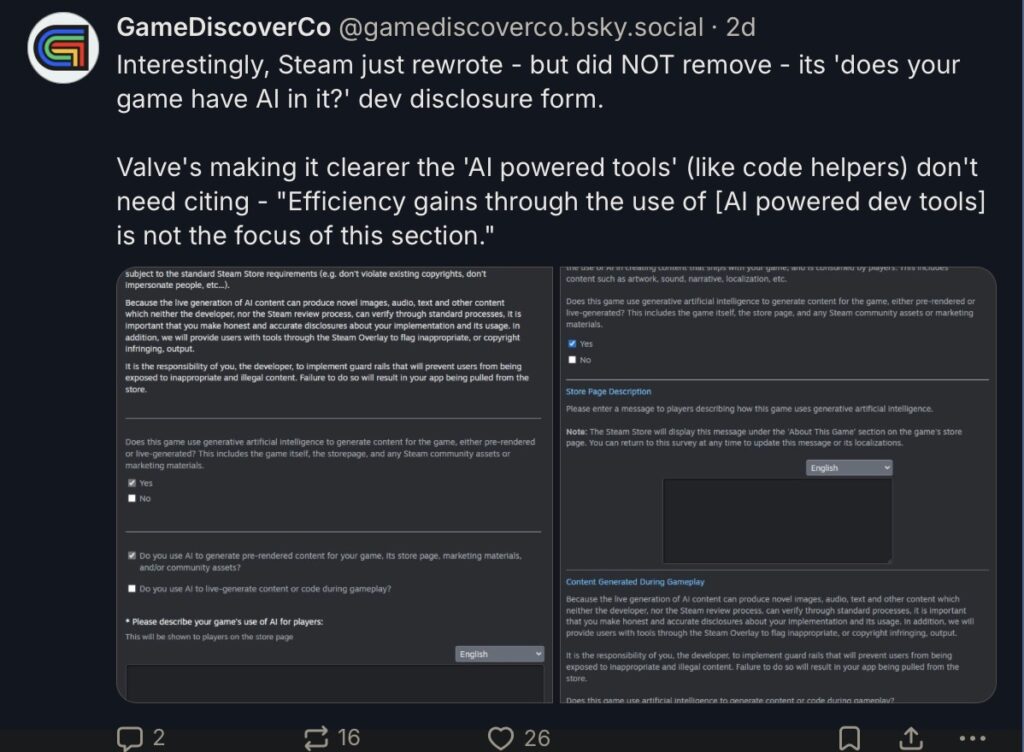
This distinction is increasingly vital as AI becomes inextricably linked with standard professional software. The industry has been wrestling with where to draw the line, a sentiment recently echoed by Epic Games CEO Tim Sweeney. Sweeney argued that digital storefronts should abandon AI disclosure labels entirely because “AI will be involved in nearly all future production” regardless. While PC Gamer’s Tyler Wilde and others have disagreed with dropping labels entirely, they acknowledge the difficulty of policing tools like Photoshop’s generative fill when used for internal concept art that the public never sees. Valve’s updated policy appears to be a compromise: acknowledging that AI is a standard efficiency tool for creators, while still respecting the consumer’s right to know if the art or story they are buying was machine-generated.
Despite this relaxation regarding internal tools, Valve remains vigilant regarding the content that actually reaches the user. The disclosure form remains consistent with the framework established in 2024, dividing usage into “Pre-generated” and “Live-generated” categories. Pre-generated assets—those created with AI help before the game ships—must simply follow standard content rules. However, the stakes are higher for “Live-generated” content, which involves AI systems creating assets in real-time while the game is running.

For these live systems, transparency and safety remain paramount. Developers are required to explicitly outline the guardrails implemented to prevent the AI from generating illegal or offensive material. Recognizing the unpredictable nature of generative models, Valve has even integrated a specific safety net for players: a button within the Steam overlay that allows users to instantly report illegal content generated by these live systems. By refining these definitions, Valve is attempting to future-proof its platform, accommodating the inevitable rise of AI-assisted development while maintaining a safety net for the players who consume the final product.