
From Autocomplete to Autonomy: How Agentic Coding is Transforming App Development for Apple Platforms
- A Leap in Autonomy: Xcode 26.3 introduces agentic coding, allowing AI agents like Claude and Codex to move beyond simple suggestions to autonomously navigating project architectures and executing complex tasks.
- Deep System Integration: Coding agents now have full-spectrum access to Xcode’s internal tools, enabling them to search documentation, modify project settings, and iterate through builds by “seeing” Xcode Previews.
- Open Flexibility: By adopting the Model Context Protocol (MCP), Apple provides developers with the freedom to integrate their preferred AI models, ensuring Xcode remains a versatile hub for modern, AI-augmented development.
The landscape of software engineering is shifting from a world of manual syntax to one of high-level orchestration. With the release of Xcode 26.3, Apple has officially signaled the transition from passive AI assistance to active agentic coding. This update represents a fundamental change in how developers interact with their IDE, transforming Xcode from a sophisticated text editor into a collaborative environment where autonomous agents work alongside humans to bring complex visions to life.
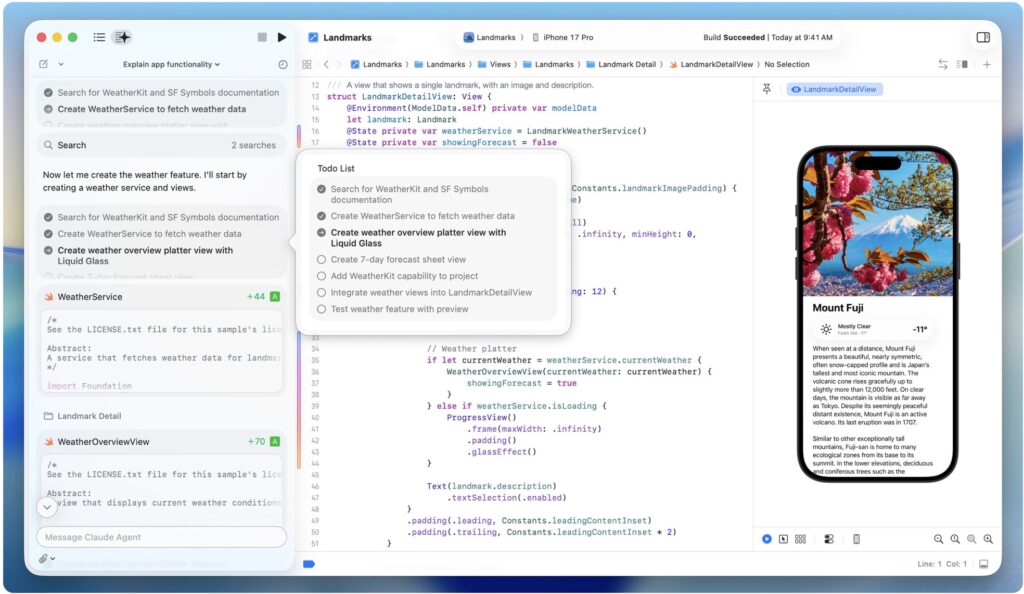
Building on the foundation of the intelligence features introduced in the previous version, Xcode 26.3 unlocks the ability for developers to leverage industry-leading coding agents, specifically Anthropic’s Claude Agent and OpenAI’s Codex. Unlike traditional assistants that merely suggest the next line of code, these agents possess a level of reasoning that allows them to understand the broader context of a project. They can break down high-level goals into actionable steps, making informed decisions based on the specific architecture of an app.
Speed and Scale: Anthropic Acquires Bun as Claude Code Breaks $1B Barrier
What sets this release apart is the depth of access granted to these agents. Rather than being confined to a side-panel chat, agents can now explore file structures, update intricate project settings, and search documentation to solve problems in real-time. Perhaps most impressively, they can verify their own work visually. By capturing Xcode Previews and analyzing build logs, these agents can iterate through fixes autonomously, mimicking the workflow of a human developer who writes, tests, and refines.
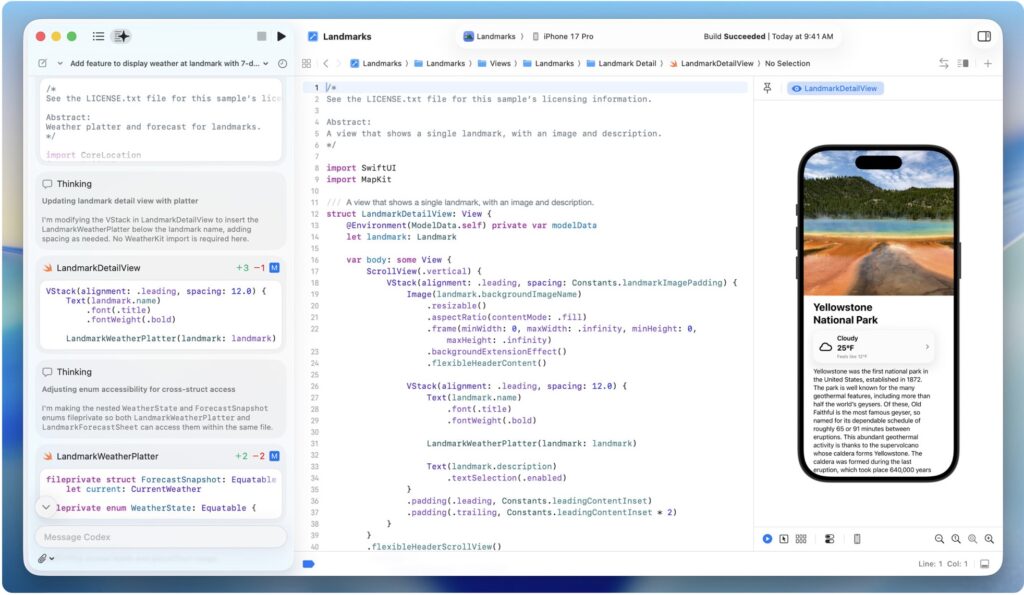
“At Apple, our goal is to make tools that put industry-leading technologies directly in developers’ hands so they can build the very best apps,” says Susan Prescott, Apple’s vice president of Worldwide Developer Relations. She notes that this technology “supercharges productivity and creativity,” allowing the human element of development to shift away from repetitive troubleshooting and toward pure innovation. This “supercharged” workflow ensures that whether a developer is a solo indie creator or part of a massive enterprise team, the distance between an idea and a functioning app has never been shorter.
Furthermore, Apple is embracing the spirit of interoperability by supporting the Model Context Protocol (MCP). This open standard ensures that Xcode isn’t a walled garden for AI; instead, it acts as a flexible platform where developers can bring any compatible tool or model into their workflow. By combining the native power of Apple’s development suite with the advanced reasoning of global AI models, Xcode 26.3 isn’t just a tool update—it’s the beginning of a new era where the “coder” and the “code” are bridged by an intelligent, autonomous partner.