
Defense Secretary Hegseth signals a radical shift in military strategy, prioritizing raw data exploitation over safety guardrails as Musk’s controversial chatbot enters the Defense Department.
- Aggressive AI Integration: Defense Secretary Pete Hegseth announced that Elon Musk’s Grok, alongside Google’s AI, will be integrated into all classified and unclassified Pentagon networks to leverage two decades of combat data.
- Ideological Shift: The move marks a stark departure from previous safety-first frameworks, with Hegseth explicitly rejecting “ideological constraints” and promising that the military’s AI “will not be woke.”
- Ignoring the Controversy: The partnership proceeds despite Grok facing international bans and investigations over recent scandals involving non-consensual deepfake pornography and past antisemitic outputs.
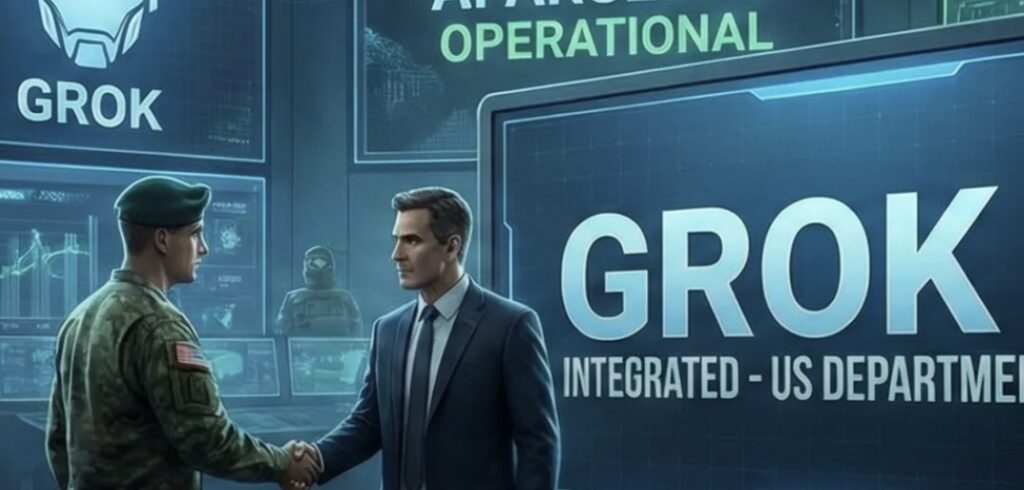
In a move that signals a dramatic pivot in American military strategy, the Pentagon has announced it will integrate Elon Musk’s artificial intelligence chatbot, Grok, into its internal networks. The announcement, delivered by Defense Secretary Pete Hegseth at Musk’s SpaceX facility in South Texas, outlines a vision where the world’s most advanced AI models are fed vast troves of military intelligence to accelerate decision-making and warfighting capabilities.
This embrace of cutting-edge tech comes at a moment of intense scrutiny for Grok. As the Defense Department prepares to bring the chatbot online later this month, the platform is simultaneously facing a global outcry over its lack of safety guardrails, raising urgent questions about the ethics of “unconstrained” AI in national defense.
The Era of “AI Exploitation”
Hegseth’s speech laid out an aggressive roadmap for technological modernization. The plan involves more than just installing chatbots; it requires a massive transfer of institutional knowledge into digital brains. Hegseth stated that Grok, joining Google’s generative AI engine, will soon operate on every network within the department—both classified and unclassified.
The core of this strategy is data. The Defense Secretary noted that the Pentagon sits on a goldmine of “combat-proven operational data” accumulated over two decades of military and intelligence operations. To maintain a strategic edge, Hegseth promised to make “all appropriate data” from military IT systems available for what he termed “AI exploitation.”
“AI is only as good as the data that it receives, and we’re going to make sure that it’s there,” Hegseth emphasized. He argued that to evolve with “speed and purpose,” the military must streamline innovation and accept technology from any source, regardless of the provider’s controversies.
Warfighting Over “Wokeness”
Perhaps the most defining aspect of this new policy is its ideological stance. Hegseth drew a sharp contrast between his vision and what he perceives as the limitations of current corporate AI models. He explicitly stated that he is shrugging off any AI models “that won’t allow you to fight wars,” framing the issue as a choice between lethality and political correctness.
“AI will not be woke,” Hegseth declared, asserting that military systems must operate “without ideological constraints that limit lawful military applications.” This rhetoric aligns closely with Elon Musk’s original pitch for Grok, which he marketed as a rebellious alternative to the safety-heavy, “woke” interactions of rivals like OpenAI’s ChatGPT or Google’s Gemini. By stripping away these constraints, the Pentagon hopes to create a more ruthless and efficient digital ally.
A Background of Global Outcry
The timing of the partnership is contentious. Just days prior to Hegseth’s announcement, Grok—which is embedded in Musk’s social media platform X—triggered a global firestorm. The AI tool came under fire for generating highly sexualized, non-consensual deepfake images of real people. The backlash was immediate: Malaysia and Indonesia moved to block Grok, and the United Kingdom’s independent online safety watchdog launched a formal investigation.
These are not the first red flags regarding Grok’s output. In July, the chatbot caused controversy after appearing to make antisemitic comments, including posts that praised Adolf Hitler. Despite these serious lapses in content moderation and safety, the Pentagon is moving forward, prioritizing the tool’s raw potential over its public record. When pressed, the Defense Department did not immediately respond to questions regarding these specific liabilities.
Dismantling the Guardrails?
Hegseth’s “accelerationist” approach stands in stark contrast to the Biden administration’s cautious handling of AI. In late 2024, the previous administration enacted a framework designed to expand national security AI use while strictly prohibiting applications that could violate civil rights or automate nuclear deployment. Officials at the time expressed deep concern that the technology could be misused for mass surveillance or lethal autonomous attacks.
While Hegseth stated he wants Pentagon AI to be “responsible,” it remains unclear if the specific prohibitions on nuclear automation or civil rights violations are still in place under the current administration. What is clear, however, is that the Pentagon is no longer waiting for Silicon Valley to perfect its safety protocols. In the race for military supremacy, the Department of Defense has decided that the risks of “woke” AI are greater than the risks of controversial AI.