With nearly 3 trillion parameters and an open-source ethos, a Chinese juggernaut is taking aim at the proprietary dominance of OpenAI and Anthropic.
- Frontier-Level Capabilities: Moonshot AI has unveiled Kimi K3, a massive open-weight AI model boasting up to 2.8 trillion parameters and a one-million token context window, engineered specifically for advanced reasoning and complex coding tasks.
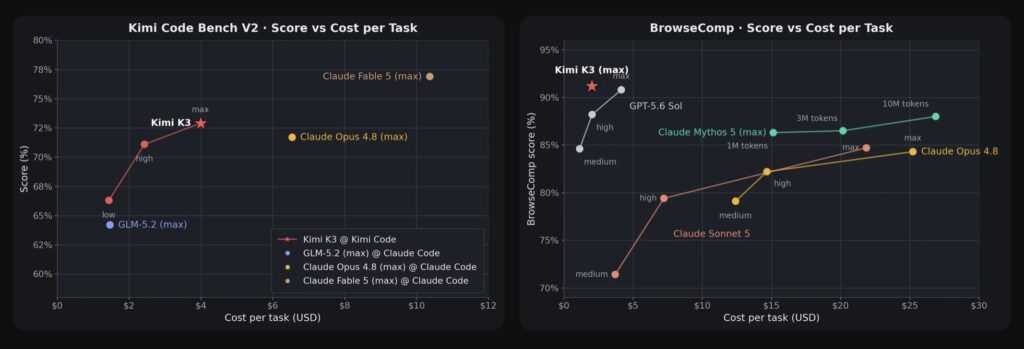
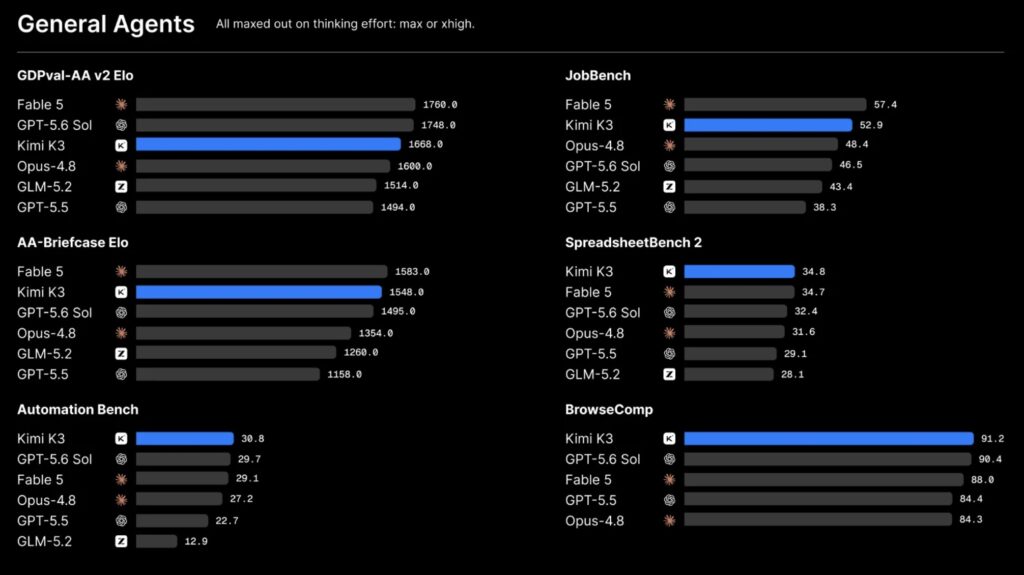
- A Direct Challenge to US Titans: While trailing slightly behind the absolute peak models like Anthropic’s Claude Fable 5 and OpenAI’s GPT 5.6 Sol, Kimi K3 substantially outperforms earlier iterations like GPT 5.5 and Claude Opus 4.8, democratizing top-tier AI for developers worldwide.
- Market Disruption and Resilience: Achieving a $20 billion valuation ahead of its July 2026 open-source release, Moonshot has triggered a massive sell-off among its regional competitors, proving that Chinese developers can innovate around advanced chip constraints.
The artificial intelligence landscape has just witnessed a seismic shift. In what is being heralded as a “new frontier of intelligence,” Chinese AI startup Moonshot AI has unveiled Kimi K3, a behemoth of a model that threatens to upend the established global hierarchy. By positioning K3 as a direct challenger to industry titans like OpenAI and Anthropic, Moonshot is not just launching a product; it is making a bold technological statement. Backed by corporate heavyweights like Alibaba and Tencent, this 2023-founded startup is proving that the race for AI supremacy is far from a one-sided affair, bringing frontier-level capabilities directly to the open-source community.
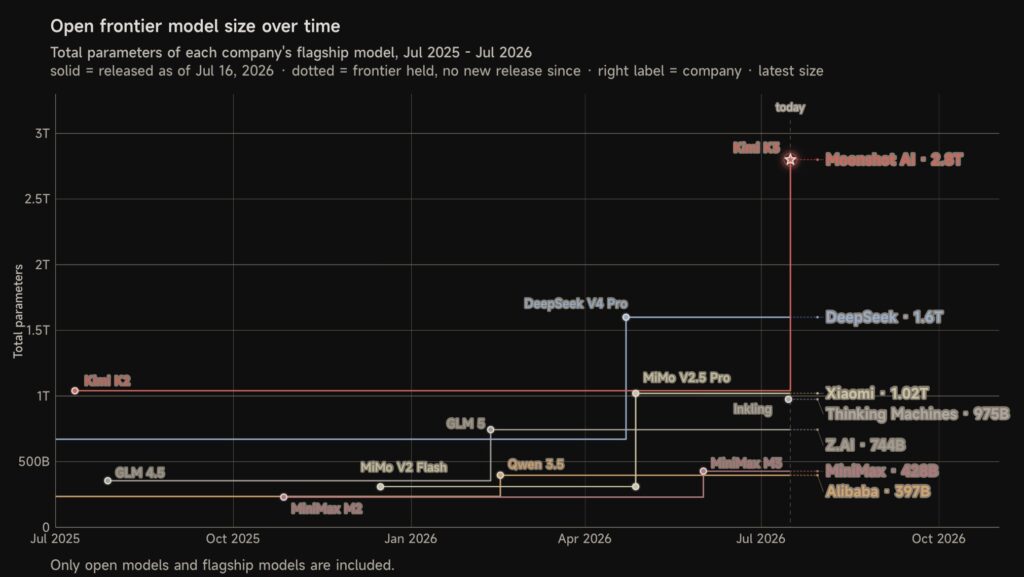
At the heart of Kimi K3’s disruptive potential is its sheer scale and accessibility. Boasting an unprecedented parameter count—widely reported at 2.8 trillion, with some specific architectural configurations leveraging 2.7 trillion—it heavily dwarfs contemporaries like DeepSeek V4, which sits at 1.6 trillion parameters. This massive scale, combined with a staggering one-million token context window, allows Kimi K3 to learn profoundly complex patterns and manage advanced, knowledge-based tasks with ease. Crucially, Kimi K3 is an open-weight model. Unlike the heavily guarded, private systems underlying OpenAI’s ChatGPT or Anthropic’s Claude, open-weight models like Kimi K3 and Meta’s Llama give developers the freedom to download, run, fine-tune, and deploy the AI independently. This democratic approach offers enterprises unparalleled control over their infrastructure, data privacy, and custom software development cycles.
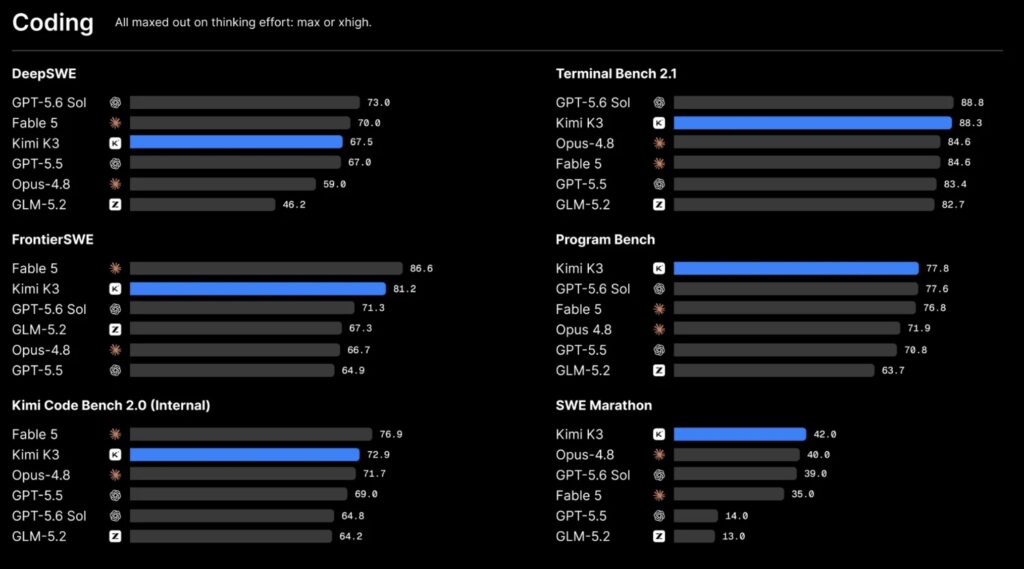
The benchmark data paints a picture of a formidable competitor. While Moonshot AI frankly acknowledges that Kimi K3’s overall performance still slightly trails the absolute cutting-edge proprietary models—namely Anthropic’s Claude Fable 5 and OpenAI’s GPT 5.6 Sol—it is anything but a runner-up. In rigorous testing environments focusing on coding and general agent capabilities, K3 performed competitively alongside Fable 5. Furthermore, it substantially outperformed a slew of highly regarded models, including Claude Opus 4.8, GPT 5.5, and SpaceXAI’s Grok. Moonshot proudly champions K3 as its most powerful open-source coding model to date, a claim that will be put to the ultimate test when the full model weights and an exhaustive technical report detailing its architecture and training process are released to the public by July 27, 2026. Until then, the company is working tightly with inference partners to ensure a reliable rollout.

The financial and market ramifications of the Kimi K3 announcement have been nothing short of explosive. Moonshot AI’s meteoric rise is underscored by a recent $2 billion funding round that skyrocketed its valuation to over $20 billion, according to Bloomberg. This represents a stunning leap from its $10 billion valuation earlier this year (following a $700 million raise) and a $4.3 billion valuation at the end of last year. With annual recurring revenue already topping $200 million as of April due to surging subscriptions for its AI services, Moonshot’s market gravity is actively crushing its rivals. Following the K3 reveal, shares of competing Chinese AI firms tumbled in Hong Kong trading: Zhipu plummeted 28.4%, Z.ai matched that steep 28.4% drop after having just released a model in June, and MiniMax fell by 15.6%.
Beyond the immediate market shockwaves, Kimi K3 represents a significant milestone in the broader geopolitical tech narrative. Bank of America analysts recently lauded Moonshot’s achievements, noting that the firm has managed to make immense strides in model design and training methodology despite facing stringent restrictions on accessing the world’s most advanced semiconductor chips. By overcoming these hardware bottlenecks to produce a world-class, open-source model, Moonshot AI has not only stunned developers but has also redefined the boundaries of what is possible within the open-source ecosystem. As the late-July release date approaches, the tech world watches with bated breath to see just how thoroughly Kimi K3 will reshape the competitive AI landscape.